
An insurance broker’s bank balance can be misleading, since a large share of it is money passing through on its way to a carrier, or a commission still owed to another party. But even these temporary holdings must be tracked and reconciled on a fixed schedule to meet tight compliance rules. And once money is transferred, the figures aren’t set in stone, meaning mid-term adjustments and cancellations can happen at any time. And of course, all financial statements need to reflect any of those changes. Add tax rules that follow uneven schedules and demanding audit requirements, and basic accounting software can become more of a hindrance than a productivity booster. In that case, it may be time to upgrade to an accounting software solution designed for the insurance industry.
What Is Accounting Software for Insurance Companies?
Accounting software for insurance companies is a financial management system built for the ways brokers, managing general agents (MGAs) and insurers handle money. These tools help manage insurance-specific accounting requirements such as client-money segregation and commission tracking, alongside standard bookkeeping features that align with UK Generally Accepted Accounting Principles (UK GAAP).
Key Takeaways
- Insurance accounting differs from ordinary bookkeeping because much of the money passing through a firm’s accounts belongs to someone else, and regulators require precise tracking.
- Entry-level software can handle routine accounting, but new insurer relationships, regulations, acquisitions and system integrations will likely push a basic tool beyond its capabilities.
- UK-specific tax and reporting rules add a layer of risk that one-size-fits-all software isn’t built to handle.
- The right software choice depends more on long-term fit, compliance support, integration capabilities and total cost of ownership (TCO) than on the lowest sticker price.
Finance Futures: Tomorrow’s Vision

Accounting Software for Insurance Companies Explained
Insurance firms need their accounting records to support the financial reporting framework that applies to their business. Depending on the type of firm and its reporting requirements, that may include UK GAAP, IFRS 17, Solvency UK or a combination of these. The same underlying transactions may therefore need to be represented in different ways for management, statutory and regulatory reporting.
For insurance intermediaries, the Financial Conduct Authority’s (FCA’s) Client Assets Sourcebook, chapter 5 (commonly known as CASS 5), adds another layer of accounting complexity. Premiums and other money held on behalf of clients or insurers must be identified separately from the firm’s own funds, tracked accurately and reconciled regularly. Some firms may also hold insurer money under “risk transfer” arrangements, which must be accounted for separately from client money even if it sits in the same trust account.
In practice, this means an insurance intermediary’s accounting records need to show not just what money was received and paid, but who that money belongs to and what the firm is required to hold. CASS 5 requires firms to perform regular client-money calculations, reconcile their records against the bank and maintain records that can support audits and regulatory reviews.
Why UK Insurance Companies Need Specialist Accounting Software
Insurance firms may be able to use generic accounting software at first, but as their operations become more complex, they may need to rely on manual workarounds or customisations to handle insurance-specific requirements. The need for specialist software usually makes itself clear, but four particular challenges can make generic accounting systems difficult to manage as a firm expands.
Premiums, Claims and Commissions Move Across Multiple Parties
A single policy can involve a client, a broker, an insurer and sometimes a co-broker or reinsurer, and a single transaction cycle can move money in several directions. Premiums come in, commissions and claims payments go out, and an MGA operating under delegated authority must report each step to its insurer through a bordereau, a structured record of premiums, commissions and claims tied to a specific binder. Relying on software that can’t view these transactions as connected steps can lead to recording gaps.
Manual Reconciliation Slows the Close
Manual reconciliation means matching insurer statements, commission records, bank transactions and client-money records by line. That eats up time and makes it harder for firms to stay on top of CASS 5’s required client-money calculations and bank reconciliations. As transaction volumes grow, even small discrepancies can take longer to identify and trace back to their source.
UK Tax and Reporting Add Complexity
Insurance Premium Tax (IPT) applies to most UK general insurance premiums, with different rates for certain types of insurance. The calculation must be applied to the appropriate taxable base for each policy. Meanwhile, insurance transactions are generally VAT-exempt, while some related advice services are not, so a single broker can be bound by different VAT treatments. Any errors in IPT or VAT treatment can lead to incorrect returns, adjustments and potential HMRC scrutiny.
Controls Matter for Regulated Firms
Regulated firms need to be able to reconstruct what happened to client money and demonstrate who authorised each action. Missing records, unclear approvals or inconsistent access controls can make audits and regulatory reviews harder to manage. Reliable audit trails and clear permissions are essential to insurance accounting.
Who Uses Insurance Accounting Software?
Not every company needs the same accounting features, and choosing software that doesn’t fit the way a firm operates is a common reason systems fall short of expectations. Each type of firm needs software configured to how it operates.
- Insurance companies and underwriters: These firms assume insurance risk and therefore have financial reporting and regulatory requirements that differ from those of intermediaries. Depending on the business and reporting basis, their accounting may need to support UK GAAP or IFRS 17 alongside Solvency UK requirements. They may also need multiple reporting views of the same underlying transactions.
- Insurance brokers and agencies: Brokers place policies and earn commission, and their accounting must separate client money held under CASS 5 from their own revenue. Their accounting systems must also track commission splits among multiple insurers and handle chargebacks when policies are cancelled prematurely.
- Managing general agents (MGAs) and managing general underwriters (MGUs): These firms operate under delegated authority to underwrite and administer business on an insurer’s behalf. Therefore, their systems must produce accurate bordereaux on a set schedule, which requires reconciling premiums and commissions between potentially large policy volumes per binder.
- Claims administrators and third-party administrators (TPAs): These administrators process and pay claims for insurers or MGAs without carrying the insurance risk themselves. Their accounting needs to connect to claims payments with the relevant policies and financial records, while giving finance teams a clear view of amounts paid, outstanding and recoverable.
10 Features to Look for in Accounting Software for Insurance Companies
Plenty of software claims to serve insurance, but not every solution has the dedicated features to back that up. These 10 capabilities separate the tools that genuinely run a broker’s or insurer’s books from generic packages with “insurance” written on the box.
-
General Ledger Built for Multi-Entity Reporting
The general ledger should be able to handle client money, insurer funds, multiple trading entities, multi-currency transactions and intercompany transfers without relying on manual workarounds. This becomes particularly important as a business grows or acquires another entity and needs to consolidate multiple sets of financial records while preserving separate client money positions.
-
Premium Invoicing and Collections
Premium billing can change throughout the life of a policy. A policy taken out in January may be amended in April to add coverage, requiring a future premium adjustment. Additional factors, such as instalment plans, return premiums following policy cancellation, and other midterm changes can affect the amounts owed and the commissions associated with them. Dedicated accounting software can automate these adjustments and keep the resulting premium and commission entries aligned.
-
Commission Tracking and Broker Settlements
Commissions comes with complications (splits between introducers, subagents or co-brokers, overrides on renewal business or chargebacks when a policy lapses early) and every change must be matched against payments. Even straightforward renewals can involve different premiums, commission rates or insurers, but the right software treats each new term as distinct while keeping it connected to its prior policy. Reconciliation should follow commissions from calculation through payment and settlement. Automated reconciliation can reveal discrepancies between expected and actual payments before they become harder to trace.
-
Claims Payment and Expense Tracking
For MGAs and TPAs handling claims on an insurer’s behalf, every payment connects to a specific policy and reserve. With claims management data integrated directly into the ledger, finance teams and AI agents can track claims payments and related expenses, rather than waiting for month-end reports.
-
Bank Feeds and Automated Reconciliation
CASS 5 requires firms to reconcile client money records against the bank within a defined timeframe. As transaction volumes grow, manually matching every incoming and outgoing payment makes it harder to complete that reconciliation efficiently. It’s important to look for tools with live bank feeds that automatically match incoming and outgoing payments against the ledger and escalate exceptions that need a human look. Such capabilities can help firms complete reconciliations faster without increasing the workload at the same rate as transaction volume.
-
Accounts Payable and Accounts Receivable
Insurance cash flows rarely settle in a single step or on the same schedule. A client may pay a premium before or after the broker has remitted funds to the insurer; the broker may retain its commission; an introducing party or co-broker may be owed a further cut. Until those transactions settle, client money sitting in trust cannot be treated as the broker’s revenue. Automation can keep accounts payable and accounts receivable current, giving owners a clearer view of what’s collectible, what’s owed and the resulting cash position.
-
Tax Management for UK Requirements
Insurance accounting software should be able to calculate IPT using the appropriate taxable base and rate for each policy type. It should also be able to distinguish VAT-exempt insurance income from standard-rated fees for taxable services, including where different treatments appear on the same invoice. These features are something a generic tax module built for retail or services businesses may not be able to achieve out of the box.
-
Financial Reporting and Dashboards
Brokers, insurers, MGAs and TPAs each answer to different stakeholders: owners want profitability, insurers want bordereaux accuracy, clients want pricing transparency and regulators want an audit trail. Reporting built for the insurance industry can track operational metrics, management reporting, statutory accounts and relevant regulatory reporting into a single environment, with views tailored to different users.
-
Integration With Policy, Claims, CRM and Banking Systems
Accounting systems must integrate with the broker’s or MGA’s policy-management system, as well as with relevant claims and banking systems. Every time policy information is reentered, there’s an opportunity for details to fall through the cracks. Integrated systems can prevent midterm revisions from turning into major reconciliation projects.
-
Automation, AI and Role-Based Controls
Insurance accounting software can automate repetitive processes such as transaction matching, commission reconciliation, payment allocation and exception handling. More sophisticated systems may also use AI to identify unusual transactions or suggest actions for review, but these capabilities should complement, not replace, clear rules and human oversight. Role-based access controls restrict users to performing or approving only the actions appropriate to their responsibilities.
Cloud Accounting Software vs. Entry-Level Tools
As an insurance firm grows, its accounting requirements can change significantly. A small broker may need basic bookkeeping and client-money controls, while a growing MGA has to manage delegated authority arrangements, commissions and more complex reporting. Larger or multi-entity firms may need consolidated and multiple reporting frameworks. The right level of accounting software therefore depends less on company size than on the complexity of its operations and reporting requirements.
Small Brokers and Startups
A new broker with a single insurer relationship and no non-statutory trust arrangements can likely work with a general small-business accounting package, provided it can separate client money from the firm’s operating funds and support the relevant CASS 5 requirements. As a broker adds insurers, handles more complex transactions or takes on arrangements such as risk transfer, it may need more specialised accounting capabilities.
Growing Brokerages and MGAs
As brokerages and MGAs grow, they may take on more insurers, policies, commission arrangements and delegated authority business. This can make it harder to keep premiums, commissions, claims and insurer settlements aligned throughout the accounting records. At this stage, firms may benefit from software that can handle more complex transaction flows and reporting requirements without relying on increasingly manual processes.
Larger Insurers, MGAs and Multi-Entity Firms
As firms expand through acquisitions, multiple legal entities, currencies or business lines, their accounting becomes harder to manage as a single set of books. They may need to consolidate entities and maintain different reporting views of the same underlying transactions. For insurers, this can also include supporting IFRS 17 financial reporting alongside Solvency UK requirements, depending on the firm’s regulatory and reporting obligations. At this stage, accounting requirements are less about basic bookkeeping and more about managing multiple entities, reporting frameworks and sources of financial data consistently.
How to Choose Accounting Software for an Insurance Company
An effective way to compare accounting software is to evaluate each option against the insurance accounting requirements and workflows the business needs. The following criteria can help decision-makers assess vendors consistently, and identify weak points and dealbreakers, before committing to a system.
- Insurance workflow fit: Ask the vendor to demonstrate relevant workflows, such as client money handling and bordereaux generation, using a realistic example rather than a generic demo. This can reveal how well the software handles necessary workflows.
- UK compliance support: Ask how the system handles CASS 5 client money reconciliation, audit trails, IPT and different VAT treatments. Also ask how the vendor keeps these capabilities current as regulatory requirements change.
- Integration capability: Test connections to the broker or MGA administration system, claims data and banking platforms before signing. Confirm what data can flow between systems, how often it updates and what happens when an integration fails.
- Automation depth: Find out how the platform automates an actual workflow, such as transaction matching or commission reconciliation. Look for automation that reduces repetitive work and handles exceptions appropriately, rather than simply adding more automated steps.
- Reporting flexibility: Have the vendor produce a relevant management report and, where applicable, a regulatory or statutory report from the same underlying data. Find out whether users can customise reports themselves or need vendor support for changes.
- Security and access controls: Client financial data is a target for cybercriminals, so ask for concrete proof (not just a feature list) of role-based access, encryption, regular security updates and independent standards such as ISO 27001. Clarify how access is granted, reviewed and removed when employees change roles.
- Scalability: Ask how the system would accommodate an acquisition, new line of business or additional currencies. Consider not only whether the software can support future requirements, but also what additional implementation, licensing or configuration those changes would require.
- Total cost of ownership (TCO): Look beyond the subscription price to the full cost of adopting and operating the system. Consider implementation, migration, training, internal staff time, integrations, add-ons, ongoing support and potential downtime. Ask the vendor for a full breakdown of its costs and remember to estimate the internal resources the implementation will require.
Is It Time for an Insurance Accounting Software Upgrade?
Firms might not notice that they’re outgrowing their accounting software until a new insurer relationship or a CASS audit turns a routine reconciliation into a multi-day fire drill. NetSuite Insurance Accounting Software consolidates premiums, commissions and claims data into a single multi-entity, multi-currency ledger, with multi-book support for UK GAAP and IFRS 17 reporting. NetSuite’s Autonomous Close capabilities use AI agents to continuously reconcile bank, intercompany and balance sheet accounts and monitor high-volume premium and claims postings, flagging variances and proposing resolutions throughout the month. With Ask Oracle, finance teams can query bordereaux status, commission splits or client money positions in natural language and get answers grounded in the same ledger. Configurable tax codes apply VAT and IPT rules automatically, and automated approval workflows speed up broker settlements and claims payments.
NetSuite’s Accounting Dashboard
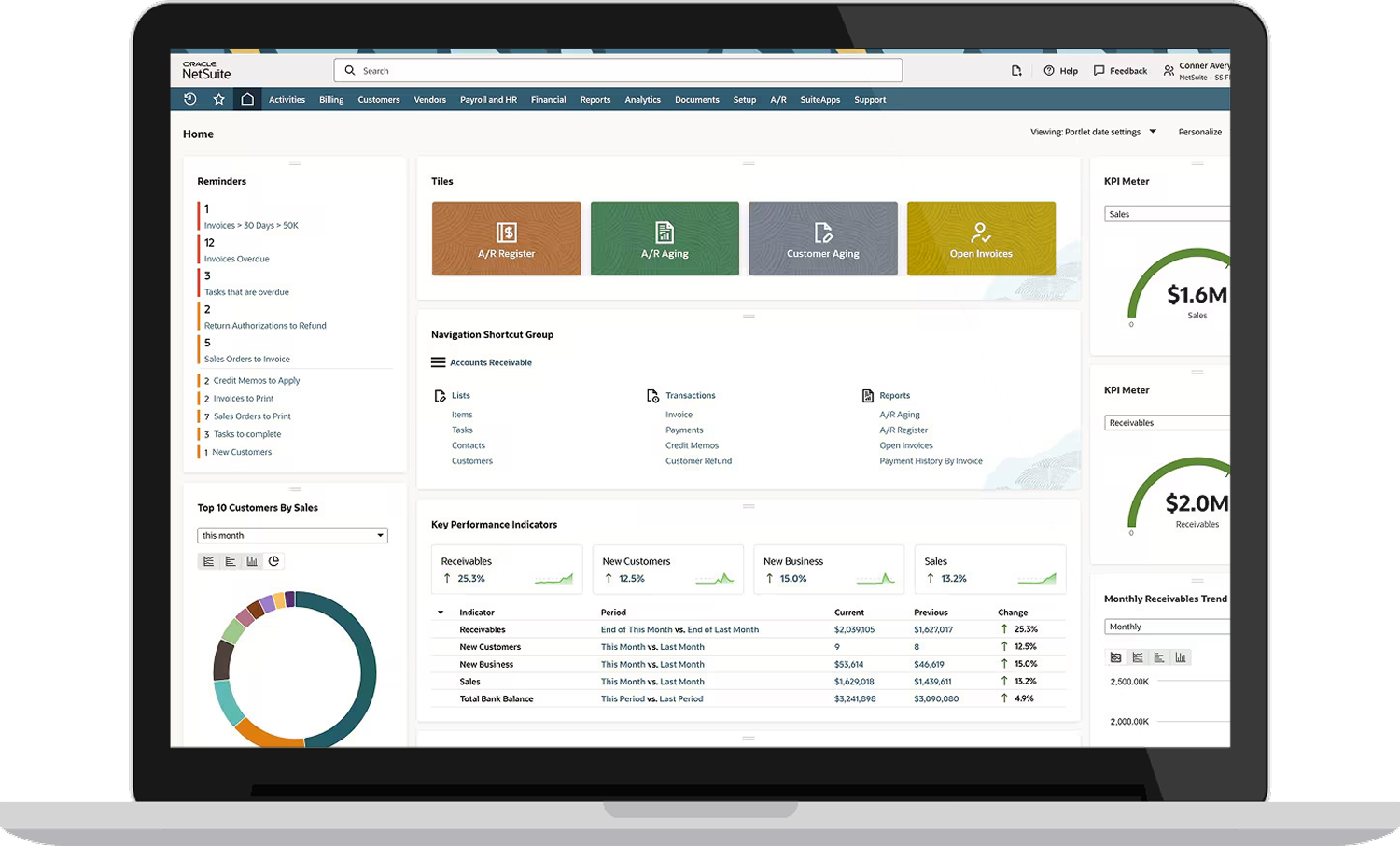
Insurance accounting is complicated for a reason: client money rules exist because in-transit money doesn’t belong to the broker, and IPT and VAT rules are mandated by law. Software built for these realities can turn compliance headaches into routine automation that keeps audit-ready records in line with relevant bookkeeping rules. Firms that invest in cloud-based systems tailored to the industry’s unique needs may be in a better position to adapt to evolving pressures, whether from growing pains or evolving regulations, without needing an entirely new system in five years.
See NetSuite for Financial Services in action here. (opens in new tab)
Accounting Software for Insurance Companies FAQs
What is the best accounting software for insurance companies?
There’s no single best accounting software for insurance companies; the right choice depends on the business type (broker, MGA, insurer) and on the complexity of its operations. Firms should weigh software candidates based on how well they handle their specific needs, such as client-money segregation and UK-specific tax rules. They should also consider the system’s total cost of ownership, not just the monthly price tag.
Can accounting software help with insurance compliance?
Purpose-built software supports the specific financial and regulatory needs of insurance companies that general tools aren’t designed for. Outcomes still depend on how the firm configures and uses the system; software can significantly improve efficiency and speed but doesn’t guarantee outcomes without a concrete implementation plan.
Does accounting software for insurance companies need to handle IPT?
IPT calculations are an important step in an insurance company’s accounting processes. Most UK insurance premiums carry IPT at 12% or 20% (calculated on a base that includes commission) and software that can’t apply the correct rate and reporting treatment can lead to HMRC exposure.
How much does accounting software cost insurance companies?
Costs vary with the type of software a company uses. For example, basic bookkeeping tools carry a lower price tag than full insurance ERPs, but subscription prices rarely tell the whole story. Total cost of ownership should include implementation, training, downtime and any integration work with existing broker or claims systems. At the same time, ROI calculations should consider direct benefits (e.g., faster close) alongside indirect benefits such as reducing the risk of non-compliance.
Is IFRS 17 only for insurance companies?
IFRS 17 applies specifically to insurance contracts, so it’s more relevant to insurers than brokers or MGAs, which usually report under UK GAAP instead. Brokers may still encounter IFRS 17 in their work with insurers that report under it.