
For many fraud teams, compliance officers, product teams at fintechs and wealth advisors, AI handles much of the day-to-day work. But even state-of-the-art chatbots and generative AI tools still wait for a prompt at every step and need constant back-and-forth dialogue to produce quality outputs. AI agents are different. They can go through multiple steps on their own, then hand a full report off to a person at the exact moment a decision is needed. But to create reliable agents, firms need a deliberate plan.
This article covers what agentic AI means for financial services, why UK regulators are watching it closely, 10 uses in which AI agents are already at work and the benefits they bring.
What Is Agentic AI in the Financial Services Sector?
Agentic AI in the financial services sector refers to specialised AI tools, known as agents, that can automate multi-step tasks within preset parameters. And when exceptions are escalated, the agent can draft an explanation of why, so a human worker can dive right in with full context.
An AI agent’s ability to move from one step to the next without human guidance separates it from the automation and GenAI tools that came before it. Traditional banking automation follows fixed rules and breaks down when something falls outside its routine. GenAI can produce detailed summaries and reports, but it needs prompts that tell it exactly what to do. Agents build on both abilities by connecting GenAI and machine learning capabilities to a firm’s own systems and data to complete multiple tasks in sequence. For example, a chatbot may be able to answer a question about a customer’s history when a transaction comes in, but an agent can pull a customer’s history, check the transaction against an established risk management model and recommend approval or escalation.
Key Takeaways
- AI agents combine multiple tools, such as generative AI, to complete multi-step tasks within predetermined permissions.
- AI agents are drawing increased regulatory attention, including from the Financial Conduct Authority and the Bank of England.
- Back-office and compliance work, such as fraud investigation and reconciliation, are common starting places that let AI agents build trust before moving to customer-facing uses.
- AI agents need clean, unified data even more than single-purpose AI tools do, since one step’s output often becomes the next step’s input.
Finance Futures: Tomorrow’s Vision

Agentic AI in Financial Services Explained
Financial services companies rely on enormous volumes of structured data for everything from processing a simple transaction to generating multi-page compliance reports in accounting software. Successful AI agents can take those large data sets and learn from them to automate workflows that are beyond the capabilities of simpler tools. But that data intensity cuts both ways: A firm that relies on untested or poorly trained AI for fraud detection or compliance, for example, can face losses and penalties that outweigh any savings. In a speech at techUK’s Agents of Change: Generative and Agentic AI in Financial Services 2026 event, FCA chief executive Nikhil Rathi described the rise of AI agents as an opportunity to expand AI's role from helping teams “summarise, detect or automate” to creating systems that “co-ordinate and transact” financial decisions, but only when paired with “the right human oversight” that “gives consumers confidence to engage”.
This caution is pushing many firms to focus on piloting agents in back-office and internal operations first, such as document processing and financial reconciliation, before moving to front-office decisions that touch customers directly. And it’s not only businesses that are sceptical, AI consumer research conducted by Yonder and the FCA in April 2026 found that only 13% of all consumers and 18% of current AI adopters were willing to give AI “real-time access to banking and financial data”. That hesitancy shows that, for the majority of consumers, the demand for speed and personalisation should not come at the cost of privacy and security.
Why Does Agentic AI Matter in the Financial Services Industry?
AI agent adoption is becoming commonplace: 81% of financial services firms surveyed in the “2026 Global AI in Financial Services Report” by the University of Cambridge are adopting AI at some level, with half (52%) of industry respondents already piloting or deploying AI agents. Even so, 51% of respondents cite the “loss of human oversight” as the third-highest risk, after data privacy and protection (73%) and model hallucinations (69%). These risks can compound for agents, since a single unchecked step can carry forward through several more unnoticed.
Minimising those risks doesn’t necessarily require the most sophisticated models, as even state-of-the-art models can degrade when real-world data slides away from what the agents were trained on, commonly known as “drift”. Generally, the cleaner and more centralised the data an agent can access, the better it performs, so a company’s investment in strong data processes and integrated business software also builds a foundation for reliable AI agents.
However, the AI advances helping businesses are also helping cybercriminals, commit fraud better, faster and at greater scale. According to UK Finance’s “Annual Fraud Report 2026”, there were more than 4 million confirmed fraud cases in 2025, an 11% increase over the prior year. Traditional fraud methods, such as remote access and malware, have declined, as criminals shift from exploiting technical flaws to exploiting human behaviour by using GenAI to craft convincing impersonation scams, deepfakes and synthetic identities. UK Finance named AI agents “the next force multiplier for global criminals” because it allows them to move from generating a single convincing fake to automating entire scams from start to finish.
That level of fast-moving fraud demands equally fast prevention. The UK Finance report notes that AI helps firms build “real-time risk assessments to identify and stop social engineering scams”. And 2025 data shows it’s working: The amount of fraud prevented grew faster than the amount lost, as firms caught £1.68 billion in unauthorised funds before they went out the door. Still, they lost £1.28 billion to various forms of payment fraud, up 4% from 2024.
What Technologies Power Agentic AI in Financial Services?
Three layers work together to make an AI agent function. Agents use large language models to interpret instructions in plain language, then analyse the actions they should take to satisfy requests. From there, the agent connects to a firm’s systems through standards like the Model Context Protocol, which grant it secure, permissioned access. Both layers sit on top of a permissions and audit layer that defines what the agent can act on without asking and what needs a person’s sign-off first. This layer also records every step the agent takes, both for internal oversight and to meet regulatory expectations, such as the “Know Your Agent” identity protocols HM Treasury has proposed as part of a broader trust framework for agentic finance.
10 Agentic AI Use Cases in Financial Services
Financial firms train AI agents to handle diverse tasks that span fraud, compliance, lending and customer-facing operations, sometimes crossing departments in the same workflow. Some use cases can be launched with minimal customisation and fine tuning, while others require more careful piloting before they’re ready for prime time, especially if customers are involved. The following 10 uses range from practices already common in the industry to niche applications that may not apply to every financial services business.
-
Fraud Identification
Fraud is one of the most common areas where AI agents show measurable results. For instance, one national bank prevented more than £1 billion of fraud in 2025 and says its new agentic AI system helps fraud teams run multiple real-time checks. These agents run multiple real-time checks during a suspected fraud case to verify identities and assess scam risks while the staff member on the call retains full authority to make the final decision. Credit agencies are also moving in the same direction. One agency’s transaction analysis tool, for example, pulls credit, identity, fraud and anti-money laundering data together with behavioural banking analytics to route cases to the appropriate team. Pilot testing of the programme showed a 200% increase in authorised push payment fraud detection, while simultaneously easing the burden on staff by decreasing false positives by 80% and total alert volumes by 50%.
-
Customer Retention and Onboarding
Any delay in customer-facing processes can motivate organisations to switch to a faster competitor. Replacing slow onboarding processes, burdensome identity verification and manual document analysis with parallel AI agents can get customers up and running faster. Agents can also watch usage patterns and app performance after onboarding, then open a ticket or recommend a fix before an issue hinders the customer experience. For established customers, an agent can watch for the behaviour that points to churn, such as a sudden drop in activity or dwindling balances, and send a personalised follow-up or notify a manager in high-value cases.
-
Lending and Underwriting
In lending, agents take on the paperwork so staff can spend more time on assessment and decisions. Agents can pull an applicant’s documents together, check them for completeness, cross-reference information against other records and assemble a clean file for the underwriter. This automation cuts the time an application sits waiting and gives the ultimate decision-maker a full picture of the account before they make a judgement call.
-
RegTech Automation
Agents can monitor rule updates from the FCA and other UK regulators, then update internal policies and documentation to stay compliant. If a major change is on the horizon, agents can send automated alerts to managers when deadlines are approaching and give staff curated training documents so everyone’s ready for the changeover. That kind of continuous monitoring catches compliance gaps while there’s still time to fix them, instead of discovering them during an audit.
-
Customer Service
Customer service agents can resolve routine requests like balance queries or straightforward transaction disputes in one pass, but too much automation can drive customers away. Ongoing monitoring can help firms segregate requests into those that the AI can reliably handle and those that should move up the chain to staff. This monitoring, combined with ongoing customer feedback, helps customer service teams see how well their tools are truly solving problems, as they look for the right balance between automation and human interaction. That balance isn’t always obvious from the back office. A Deloitte survey of US banking executives and their customers showed a 34-point gap between the bankers and customers, with 93% of bankers rating their institution’s self-service capabilities as “excellent” or “good” compared to 58% of customers. When planning improvements to close that gap, customer service teams can use AI agents to generate the detailed performance data that manual analyses often miss.
-
Financial Crime Compliance
Anti-money laundering initiatives come with a lot of investigative legwork to identify patterns and stay on top of the latest schemes. An agent can run parallel workflows simultaneously to pull a customer record, screen it against sanctions and watchlists, review the transaction history and draft a plain-language narrative of any suspicious activity before passing off its findings to the team to review it and make a determination. These reports also include the information regulators and enforcement officers need, formatted the way they expect it, to prosecute a case when real wrongdoing occurs.
-
Legacy Software Orchestration
Many financial institutions run on legacy systems that are decades old and load bearing, so new infrastructure or AI tools have to work around them. An integrated system, like an ERP platform, creates a shared database that gives agents structured, governed access to the data and functions they need. These systems are modular, so firms can add new capabilities to existing infrastructure they already trust through built-in features or API integrations, instead of replacing legacy systems. Many ERP systems come with built-in AI agents designed for how their customer companies already work.
-
Back-Office Automation and Efficiency
Banks’ back offices are full of the repetitive, checkable work agents do best. During reconciliation, for example, an agent can match transactions against bank statements, transaction histories, the general ledger and subsidiary accounts. In multi-entity businesses, agents can handle intercompany eliminations by tracking loans, transfers and shared expenses to avoid double counting activities between subsidiaries. When a discrepancy pops up, such as a timing difference or a missing invoice, an agent can trace it back to its root cause and prepare a journal entry to correct it. Specialised agents play a role, too. Accounts payable agents can match invoices against purchase orders and receipts to catch mismatched quantities or prices and route payments for further review and approval.
-
Wealth Management
For wealth managers, any unbillable work that can be offloaded to agents can translate to higher productivity and higher margins. According to Deloitte, advisors spend close to 70% of their time on behind-the-scenes tasks, with only 30% being spent on building client relationships, arguably the area advisors add the most value. By using AI to summarise client meetings, draft follow-ups, search through client histories and log notes into the CRM, advisors can make more detailed recommendations in a fraction of the time. According to Deloitte, the tech stack may be the biggest swing factor when it comes to capturing value with AI. If data is fragmented and hard to integrate, even motivated advisors and supportive firms will find it difficult to scale AI.
-
Cash Management and Treasury Operations
AI treasury agents can pull cash positions from multiple accounts and entities and compare them against set liquidity limits to warn account managers if anything is drifting out of range. For forward-looking analysis, agents can run what-if scenarios for funding or investment questions before any capital is committed. Some banks even offer their own AI tools. One UK commercial bank, for example, markets AI agents to manage working capital. The finance team can use these agents’ recommendations and insights to pivot operations quickly without overcommitting resources when new opportunities arise or market forces shift.
Advantages of Agentic AI in Financial Services
AI agents bring two types of benefits: quantifiable cost and time savings, and harder-to-measure indirect benefits, such as reduced fraud vulnerabilities and compliance risks. Specific benefits vary from company to company and depend on a firm’s data infrastructure and the processes it automates first. AI’s value also depends on how well prepared the people using it are, as even simple training can meaningfully improve buy-in and returns:
- Informed decision-making: Rather than pulling one report at a time, an agent can gather account history and cross-reference it against a risk model to assemble the full picture before looping in a person. That gives the person making the call a complete case, not a stack of disconnected reports they must assemble themselves.
- Efficiency gains: Multi-step tasks that once took a person hours or days, such as compiling a Suspicious Activity Report narrative from several sources or reconciling multi-system accounts, can now run as a single chained process without any manual handoffs. Detailed reports are available whenever they’re needed, whether they’re month-end regulatory requirements or ad hoc analyses tailored to multiple stakeholders with different levels of expertise.
- Accuracy improvements: Because an agent works through the same sequence of steps every time, whether it’s five checks on a loan file or three cross-references on a fraud case, there are no shortcuts when deadlines get tight, as there could be with a rushed manual review. And when problems do pop up, a full audit trail makes them easy to trace and fix.
Drive Your AI Strategy with NetSuite
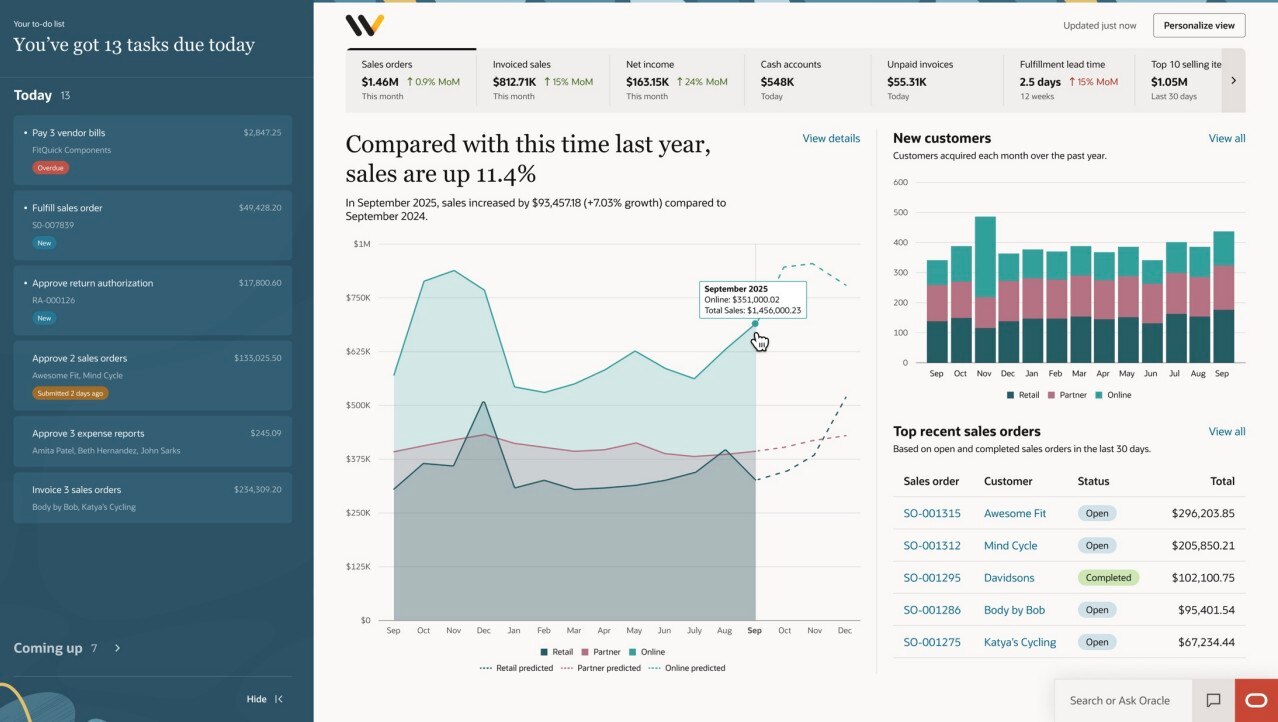
A successful AI implementation hinges on clean, connected data, as even state-of-the-art models can struggle to answer basic questions about a business without a sound database to rely on. NetSuite ERP Software for Financial Services brings financial, operational, regulatory compliance and customer data into a single platform, rather than creating a patchwork of exports and workarounds. This foundation upholds NetSuite’s AI agents, including Autonomous Close, which monitors the financial close and proposes fixes before they cause delays, and SuiteAgents, a framework for building agents tailored to the firm’s existing processes. NetSuite’s AI Advisors, including Ask Oracle, allow finance and operations teams to query the company’s data conversationally and get cited answers for easy verification. Meanwhile, NetSuite’s AI Assistants, such as Bill Capture and Anomaly Detection, handle the repetitive checks in accounts payable and financial data to feed a cleaner picture to the agents and advisors built on top.
NetSuite’s Embedded AI
Agentic AI seems like a new frontier, but it’s quickly becoming standard practice throughout the financial services industry. AI agents expand what AI can do, but only when companies carefully define what they’re allowed to handle. Agents’ scopes are likely to expand over time, as governance frameworks mature and firms gain confidence in their agents’ capabilities and as pilot programmes mature and adoption spreads. For now, the firms already getting real value from their agents are investing in the unified data and clear guidelines that govern the implementation and operation of today’s and tomorrow’s AI tools.
See NetSuite for the Financial Services sector in action here (opens in new tab)
Agentic AI in Financial Services FAQs
What is the difference between agentic AI and traditional AI?
Traditional AI systems are built to complete a single task, such as assessing whether a transaction is high-risk, and then stop and wait for another prompt or request. AI agents typically involve oft-repeated workflows that string several tasks together towards a goal, like pulling in transaction and account history to assess the customer’s buying behaviour, comparing it to current fraud trends, cross-referencing it with established fraud-case outcomes and sending a detailed report to the fraud team for determination.
How is agentic AI different from generative AI?
Generative AI creates content, such as a meeting summary or an email draft, often in response to a manually issued prompt. AI agents can string multiple requests together without waiting for a human to manually issue a new prompt at every step. For example, an agent may use generative AI to draft an email, then send it to a client, update their account, schedule a follow-up message and notify the account manager.
Which back-office processes are best suited for agentic AI?
Processes that are repetitive and well-defined are often the first steps teams hand off to AI agents, such as reconciliation, Suspicious Activity Report drafting, onboarding document verification or customer service follow-ups. Because these tasks come with clear rules to follow and measurable outputs, financial services firms start with them before extending their agentic coverage to more complex workflows, such as cash flow management or compliance reporting.