
A wealth advisor sits down for a review and pulls up three different screens to piece together what’s going on with a client. The relationship manager down the corridor spoke to that same client earlier in the week about a pension query, but nothing on the advisor’s screens shows it.
This is a common challenge for UK financial services firms, where data can be stored among a patchwork of platforms instead of in one comprehensive record. Customer relationship management (CRM) software helps bring that information together, giving firms a more coherent view of their clients while supporting growth and regulatory obligations.
What Is CRM for Financial Services?
CRM for financial services refers to software that gives banks, insurers, wealth managers and fintechs a consolidated view of client relationships, including accounts, communications and relevant regulatory history. It can also help firms capture a range of information, such as household connections and customers’ vulnerability-related needs, as well as maintaining records of client interactions and other activity.
Key Takeaways
- A CRM depends on a single, accurate client record to grow relationships and prove regulatory compliance.
- Requirements vary considerably across financial services that can range from practice management platforms for advisors to trading platforms for insurance brokers.
- Implementations can fail because of poor adoption and weak change management, not necessarily due to the software itself.
Why UK Financial Services Firms Need CRM
A relationship manager working from an incomplete client record moves slower because they’re left hunting down information that should already be on file. And if a regulator or the Financial Ombudsman Service later asks the firm to show how it treated that client fairly, it may not be able to produce that evidence at all. Problems like these are making CRM a more important consideration for UK financial services firms for four reasons:
- Siloed client data: Many firms still hold pieces of the same client relationship in separate systems or even spreadsheets, with no reliable way to know which data is current. Advisors and service staff end up working from partial information, which slows onboarding and can make it harder to demonstrate the consistency of client records and processes during a compliance review.
- Rising customer expectations: Clients increasingly expect the same kind of fast, connected service from their bank, insurer or wealth manager that they experience from tech-driven businesses. They want faster and more proactive service, but they still expect firms to handle their personal and financial data securely.
- Regulatory obligations: The FCA’s Consumer Duty requires firms to monitor and assess whether they are delivering good outcomes for retail customers, and to be able to provide evidence of their approach. In light of anti-money laundering (AML) and Know Your Customer (KYC) requirements, well-structured, retrievable client records are essential for demonstrating how the firm has handled customer relationships and decisions.
- Competition and retention pressure: Switching banks (namely because of financial incentives offered) is common enough to make customer retention an important consideration. In a 2025 KPMG survey, 17% of adults said they switched their current account in the past year, rising to 45% among 18- to 24-year-olds. In this environment, firms need a clear view of client needs, interactions and opportunities to improve relationship quality before customers churn.
CRM Use Cases Across Financial Services
A wealth advisor managing hundreds of client households has very different CRM requirements from a bank’s commercial lending team or an insurance broker running quotes through a trading platform. The nature of the relationship, the regulatory regime and the day-to-day workflow all shape what good CRM looks like in the following market segments.
Wealth and Financial Advice Firms
Financial advisors and wealth managers use CRM software to build a client’s fact-find, map their household structure, run risk profiling and generate suitability reports. Many advice relationships span decades and multiple product lines: a pension here, a protection policy there, an investment portfolio somewhere else, so some CRM platforms double as practice management and financial planning tools that may also handle cash flow modelling and review scheduling. Firms can also layer open banking data feeds on top of these systems to help advisors keep financial information and cash flow models current, so clients aren’t obligated to re-enter information.
Banking and Lending Teams
On the retail side, CRM underpins personalised servicing and cross-selling. For example, if a mortgage customer is nearing the end of a fixed rate, the system can notify the lender to make a proactive call about remortgaging options. On the commercial and lending side, relationship managers rely on CRM to manage a pipeline of prospects and credit applications and track covenant reviews. Generative artificial intelligence (GenAI) is also being used in lending, with some lenders using it to draft credit papers and summaries. Regulatory requirements pertaining to individual accountability and consumer outcomes also heighten the importance of clear records and evidence, and a financial services CRM can help capture and maintain that information along with the client and deal record.
Insurance Providers and Brokers
Quoting, policy administration and client management are inseparable in commercial and personal lines broking. So, in UK insurance, these functions are often brought together in broker trading platforms that combine CRM, policy administration and market connectivity. Accurate, up-to-date data is essential for customer self-service, and it also supports fraud detection and risk assessment. Embedded insurance sold at the point of another transaction, telematics-informed pricing and AI-assisted underwriting are further increasing demand for richer and more timely customer data. As these trends develop, CRM capabilities are becoming an increasingly important part of the broader insurance platform.
Fintechs and Payments Firms
Fintechs and payments firms often build customer data and relationship functionality directly into their web and mobile applications, with APIs connecting customer information across different systems. Open banking lets customers consent to sharing their transaction data with a fintech directly from their own bank account, and UK open banking connections passed 16.5 million in December 2025, up from 12.1 million a year earlier. When integrated into the firm’s wider systems, that data becomes part of the same client record the CRM already holds, making it useful for supporting affordability assessments and other services that rely on understanding a customer’s financial position. At the same time, however, fintechs and payment firms are subject to regulations that vary by activity and business model, such as specific requirements for payment and e-money services.
Client Service and Relationship Management Teams
Client service and relationship management teams use a CRM to log inbound queries, complaints and service requests in the client record, giving everyone who touches that client the same view of what’s already happened. That same log lets managers track how quickly the team resolves issues and also identifies recurring complaints tied to a specific product or process. Vulnerability-related information, consent and communication preferences can be recorded in the client record, where service teams play a key role in keeping data current. Client service and relationship management teams are often the first to hear when something’s changed, so they need to record or flag it before the next person picks up the phone. A client who mentions a bereavement while querying a bill, for instance, shouldn’t have to repeat that fact three months later during an unrelated call.
Finance Futures: Tomorrow’s Vision

9 CRM Capabilities Financial Services Firms Should Prioritise
Not every CRM feature carries equal weight inside a financial services firm. Features that are optional in a generic sales CRM can become important when firms need to manage complex client relationships, integrate data from multiple systems or maintain appropriate records for regulatory purposes. The following capabilities are where generic CRM configurations can fall short, and where financial services-specific functionality can add value.
-
360 Customer View: Household/Account Views
A 360 customer view refers to a consolidated view of each client that extends to the wider household or connected-party structure around them: a spouse, dependants, a family trust or even a linked business. Where the relevant systems are connected, it can bring together accounts and policies associated with that structure, including products a particular advisor doesn’t directly manage. Without this broader view, advisors and service staff may see only part of the client relationship, increasing the chances of missing cross-sell opportunities or basing suitability assessments on incomplete information.
-
Lead, Pipeline and Opportunity Management
Standard pipeline functionality (tracking prospects, opportunities and referral sources all the way to conversion) remains essential, particularly for advice firms managing organic growth and for banking or lending teams running structured sales processes. In financial services, an opportunity can’t simply close the moment a client buys a product. It must connect with the client and carry through to the compliance processes that follow a sale, which may include suitability (where applicable) and other relevant product and customer records. Changes in pipeline stage can also trigger the appropriate workflow, so staff won’t have to perform each step manually. When an opportunity moves from proposal to closed won, for example, the CRM can trigger the next steps in the relevant client, documentation and compliance workflows.
-
Onboarding and KYC Workflow Support
A financial services CRM can support KYC through structured workflows for identity verification, document collection, risk rating and enhanced due diligence for higher-risk customers. It can also make sure the relevant records and workflow history are retrievable, helping firms demonstrate how checks were completed as part of their AML processes. When these steps all occur in a structured onboarding workflow, the need for manual handoffs decreases, so it’s easier to track outstanding checks and documentation. Strong KYC records also create the foundation for successful relationships.
-
Compliance, Consent and Audit Trails
A financial services CRM can help firms log and retrieve information relevant to Consumer Duty monitoring, including client segmentation, vulnerability status, fee and value evidence and suitability reviews. It can also record consent, communication preferences and other information relevant to the firm’s data protection processes while making appropriate vulnerability information available to staff who need it. Audit and activity histories can register actions taken against the client record, including exactly what changes were made and by whom. Firms without these capabilities in place may not be able to easily answer regulator questions without reconstructing documents from scratch.
-
Marketing and Client Communication Automation
Firms should prioritise CRM capabilities that let them segment clients and automate client communications, such as onboarding sequences, review reminders and messages based on life stage or products held. Used well, these tools can support commercial growth. They can also help firms provide clear, timely information throughout the client relationship, which is relevant to the Consumer Duty expectation that clients fully understand the firm’s communications. The key is verifying that communication triggers and audience segments are based on accurate and current client data.
-
Document Management and Secure Collaboration
Suitability reports, KYC documentation, policy schedules, signed agreements and client correspondence should all be easy to access from the relevant client record and contain appropriate version and access controls. Retention also needs to satisfy the applicable regulatory record-keeping rules. Depending on the firm’s needs, document management features may be integrated with client portals, have e-signature capabilities and allow for secure messaging to support collaboration between clients and advisors. Because these records can contain large volumes of sensitive personal data, the system should also provide appropriate security controls, including encryption at rest and in transit, and be configured to meet the firm’s UK GDPR obligations.
-
AI-assisted Relationship Insights
Firms should prioritise AI capabilities that help advisors and relationship teams extract useful information from client interactions and records. Meeting summarisation, next-best-action recommendations, portfolio and risk-alignment checks and prospect research have become realistic uses of AI inside a CRM, and all of them can minimise the time spent on preparation and routine analysis. More sophisticated financial services-specific agentic AI can go on to prepare meeting briefs, reveal potential issues or deal with routine client queries, although those uses still require appropriate human oversight. Firms should also assess how AI systems handle accuracy, client data, explainability and accountability before using them in regulated workflows.
-
Reporting and Analytics Dashboards
Besides individual client records, firms need full visibility into pipeline and revenue, customer outcomes, service levels and complaints trends and advisor and team activity. For Consumer Duty, this can help firms monitor customer results, identify developing issues and assess whether changes are needed. Dashboards that bring this information together can make trends easier for compliance, operations and management teams to identify and act on, rather than relying on ad hoc reports assembled from separate systems.
-
Integration With Finance, Core Systems and Productivity Tools
Integration with core banking or policy administration systems, investment platforms, open banking data and everyday productivity tools, such as email and calendar software, is an important capability for firms that want their CRM to provide a consolidated view of client information. Without the right integrations, staff may still need to switch from one system to another to find relevant information; this applies to finance and ERP systems, too. Understanding how CRM and ERP systems work together can help firms connect client and revenue data with billing, contracts and financial reporting to give teams a joined-up view of the client relationship and its financial impact. Open APIs can make these integrations easier to build and maintain, although the complexity will depend on the systems involved.
Benefits of CRM for Financial Services Providers
CRM for financial services can benefit teams throughout the business, whether by improving an advisor’s day-to-day workload or management’s regulatory reviews. Many of these benefits build on the same underlying capabilities, such as structured client data, workflow management and accessible records. Firms usually maximise their return in the following ways:
- Higher retention and wallet share: A CRM’s broader view of a client relationship can make it easier to see relevant opportunities, such as a pension due for consolidation or a family member in the same household the firm isn’t yet serving. Firms that act on those signals consistently may see more of a client’s wallet share move their way, often without the client ever having to ask.
- Faster client onboarding: A unified client view can reduce some of the back-and-forth that slows onboarding, because advisors and operations staff have easier access to information already held somewhere in the firm’s systems. A more efficient onboarding process also means that less time will elapse before a new client starts generating revenue.
- Better compliance evidence: A well-configured CRM can help firms record and retrieve information relevant to suitability, KYC and other compliance processes, especially when the FCA or the Financial Ombudsman Service comes asking.
- More productive advisors and service teams: Automating data capture, document handling and workflow orchestration can give advisors and relationship managers meaningful time back for client-facing work. AI-assisted CRM tools can cut time spent on such tasks as summarising meetings and retrieving information, although the productivity benefit depends on how accurately and effectively the tools are used.
- Improved data-driven decision-making: Consolidated, well-governed client data can support more-informed business decisions, such as identifying underserved client segments, reviewing fair-value assessments, analysing complaints and understanding vulnerability patterns in the client base. These patterns are difficult to assess reliably when information is stored in separate systems. Firms that can see these patterns clearly can identify issues sooner and decide where action may be needed.
How to Choose a CRM System for Financial Services in 6 Steps
Selecting a CRM is a high-stakes decision for regulated financial services firms because the system must support both client management and relevant compliance processes. A CRM that doesn’t address the firm’s operational and regulatory requirements may require significant reconfiguration or replacement. The following framework should help with the selection process:
- Define user groups and workflows: Start by identifying the people who will use the system daily, before looking at any feature list. Map their actual workflows first, then use those groups to test each candidate CRM. Does its out-of-the-box process match what these teams already do, or would it need heavy configuration to fit?
- Assess data model and integration needs: Confirm whether a platform’s data model can support financial services relationships, such as households, accounts and holdings, or whether a generic contact-and-deal model would need adapting. List every system the CRM must connect to, then ask every vendor exactly which of those connections come prebuilt and how open its API is to accommodate anything that isn’t.
- Review security and data protection controls: Verify the availability of role-based access controls that govern what an advisor, compliance officer and administrator can each see and do within the same client record. Check where data will be hosted, how international transfers are handled and whether data is encrypted at rest and in transit. These are baseline requirements that should form part of the firm’s wider security and data protection capabilities.
- Evaluate AI governance: Confirm how responsibility for the CRM’s AI features will be assigned within the firm, whether AI-generated content can be reviewed before it reaches a client, and what information the vendor provides about how its models produce outputs. Firms should also decide where AI can assist with tasks like drafting notes or flagging next steps, and where a person needs to make the final call, especially on decisions that affect a client’s money or risk exposure.
- Estimate total cost of ownership: In financial services, CRM costs can extend well beyond the software licence, particularly when firms need to configure workflows, reporting and integrations for specific requirements. Integration with legacy core banking or policy administration systems can add significant cost and complexity, regardless of how straightforward a vendor’s demo makes the process appear. To estimate these costs, scope the configuration, compliance and integration work with input from relevant internal teams.
- Plan implementation, migration and adoption: Assess how the vendor will approach data migration, staff training, testing and rollout, and what support it provides throughout implementation. Buyers should also consider whether the proposed approach matches the firm’s size, complexity and available resources, including how much configuration and integration work will be required before the system is ready for wider use.
CRM Implementation Challenges to Plan For
CRM implementation can run into problems that have little to do with the software itself. In financial services, issues with data, adoption, integration and governance can undermine the value of the system and create additional compliance or operational risks. Firms should plan for the following:
- Legacy and siloed data: In legacy environments, client data is typically fragmented, duplicated or inaccurate. Cleanse, deduplicate and validate data before migration to avoid transferring existing problems into the new CRM. Firms should also decide which data needs to be migrated and how it will be checked after the move.
- Low user adoption: A CRM that advisors and service staff prefer not to use provides limited benefits. Adoption can suffer when the system adds unnecessary work or doesn’t reflect how teams really manage client relationships. Involving frontline staff in workflow design before go-live can help identify problems early and smooth adoption of the new processes.
- Compliance risks: Poorly configured workflows, permissions or record-keeping can create compliance and operational risks. Involve compliance and the relevant senior managers in CRM selection and configuration from the outset, and test that the system supports the firm’s requirements before go-live.
- Poor integration: Because a CRM’s value depends partly on the information it can bring together, integration failures sabotage the whole business case. Treat integration development and testing as a foundational part of implementation, with time set aside for resolving differences in data formats, systems and processes.
- Weak data governance: Even a well-integrated, widely adopted CRM can suffer from declining data quality if clear ownership, defined processes for updating records and periodic audits of record completeness are lacking. Firms should treat data governance as an ongoing responsibility, not something that ends when the CRM goes live.
Connect Client Relationship Data with NetSuite CRM
Client relationships in financial services hold up only if the data behind them does, too. NetSuite ERP Software for Financial Services brings client and relationship data to financial and operational processes. Many features, such as approvals, segregation of duties, and audit trails, support firms’ governance and regulatory requirements. Together, CRM and ERP give financial services firms a more connected view of client relationships, the activity around them, and the financial impact on the business.
NetSuite Customer Relationship Management (CRM) gives teams a 360 Customer View of every prospect and client, so advisors can access relevant relationship information without switching among multiple systems. Sales force automation and case management connect opportunities and service request to that same client record, too.
Stand Up to Regulatory Scrutiny with NetSuite
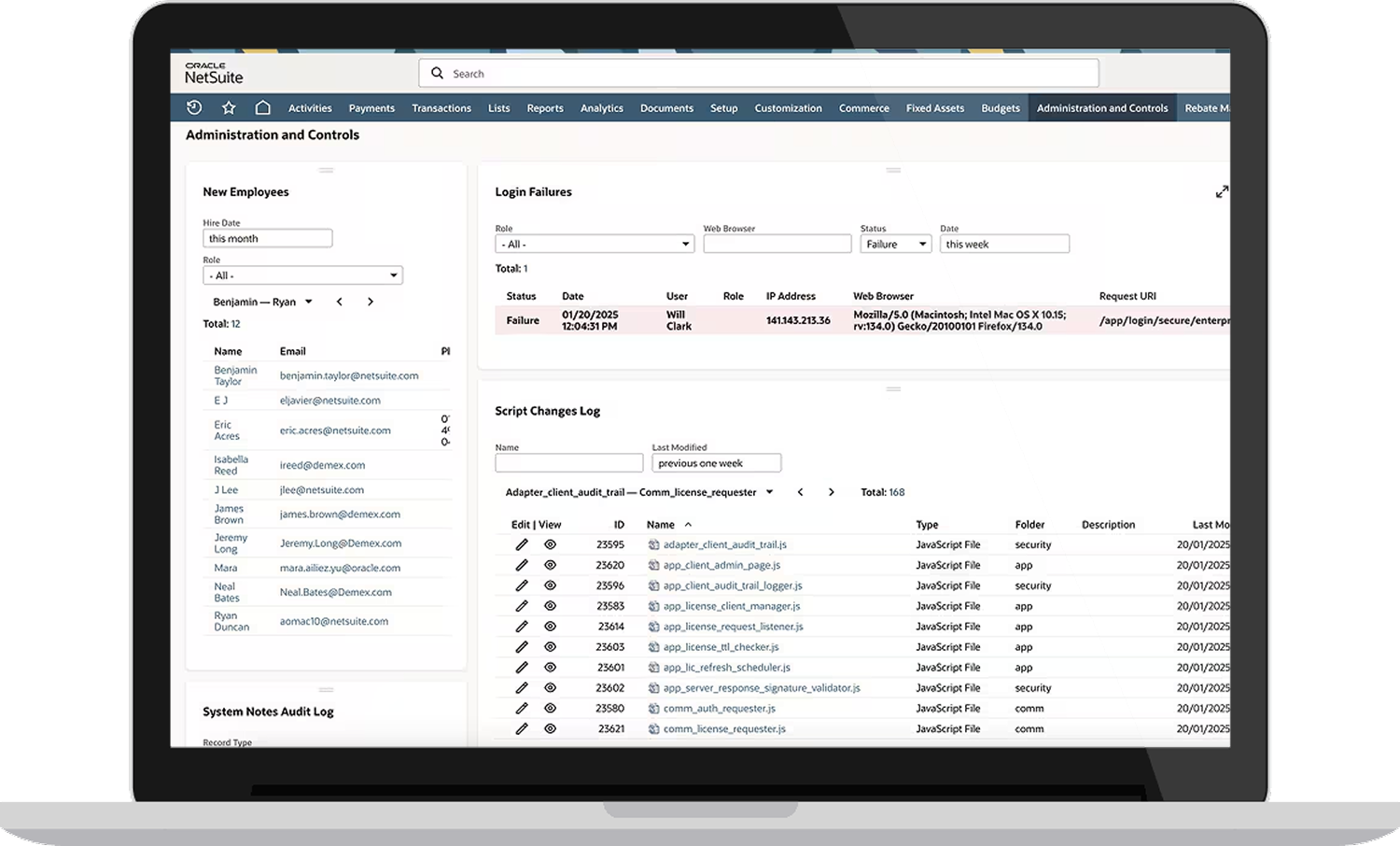
CRM sits at the centre of how financial services firms manage client relationships and maintain the records needed to support regulatory requirements. A system that provides a consolidated client view, appropriate audit histories and structured workflows can support both goals, but actual value hinges on establishing clean data, effective integration and ongoing governance. Firms that build those foundations can adapt the CRM as their client needs, regulatory requirements and use of AI continue to evolve.
CRM for Financial Services FAQs
Which financial services firms need CRM software?
CRM can be useful for firms with ongoing client relationships, particularly if they need to manage client data, communications, workflows and records scattered among multiple teams.
What features should financial services CRM include?
A financial services CRM should include complete client and household views, onboarding and Know Your Customer workflow support, appropriate compliance and audit trail capabilities and integration with relevant core banking or policy systems. Firms should prioritise the features that match their specific client relationships, workflows and regulatory obligations.
Can CRM help with compliance in financial services?
Yes. CRM can help firms record, organise and retrieve information relevant to such processes as Know Your Customer, suitability, customer support and Consumer Duty monitoring. It can also provide activity histories and workflows that help firms provide evidence on how processes have been managed. However, CRM, by itself, does not make a firm become compliant or replace specialist compliance systems and controls.
How much does CRM for financial services cost?
The cost of a CRM for financial services varies, depending on platform, number of users, firm size and the level of configuration and integration required. A realistic estimate should include implementation, data migration, training and ongoing administration, as well as the cost of the subscription itself.