
In the UK insurance industry, revenue is renewal-driven, sold largely through brokers and other intermediaries, and subject to specific Financial Conduct Authority (FCA) rules on customer treatment. Sustaining that revenue requires purpose-built customer relationship management (CRM) software that tracks each policy through its renewal cycle and models the underlying broker and insurer relationships, while also capturing the customer-engagement records regulators require.
What Is Insurance CRM?
Insurance CRM software is a system that gives brokers, agencies, managing general agents (MGAs) and insurers a single, governed view of their clients, prospects and intermediary partners, from first quote through renewal or lapse. It also tracks the sales pipeline and renewal tasks tied to each policy.
Industry-specific CRM systems coordinate sales, renewals, service and compliance activity around each client. Most platforms run in the cloud and connect to a firm’s broker, policy or claims systems.
Key Takeaways
- Insurance CRM is organised around policies and the insurer, broker and partner behind each.
- To avoid duplicate data and errors, firms must clearly define boundaries between which types of data their CRM, policy administration, broker management and finance systems own.
- Firms using AI responsibly for lead scoring and predictive analytics need named accountability and human review.
Finance Futures: Tomorrow’s Vision

Where Insurance CRM Fits into UK Insurance Operations
Generic CRM platforms are often organised around individual deals that close and end. In insurance CRM systems, the central object is a policy, which can be quoted, bound, adjusted midterm or renewed, have a claim made against it, or lapse. A single client can hold several policies running on different timelines, and the CRM must track them all simultaneously. Because each policy is placed with a specific insurer, a broker’s CRM must also represent those insurers, any wholesale partners involved, as well as its clients. Meanwhile, an MGA’s CRM must centre on broker relationships, and a claims or service team’s CRM must collect thorough case histories.
Broker and Agency Sales Teams
Much of personal lines broking, insurance such as home and motor cover sold directly to individual consumers, is quoted and purchased through price comparison sites. A single customer can generate several competing quotes that don’t convert right away, so the CRM must track and follow up on those leads. Since customers can shop around again at renewal, the system must also run proactive renewal communications. In commercial lines broking, the CRM needs to support prospecting and advance renewal preparation for account executives managing hundreds of client relationships with multiple policies and renewal dates.
MGAs, MGUs and Specialist Insurers
MGAs and managing general underwriters (MGUs) typically operate under delegated authority from insurers, allowing them to underwrite and, depending on their mandate, bind business on an insurer’s behalf. CRM systems can help them track broker relationships, submissions, quotes, binds and conversion trends by broker, class or region. Because MGAs rely on capacity providers, they also need to provide the risk, premium, claims and other performance data required by their delegated authority agreements. Specialist insurers may use CRM to manage broker relationships and business development alongside underwriting or policy systems that handle risk assessment, pricing and other core underwriting processes.
Customer Service, Claims and Retention Teams
Service teams handle midterm adjustments, document requests, payment queries and cancellations, while claims teams handle the initial report, investigation and settlement. Claims often sit in a separate system, but the CRM still needs to know a claim is open, so service and retention teams don’t reach out with a cross-sell campaign at the wrong moment. The CRM lets any representative who picks up a call see a customer’s complete history and any open issues. Firms can use the information to show regulators they’ve treated customers fairly.
Insurance CRM, AMS and Policy Administration Systems
Every insurance firm eventually runs into the same question: Which system is supposed to hold which piece of information? Four categories of software typically divide that work, and confusion about their boundaries is one of the most common sources of CRM implementation problems.
Insurance CRM
Insurance CRM tracks who a customer or broker is, what’s been discussed with them and what should happen next. Many platforms also hold insurance-specific data, such as policy summaries and commission figures, which increasingly overlaps with broker management and policy administration systems. Even when the same information appears in more than one place, firms need to decide clearly which system holds the master record for each type of data.
Agency or Broker Management Systems
A broker or agency management system (AMS) is the operational and financial system of record for an intermediary, covering policy records, client money accounting, insurer connectivity and document production. It tracks transactions and their money: which policy is in force, what’s owed and what’s been paid. Many systems now include CRM-like features, so the decision to add a separate CRM often comes down to how much sales, marketing and service functionality is needed. Firms that focus more on selling new business than servicing existing accounts tend to rely more heavily on CRM capabilities, while firms focused primarily on servicing existing clients rely more on a broker management system’s internal tools.
Policy Administration and Core Insurance Systems
A policy administration or core insurance system serves as the system of record for an insurer’s or MGA’s products. It covers rating, policy issuance, endorsements, billing and claims. It enforces the rules a product must follow, including the delegated authority limits that govern what an MGA can bind on an insurer’s behalf. Policy and premium information typically flow from the policy administration system into the CRM, so the CRM reflects accurate policy status.
ERP and Finance Platforms
An enterprise resource planning (ERP) or finance platform manages the general ledger, accounts payable and receivable, financial reporting, human resources and procurement. It consolidates client money and commission data into group-level figures, producing the reporting an insurance group needs to run its business. Firms with several entities, subsidiaries or acquired books of business often accumulate a mix of finance systems; once spreadsheets and disconnected accounting tools can no longer keep pace, firms often replace them with a single ERP. This is usually when CRM-ERP integration becomes necessary to consolidate CRM, broker management and financial data.
Common Insurance CRM Use Cases
A commercial account executive preparing for a client renewal, a claims team logging a customer’s report of storm damage and an MGA underwriter reviewing a broker’s latest submission all use the same CRM but for different purposes.
Lead Capture and Quote Follow-Up
As leads arrive from websites, price comparison sites, referral partners and broker submissions, the CRM captures each, checks it against existing records, assigns it based on a set of rules and schedules follow-up activity. In personal lines, a customer might review several competing prices at once, so timely, relevant response is crucial. In commercial lines, where it can take weeks to prepare a quote, tools that track outstanding quotes and expiry dates keep good opportunities from lapsing. Because most electronic communication counts as marketing under UK rules, the CRM must also track each lead’s consent status.
Policy Renewal and Retention Workflows
The CRM generates renewal tasks at set intervals before a policy’s expiry date. For commercial clients, that process often starts months ahead with an updated risk review, a market submission and a recorded client decision. For personal lines, the CRM manages outreach to at-risk or potentially vulnerable customers and records the reason someone churns. Because General Insurance Pricing Practices (GIPP) rules prevent charging existing home and motor customers more at renewal than a new customer would pay for the same cover, that outreach, not price, is the main lever insurers have for retention.
Cross-Sell and Upsell Campaigns
Analytics can identify customers who might benefit from additional cover, such as a commercial client without cyber insurance or a homeowner without legal expenses cover. The CRM then segments those customers, checks marketing consent and creates a campaign or handler task. Underinsurance is a genuine problem in several classes of cover, so this targeting can address genuine customer protection shortfalls. Cross-selling must reflect a product’s true target market and exclude customers unlikely to benefit; regulators have scrutinised add-on products sold too broadly. A campaign built on a clear, documented customer segment is easier to defend than one built on a broad mailing list.
Claims and Service Handoffs
Claims often determine whether a customer trusts an insurer or broker. When a customer reports a claim through a contact centre or portal, they don’t want to repeat the same information later. To minimise those complaints, the CRM captures the initial details and hands them off to the claims system, then displays that claim’s status to service and account teams. For standard service requests, such as midterm adjustments, the CRM creates a case and routes it through to resolution instead of relying on email threads or phone notes. Note that any health information disclosed during a claim needs the same restricted access controls as other sensitive personal data held in the CRM.
Broker Performance and Pipeline Visibility
For MGAs and insurers, the CRM tracks submissions, quotes, binds and declines by broker, alongside relationship activity such as visits and training sessions. For brokers, the same idea applies to individual account executives and their books of business. Knowing which brokers or producers generate profitable business, and understanding why submissions get declined, helps a firm direct underwriting time and business development effort where it pays off. Regulators also expect firms to monitor that their distribution partners are selling into the intended target market, which makes this visibility a compliance matter as well.
Business Benefits of Insurance CRM
Vendor literature often presents CRM benefits as an inherent outcome of buying software. In practice, realising benefits depends on specific conditions, mainly clean data, working integrations and active use.
- Stronger customer relationships: A shared, accurate record of a customer’s preferences and history keeps service continuous when an account handler leaves the firm, provided that staff logs the substance of each conversation in the CRM. Automated tools can’t always capture those details.
- Better renewal visibility: When renewal data flows from a firm’s policy or broker management system into the CRM, managers can see the renewal book weeks or months ahead. That visibility gives handlers time to intervene on at-risk renewals and lets managers plan staffing around renewal volume.
- More consistent service: Workflows, templates and service-level tracking reduce variation in how different staff or offices handle the same type of request. Consistency may also reduce complaints, their associated handling costs and the risk of Financial Ombudsman Service involvement.
- Higher sales productivity: Automating routine insurance tasks and prioritising leads frees producers to spend more time with clients and less on tedious tasks such as data entry and scheduling. By tracking conversion rates and renewal retention against baseline rates, firms can see whether time reallocation translates into measurable insurance-related KPIs.
- Improved data and reporting: A well-governed CRM creates structured data that can be analysed by conversion source, retention segment, service time and broker performance. Reports drawn from the CRM show current data, so managers can make decisions without waiting for someone to compile and reconcile disconnected spreadsheets.
- Stronger compliance support: Structured data also doubles as compliance evidence. CRM systems can record customer needs and vulnerability information, capture marketing consent, log communications and advice, and track complaints against required timelines.
12 Insurance CRM Features to Prioritise
A commercial account handler needs to see a client’s full policy history before a renewal call. An MGA needs its underwriters to see which brokers are sending profitable submissions. A compliance officer needs an unbroken record of every disclosure sent to a customer. A single CRM can support all those use cases and more.
-
Policy and Client Management
The CRM tracks clients (individuals, households or businesses) together with every policy they hold. Each policy record includes its type, insurer, premium, commission, key dates and status, all necessary to support renewals, cross-sells or claims handoffs. Firms should look for a data model that handles many-to-many relationships, such as one policy covering multiple insured parties or one client holding policies with multiple insurers. If policy data doesn’t sync reliably from the broker or policy administration system, the CRM can show an outdated premium, renewal date or policy status, so every process that depends on that data acts on the wrong information.
-
Contact Management
Insurance relationships are rarely one-to-one: A commercial client might have separate finance and risk contacts, and an MGA typically deals with several producers inside the same broker firm. Contact management handles this by holding records of individuals and organisations, along with their roles, relationships, communication preferences and consents. Firms should look for relationship mapping, household and corporate hierarchies, and deduplication tools that catch the same contact entered multiple times. Consent and communication preferences must also link directly to marketing and data protection rules under UK GDPR, so a CRM doesn’t accidentally contact someone who has opted out.
-
Lead Management and Opportunity Tracking
This feature captures, qualifies, assigns and converts leads into opportunities, with the original source tracked throughout. It ties marketing spend and broker development efforts to results, something that is difficult to measure without reliable lead data. Configurable opportunity types separate new business, renewal, midterm and cross-sell activity for pipeline reporting. Consistently capturing reasons for lost opportunities also helps a firm understand patterns that show why business doesn’t convert.
-
Pipeline Management
Pipeline management visualises and manages opportunities by stage, value, probability and expected renewal or close date. Managers use this to forecast premium and commission payments, and MGA underwriting managers use it to compare submission flow against available capacity. New business and renewal pipelines should stay separate because blending them will hide which activities drive results. Producers and account handlers spend much of their time outside the office, so they need to be able to view and update the pipeline from a phone or tablet.
-
Renewal Management
Automating and tracking renewal work, from early preparation to the recorded outcome, helps general insurance firms keep existing premium on the books by avoiding missed deadlines or late follow-up that turn into lapses. Renewal needs vary by policy class and value, so rule-based task creation, generating different tasks and timelines depending on customer revenue, keeps a large commercial account from getting the same simple reminder as a low-cost personal policy. Highlighting accounts at risk of lapsing is equally useful since it directs staff attention to the renewals that need it most.
-
Compliance and Documentation Management
UK regulators expect firms to record and retrieve information about customer needs and to keep orderly records of their business. Storing and evidencing advice, disclosures, consents, vulnerability information and complaints, with audit trails and retention controls attached, helps firms meet these requirements. Vulnerability information must be captured in a structured, searchable way with limited access. Complaint case management that automatically tracks regulatory deadlines helps firms comply with required response windows. Document generation and storage should connect to the system that holds policy documents instead of creating a second, disconnected archive.
-
Real-Time Reporting
Boards need current information to review customer outcomes, and managers need daily visibility into pipeline, service and retention. Real-time dashboards and reports automatically update as the underlying data changes. Users can drill down into individual records and configure views for their specific needs. Reporting must also break results down by customer segment, since the FCA Consumer Duty requires firms to monitor outcomes for different groups, not just aggregate totals. The ability to combine CRM data with information from a policy or broker system, either directly or through a shared data warehouse, can determine how useful reporting is.
-
Sales Force Automation
Sales force automation handles a producer’s routine tasks, including activity logging, reminders, task assignment, approval routing and email sequences. It also automatically routes deals outside normal terms for manual approval, instead of depending on someone remembering to escalate them. Any automated direct communication to customers, such as email sequences, must have guardrails to block sending messages without valid consent.
-
Communication Tracking
Emails, calls, meetings, texts and letters logged against client and policy records are evidence of the advice and support a customer received. That record helps with complaint handling and shows whether the firm meets Consumer Duty requirements for clear communication. Integrated email and telephony capture with call recording capabilities can build these records automatically. A single timeline that combines every channel shows the full sequence of events to whoever picks up the next call or email. Retention settings for these records should match the firm’s documented policy and align with data protection laws.
-
Revenue Management
Revenue management tracks and forecasts premium, commission and fee income by client, product, insurer and producer. It ties broker and MGA commissions and fees to the right client, product and producer as each policy is written while also calculating the insurer’s margin. Revenue management works best when data syncs automatically from the broker or policy system, because duplicate manual entry is where errors creep in. Forecast models should also distinguish new business, renewals and midterm adjustments, since blending them into one number hides sources of growth or attrition.
-
Commission Tracking
Commission tracking records commission rates, splits between producers or introducers, clawbacks and payment timing. For MGAs, it also monitors profit commission, a bonus tied to how their book of business performs. Commercial customers can ask their broker to disclose the commission earned on their policy, so that figure must be available at the policy level. Commission schemes can push producers toward whatever pays best, so firms need to compare commission by product against each producer’s sales mix to check that sales are following the customer’s needs, not only the payout.
-
Security Controls
Security controls include identity and access management, role-based permissions, encryption and audit logging. Insurance CRMs often hold sensitive data, including health information and underwriting-relevant details such as criminal convictions. That data needs field-level restrictions, because broad access to a customer’s health condition or vulnerability status increases privacy risk and the chance of misuse. Multifactor authentication and single sign-on reduce the risk of exposing sensitive data. Firms should look for systems with independent assurance, such as ISO 27001 or SOC 2 certification, and documented recovery objectives that match their resilience requirements.
Insurance CRM Requirements by Business Model
The same CRM platform can serve a personal lines broker, an MGA and a life insurer. Each one configures it differently, however, because their relationships, revenue cycles and regulatory obligations don’t line up. The table below sets out what each business model typically needs most from its CRM.
| Business Model | Distinctive CRM Priorities | Integration Needs |
|---|---|---|
| Brokers and Agencies | Renewal management as the core workflow, split between personal and commercial processes; producer performance and commission forecasting; the ability to disclose commission to commercial clients on request | Broker management system, insurer e-trading platforms |
| MGAs and MGUs | Broker relationship management, including onboarding and submission tracking; visibility into submission-to-bind performance linked to underwriting data; capacity provider reporting tied to delegated authority terms | Underwriting workbench or policy administration system, broker portals, bordereaux reporting |
| Life, Health and Protection Teams | Strict access controls for health data; advisor and intermediary relationship management, including commission and clawback tracking; persistency monitoring designed to support customers; vulnerability identification, particularly at claim stage | Core administration systems and adviser platforms |
| Property, Casualty and Commercial Insurance Teams | Compliant renewal processes and outcome monitoring for personal lines; broker relationship management and account planning for commercial lines; claims integration and clear customer communication during a claim | Policy administration system, claims system, contact centre platform |
Responsible AI in Insurance CRM
AI already powers lead scoring, call summarisation and renewal risk prediction in most insurance CRM platforms. In fact, a survey by the Bank of England and the FCA found that 95% of insurers surveyed were using AI in 2024, the highest adoption rate of any UK financial services sector. As the use of AI in insurance expands, governance is becoming a top priority.
- Lead prioritisation and next-best action: AI can score leads and existing customers to help producers focus their time. It also identifies customers who appear underinsured relative to their circumstances. Because these models learn from historical data, they risk reinforcing biases, such as deprioritising older customers or those in lower-income areas. To guard against that, firms should exclude characteristics such as age, disability or postcode from the model, check that no other data point is simulating them, and let staff override a recommendation and record the reason.
- Service summaries and follow-up tasks: Generative AI summarises calls and case histories, drafts follow-up emails and creates tasks directly from a conversation to minimise administrative work. An inaccurate summary can become part of the formal customer record, so firms should mandate human review of automated briefs.
- Renewal risk and churn signals: Predictive models can identify customers likely to lapse, so a firm can intervene earlier to, for example, resolve a service issue or catch a change in a customer’s circumstances. To comply with GIPP, these models cannot vary price based on the length of a customer relationship, and anyone showing signs of financial difficulty should be routed to support instead of a sales conversation.
- Governance and human review: Effective governance starts with a named person responsible for an AI tool’s actions and a record of its training data, which help explain the tool’s recommendations. It also means human review for any decision that could materially affect a customer’s cover, price, claim or access to support.
How to Choose Insurance CRM Software in 6 Steps
Firms that start by comparing CRM feature lists often end up with a system that scores well in a demo but doesn’t fit how the firm operates. The following six steps turn insurance CRM selection into a structured business decision.
- Map insurance-specific workflows: Document current and target workflows, including renewals, midterm changes, claims handoff, complaints and vulnerability handling, broker or advisor management, and reporting. Note where each workflow requires manual data re-entry, encounters delays or produces weak compliance evidence.
- Define integration requirements: Decide which information the CRM will own as the system of record (typically relationship and interaction data). Confirm that all platforms under consideration integrate with broker and policy administration systems and any other master records in use.
- Assess compliance and data protection needs: Identify the evidence that proves different customer groups were treated fairly, then check whether candidate CRMs can capture that data, along with vulnerability recording, complaint handling, audit trails and marketing consent. Confirm how the CRM handles sensitive data such as health information, which carries stricter legal requirements under UK GDPR.
- Prioritise adoption and mobile access: A CRM that staff don’t use produces poor data and generates little value, so choose a system that fits how people work: mobile access for producers in the field and fast single-screen views for contact centre staff. Plan for role-based training from the outset to foster user adoption.
- Review AI and automation controls: For each AI feature under consideration, ask what data it uses, where that data is processed, whether it can be switched off for specific roles or data types, and what logs exist for audits or complaint investigations. Also ask how the vendor prices AI usage.
- Calculate total cost of ownership: Licence costs are usually a smaller share of the total cost of ownership than firms expect. Request pricing for the full multi-year scope, including implementation, data migration, integration, training and ongoing administration.
When Should an Insurance Firm Move Beyond Standalone CRM?
If staff constantly re-enter data between the CRM and a broker or policy administration system, or the renewal pipeline in the CRM doesn’t match the policy system, that usually means the systems aren’t properly connected. That disconnect creates a compliance problem when a firm can’t produce outcome evidence for a customer segment without manually pulling data from several places. Growth through acquisition often makes this worse, with multiple CRMs and broker systems yet no single view of a client relationship. Fragmented data also makes it hard to build reliable AI or automation. Whether the right fix is deeper integration, an insurance-specific CRM, consolidating platforms or implementing a shared data layer for reporting depends on whether the constraint is related to process, data, integration or the platform.
Connect Insurance CRM With NetSuite
UK insurers, brokers and MGAs contend with fragmented policy, claims and financial data, plus manual renewal tracking and limited visibility into commission and performance. NetSuite Insurance ERP software calculates and reconciles commission for brokers and intermediaries automatically, with role-based dashboards that track premium and cash position as figures change. For deeper analysis, NetSuite Analytics Warehouse lets teams query that data in plain language and surfaces patterns and anomalies across large data sets, while AI-generated commentary in NetSuite Planning and Budgeting helps teams understand variances. Audit trails also give compliance teams documentation ready for regulatory review.
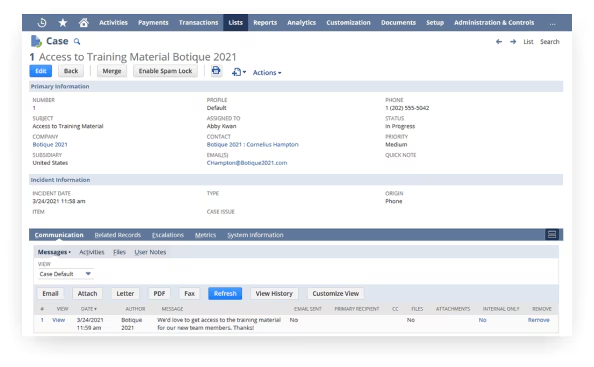
NetSuite CRM then gives account and service teams direct access to each client’s contact history, renewal dates and service record, keeping producers and support staff aligned without switching systems. Built-in generative AI in NetSuite Text Enhance can draft client emails and summarise service cases, and firms that use their own AI assistant can connect it through the NetSuite AI Connector Service, with role-based controls over what it can access.
Full Customer Visibility with NetSuite
CRM sits at the centre of how UK brokers, MGAs and insurers manage client relationships, prepare for renewals and demonstrate fair treatment under outcomes-focused regulation. Getting real value from it means choosing features built to service and sell policies and renewal cycles. As AI and agentic capabilities move further into everyday workflows, firms that build governance into their CRM from the start will be the ones best positioned to put those tools to work responsibly.
Insurance CRM FAQs
What is the role of CRM in an insurance company?
The role of CRM in an insurance company is to connect sales, service and renewal activity around each client and policy so that different teams can act on the same up-to-date information. It also supports compliance by recording customer needs, consents and communications that a firm may need to produce as evidence of fair treatment.
What are the 7 components of a CRM?
The seven components of a CRM are typically customer and contact data management, sales force automation, marketing automation, service and case management, workflow automation, analytics and reporting, and integration and security.
What is the difference between insurance CRM and AMS?
The difference between an insurance CRM and an agency management system (AMS) is that an AMS holds policies, client money and insurer transactions, while a CRM manages the relationships, communications and sales activity built around those policies.
What features should an insurance CRM include?
An insurance CRM should include policy and client management, contact management, lead and pipeline tracking, renewal management, compliance and documentation tools, real-time reporting, sales force automation, communication tracking, revenue and commission tracking, and security controls.
How much does insurance CRM cost?
The cost of insurance CRM varies widely by vendor, user count and the scope of features. Licence fees are usually only part of the total, with implementation, data migration, integration with existing broker or policy systems, and staff training typically adding to that initial cost.