
A financial technology company can run on a spreadsheet and basic accounting software for its first year or two. But once it combines Financial Conduct Authority (FCA)-regulated operations with rising transaction volumes, safeguarding obligations, multiple entities and cross-border activity, those tools can’t keep up. ERP software brings together finance, compliance and reporting in a single system of record, so fintechs don’t spend their days reconciling tools that were never meant to communicate.
What Is ERP for the Fintech Sector?
ERP for the fintech sector refers to the integrated platform a fintech company uses to run general ledger accounting, payables and receivables, revenue recognition, treasury, procurement, regulatory reporting and other internal operations, which is distinct from the platform used by its customer-facing systems. Fintech-specific ERP systems are configured to address the sector’s unique complexities, including multi-currency settlement and safeguarding of customer funds. As the operational and financial nervous system behind a fintech’s product, ERP software turns transactional data into numbers a CFO, auditor or regulator can trust.
Key Takeaways
- A fintech ERP system centralises scattered data into a system of record that can withstand regulatory scrutiny.
- This single data repository establishes a foundation for AI-driven automation and analysis, which leads to a competitive advantage.
- Fintechs commonly begin considering ERP software when regulatory obligations coincide with multi-entity, multi-currency, high-volume or complex revenue operations.
ERP for Fintech Companies Explained
The UK is the world’s second-largest fintech market, behind the United States, drawing £2.67 billion of investment in 2025. To understand how ERP works in the sector, consider the following example. A payment company authorises and settles merchant transactions through its product. For each settlement cycle, summarised transaction and fee data flows into the company’s ERP system, where it becomes accounting entries, processing revenue, scheme fees, merchant liabilities and foreign-exchange gains or losses. From there, the ERP software reconciles bank and safeguarding balances and recognises revenue under International Financial Reporting Standard (IFRS) 15. It also consolidates results from all of the payment company’s legal entities to produce the management accounts and regulatory returns the business runs on.
ERP software works with the dedicated regulatory technology a fintech uses for Know Your Customer checks, sanctions screening and transaction monitoring, connecting to those tools via APIs. It’s not a substitute for a fintech’s core banking or payments ledger, and it’s not the system of record for customer-held funds or safeguarding accounts, though it must reconcile against both. Many fintechs hold several regulatory permissions at once and restructure them into multiple legal entities as they expand. Once a firm reaches a certain size, the ability to hold separate, auditable books per entity while also producing a consolidated group view becomes close to a legal necessity. This is exactly what an ERP system is built to handle.
What Is the Difference Between Accounting Software and ERP Software?
Accounting software records and reports financial transactions. Basic tools run as single-entity systems within multi-currency support, and they treat other operational data as external inputs that staff must import and reconcile. ERP is a broader platform that includes accounting plus other operational functions, such as procurement, human resources, revenue management and compliance. These modules all draw on a single shared database and generate transactions natively, so the numbers automatically remain consistent.
What Do Fintech Companies Need ERP For?
The need for ERP becomes apparent as transaction volumes climb and regulators take a closer interest. When spreadsheets and single-purpose tools start posing operational and regulatory risks, ERP software can mitigate them in the following areas:
- Compliance: UK fintechs operate under FCA regimes: Consumer Duty, the Senior Managers and Certification Regime and anti-money-laundering rules, that demand documented proof of good conduct. ERP tools support this through audit trails, approval workflows and segregation of duties.
- Financial visibility: A lag in reporting can hurt fintechs running on thin margins with volatile revenue models. ERP dashboards show cash, revenue, burn and gross margin in real time.
- Data unification: ERP software ingests data from the product ledger, payment processors, banking providers, payroll, CRM system and other feeds via APIs and translates it all into one consistent chart of accounts.
- Scalability and growth: Spreadsheet workarounds and extra head count shouldn’t be required just to keep the books when adding entities, currencies or product lines. With ERP, a growing business expands its system rather than its finance team.
Finance Futures: Tomorrow’s Vision

9 Core ERP Features for Fintechs
An ERP system’s value for fintech companies lies in its ability to handle the industry’s complex finance requirements and intricate revenue arrangements while holding up to constant supervisory scrutiny. The following features provide the capabilities a fintech leans on most, from day-to-day accounting to compliance and AI-driven automation.
-
Financial Management
The general ledger, accounts payable and receivable, cash and bank management and fixed-asset tracking run from one shared ledger, so every posting updates the same set of books. The financial management module of an ERP system also maps those transactions to statutory formats under Financial Reporting Standard (FRS) 102 or IFRS, and files VAT returns through HMRC’s Making Tax Digital programme. For payment and e-money firms, ERP integrations and controls can support the daily internal and external checks FCA rules require and maintain auditable records of customer liabilities, protected balances, exceptions and remediations.
-
Revenue Recognition
Fintech pricing often combines several obligations in one arrangement: a platform fee and volume rebates within a single merchant contract, for example. The revenue recognition feature applies the rules set out in IFRS 15, identifying a contract’s separate performance obligations and recognising revenue against each one as it’s satisfied. The ERP system stores the contract terms centrally and generates the recognition schedule automatically as delivery data arrives. It also automatically produces forward-looking schedules of deferred and recognised revenue, replacing the manual recalculation for each period that tends to draw auditor scrutiny.
-
Expense Management
Expense management captures supplier invoices and employee spend, often posting transactions directly to the ledger from an integrated corporate card provider. For fast-scaling fintechs, early attention to this automation matters, because spend volumes climb quickly and manual processes break under the load. Automated workflows check each submission against company policy and route it to the right approver based on its value. Firms can align these workflows with their internal delegation-of-authority policy and governance frameworks, establishing evidence of who approved each expenditure and why. This is the kind of financial control the FCA and other regulators expect. This module also automatically converts foreign-currency claims into the reporting currency.
-
Reporting and Analytics
Reporting and analytics pull figures from the same transactional data as the ledger, so a board pack and a regulatory return reconcile to identical numbers. Finance teams can build role-based dashboards based on the up-to-date metrics they watch most closely, whether gross margin or cash runway. And increasingly, natural-language tools let users query data directly instead of commissioning bespoke reports. The module also generates financial and operational management information that supports fair-value assessments and Consumer Duty outcome monitoring. However, firms typically combine ERP data with customer, product, complaints and service data from other systems to build the evidence required.
-
Global Business Management
This ERP feature maintains a separate set of books for each legal entity and rolls them into a single, consolidated view. Doing so allows a fintech expanding from the UK into the EU or US to run one system instead of a patchwork of tools for each country. Multi-book accounting maintains UK GAAP and US GAAP records concurrently from the same underlying transactions. That helps firms that must report under more than one framework, for instance, those with US investors that expect US GAAP figures or those pursuing a dual listing.
-
Compliance and Regulatory Reporting
Compliance functionality enforces role-based access and segregation of duties at the point of every transaction and records each action in an audit trail. When the FCA issues an information request, for example, a fintech can produce the relevant data quickly, without compiling it by hand. Plus, under the Senior Managers regime, firms must allocate relevant responsibilities to named individuals and maintain clear governance. ERP audit trails and access controls can help those individuals provide evidence of the design and operation of financial controls within their designated areas.
-
Automation and AI
An ERP system uses AI to automate repetitive work, such as matching payments during reconciliation or chasing overdue invoices in collections, by deploying AI agents that act with limited human oversight. Transactions are scanned as they post, with anomalies identified for fraud or compliance review before they settle into the accounts. And AI-assisted forecasting models scenarios, such as pricing changes or entries into new markets.
-
Cloud ERP
When a rule changes, for example, HMRC updates the Making Tax Digital format or a new IFRS disclosure comes into force, a cloud ERP vendor simply updates its software to comply. That update reaches customers automatically in the next release, with no need to commission in-house IT projects. Managed hosting also transfers security patching to the provider, which supports the operational-resilience expectations the FCA and Prudential Regulation Authority (PRA) place on authorised fintech firms (although the firms remain accountable for overseeing these arrangements). And capacity flexes with funding stage, so a fintech can activate modules and add entities as it scales into new markets without replatforming.
-
Integrations
Fintechs tend to be API-first by nature, which makes them well suited to ERP integrations today. Open Banking, the UK framework that lets authorised providers access bank data and initiate payments through secure APIs with a customer’s consent, connects ERP software directly to a fintech’s banks. Bank feeds then reconcile with the ledger automatically, and the same API links reach payroll and CRM systems, giving finance one complete view. Open Finance extends this same consent-based data sharing to products beyond current accounts, such as pensions and investments, widening what a fintech can connect to. Because they’re already built on API-first architecture, fintechs can adopt these integrations with little rework.
Advantages of ERP for Fintech Companies
When financial and operational data resides in one place, fintechs can finally begin to move past the manual workarounds and reporting gaps brought on by their old, fragmented systems. Many of the following benefits compound as a business scales into new entities and markets:
- Improved visibility: Dashboards replace the monthly close-and-report cycle with continuous access to current data, shortening the time between an event and management’s ability to act on it. This matters most at fintechs with thin-margin models, where timing drives risk and pricing decisions.
- Centralised financial data: A single shared database removes the reconciliation burden that disconnected point solutions perpetuate. Centralised data gives every function one version of the truth to work from, rather than several partially overlapping exports.
- Less manual effort: Automated transaction capture, bank feeds, card sync and rule-based revenue recognition eliminate the need for repetitive data entry. Finance teams spend less time keying and reconciling and more time on analysis.
- Simplified compliance management: Built-in audit trails and segregation-of-duties controls give compliance teams a defensible, evidenced basis for reporting. These controls apply to every transaction, so they hold up as a fintech scales, keeping oversight in step with growth to prevent enforcement actions.
- Greater reporting accuracy: ERP data originates from one transactional source, which eliminates the transcription errors, version mismatches, double-counting and other mistakes that plague spreadsheet-based reporting. Both statutory accounts and internal management reports become more accurate as a result, and they hold up under the scrutiny of auditors and regulators.
- AI-readiness: ERP software’s consolidated transactional data lays the groundwork for the AI capabilities now transforming the industry. Fintechs positioned this way can adopt AI-driven automation, forecasting, anomaly detection and fraud monitoring without having to retrofit their data architecture later.
How to Choose the Right ERP Software for Your Fintech
Choosing the right system starts with a clear set of requirements, drawn from every team that will use the ERP system: not just finance, but compliance, operations, and, often, product and engineering. At a minimum, those requirements should include statutory reporting under FRS 102 or IFRS, Making Tax Digital filing capabilities, IFRS 15 revenue automation, safeguarding-account reconciliation, native multi-currency and multi-entity support and enough audit depth to satisfy Consumer Duty and Senior Managers obligations.
ERP rollouts tend to succeed when a senior leader owns the project, so a named sponsor should be in place early on. The sponsor and a cross-functional team can then shortlist vendors and put them through product demonstrations and reference calls: ideally, with other regulated UK fintechs of a similar size, to see how each system handles the requirements in practice. As the field narrows, the deciding factor is often total cost of ownership. Consider licence, implementation, migration and support costs combined, not just the licence fee alone, which can mask a far larger bill.
Does Your Fintech Company Need an ERP System?
Not every early-stage fintech needs an ERP system. Adopting one too soon can become a costly distraction. The more useful question is whether any of the following specific scenarios have come to pass:
- A finance team leans on manual processes to stitch disconnected systems together and adds head count just to keep them running.
- The fintech opens a second legal entity or starts operating in multiple currencies.
- The firm becomes FCA-authorised, which brings formal regulatory reporting obligations.
- Investors or auditors start questioning the accuracy or timeliness of financial data.
If none of these conditions has yet appeared, well-configured accounting software may remain the more appropriate choice.
Move Beyond Spreadsheets and Disconnected Systems with NetSuite
Growing fintechs often hit the same wall: disjointed systems, spreadsheet reconciliation and compliance controls that strain as the business scales. NetSuite ERP Software for Financial Services unifies financials, billing and controls on one cloud platform, so teams work from a single set of numbers for all entities and currencies. NetSuite’s embedded AI shoulders much of the manual load, assisting reconciliations, detecting unusual transactions, forecasting performance and drafting plain-language commentary on what the numbers show. AI agents take it a step further, handling routine multi-step tasks per the firm’s approval rules so finance teams stay focused on exceptions. Role-based access and complete audit trails keep records ready for inspection by the FCA and PRA, while automatic consolidation strips out internal transactions between entities to shorten the close as the group grows.
Instant Insights with NetSuite AI
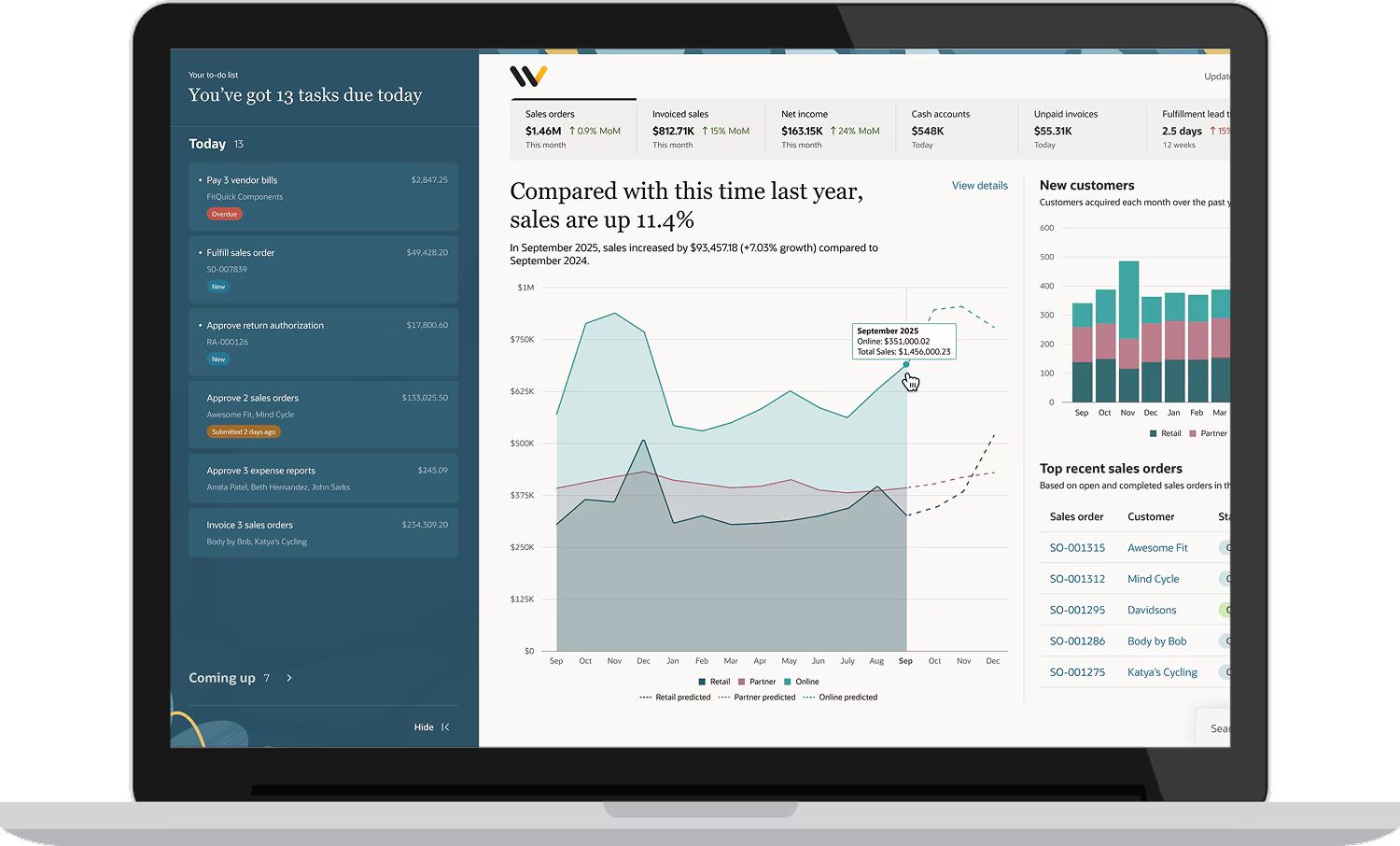
A successful fintech ERP system takes the consolidation and compliance reporting that once consumed a finance team and turns it into routine output. Most fintechs reach for one at a similar point in their growth, as FCA authorisation and multi-entity, multi-currency operations converge. And as embedded AI and Open Finance reshape what these platforms can do, ERP looks less like back-office plumbing and more like the infrastructure that fintech growth will run on.
See NetSuite for Financial Services in action here (opens in new tab)
ERP for the Fintech Sector FAQs
What are the seven stages of ERP implementation?
The seven stages of ERP implementation are software selection, implementation planning, software training, software testing, software deployment, user support and post-implementation review. For a regulated fintech, each stage should preserve continuous audit-trail integrity from the old system to the new one.
How much does an ERP cost for a fintech operation?
An ERP system’s cost depends on user count, the modules selected and implementation scope, so most vendors quote individually rather than publish list prices. Beyond the annual licence, fintechs should budget for implementation, data migration and training, which together often match or exceed the cost of the software.