
UK healthcare supply chains are under sustained pressure. Medicine supply disruptions remain a persistent problem, while fresh challenges keep arriving, from a centralised NHS buying model under scrutiny to changing post-Brexit rules for medicines and medical devices. For providers and suppliers in the middle, these stresses tend to show up as operational problems, such as delayed procedures or last-minute substitutions that could pose safety risks. Effective supply chain management provides a clearer view of the whole supply chain, helping organisations anticipate shortages, manage inventory and respond to disruptions before they affect care.
What Is Healthcare Supply Chain Management?
Healthcare supply chain management is the coordination of sourcing, buying, storing, moving and tracking the medicines, devices and consumables a healthcare organisation needs to treat patients. It connects manufacturers, distributors, procurement teams and clinical teams so the products they require are available where and when they are needed.
What separates a healthcare supply chain from those in other sectors is the stakes. A late delivery can mean a postponed operation or a substitution that carries additional clinical risk, both of which are more dire than a missed sales target. That double demand: cost control while protecting patient safety, is behind almost every decision a healthcare supply chain team makes.
Key Takeaways
- The NHS Supply Chain is a major procurement route in England, though trusts also use regional arrangements and direct purchasing, while private providers manage their own supply chains.
- Medicine supply disruptions are an ongoing concern, making forecasting, inventory control and resilience important parts of healthcare supply chain management.
- Healthcare procurement must navigate changing procurement rules, medical device requirements and NHS sustainability criteria, adding compliance considerations to the challenge.
- Fragmented systems and manual stock-keeping add administrative work for clinical staff and make it harder to see what an organisation holds, spends and uses.
- Connected systems, including ERP, give supply chain teams a shared view of stock, spend and demand: the foundation for better forecasting, standardisation and compliance.
Healthcare Futures: Tomorrow's Vision

Healthcare Supply Chain Management Explained
A healthcare supply chain is really several supply chains running at once. Consumables like gloves and dressings move in high volume and need steady replenishment. Pharmaceuticals follow a tighter path, with cold-chain storage for some, controlled-drug rules for others and strict expiry requirements for all. High-cost implants and stents may arrive on consignment for a named patient, get recorded during the procedure and are only paid for after use. If teams lose track of any of these goods, or their associated information at any time, the consequences can include expired stock, a missing item during an operation or difficulty identifying affected stock during a recall.
Managing supplies well involves more than just the purchase price. An implant that costs less upfront but leads to more revision surgery can cost more over its lifetime than a more expensive implant that lasts longer. Procurement teams therefore need to weigh clinical results and whole-life cost together. This also means supply chain and clinical teams must work from the same record of what was bought, what was used and the outcomes associated with those products. When that record is spread among separate systems, purchasing and stocking decisions may be based on incomplete information.
How Does the Healthcare Supply Chain Work in the UK?
In England, the NHS Supply Chain is a major national procurement route for medical equipment and consumables. It procures, warehouses and delivers products on behalf of NHS organisations, using a large, national catalogue to aggregate demand and negotiate with suppliers. But trusts can also buy through regional procurement arrangements or directly from suppliers, so NHS Supply Chain does not cover every NHS purchase.
This distinction is important because national buying power does not automatically produce the best results. NHS Supply Chain estimates that the NHS spends roughly £8 billion a year on medical equipment and consumables, yet the National Audit Office concluded in 2024 that the NHS Supply Chain was “not yet fulfilling [its] potential” and that its systems “do not work well for all its customers”.
Another difference: No single procurement system covers the whole UK. England, Scotland, Wales and Northern Ireland have separate health systems, while England NHS trusts use a mixture of national, regional and direct procurement routes. As a result, a supplier selling into the UK must work with multiple buying organisations, contracts and procurement requirements.
The private sector adds another layer of complexity. Independent providers deliver NHS-funded care under contract as well as treat private patients; in the year to August 2025, they delivered around 10% of NHS elective activity. Unlike NHS trusts, private providers are not part of the NHS Supply Chain operating model and typically manage their own procurement and inventory arrangements. Alongside them are manufacturers, distributors, wholesalers, pharmacies, care providers and other organisations that buy, store, move or use healthcare products. Each adds another point at which demand, stock, orders and compliance must be managed.
Why Is Healthcare Supply Chain Management Important?
The first reason is patient care. When the right medicine or device is unavailable when it is needed, treatment may suffer, a risk that a working supply chain would have removed. Supply chain shortages demonstrate how big the issue has become, having become a routine part of UK healthcare, with community pharmacy teams reporting out-of-stock medicines almost daily.
Cost is another reason. NHS finances are tight, while the large elective backlog creates substantial demand for planned treatment. For supply teams, the timing and mix of that activity can still be difficult to predict, and uncertainty can lead to rushed orders at premium prices or excess stock that later expires. Better supply chain management helps because with it comes better forecasting and tighter stock control. Teams can order closer to expected demand, while reducing excess inventory, meaning fewer products expire. For private providers and suppliers, controlling purchasing, inventory and waste also helps protect margins in a cost- and regulation-sensitive market.
Common Healthcare Supply Chain Management Challenges
Five supply chain management challenges come up repeatedly in UK healthcare. The following challenges range from problems with internal data and processes to external pressures, such as supplier disruption and regulatory change:
- Fragmented systems and data: Purchasing, finance and clinical areas may hold different parts of the inventory record, making it difficult to see stock throughout the organisation. Once stock reaches the wards, tracking can become less consistent, making it harder to answer questions about what is on hand or approaching expiry.
- Variable demand and inventory control: Without reliable consumption data, teams have less basis for setting reorder points and stock levels. This increases the risk of holding too much of some items and too little of others.
- Supply disruption and supplier concentration: When a critical product comes from only one or two manufacturers, a single factory fault or shipping delay can quickly become a wider supply problem. The frequency of reported disruptions is significant; suppliers submitted around 1,400 supply-issue notifications to DHSC in 2025, with manufacturing problems cited in 62% of them.
- Clinical time spent on inventory tasks: When tracking does not follow products into wards and theatres, clinical staff may have to count stock or enter product information manually. That adds administrative work to already busy clinical environments and can make inventory data less complete.
- Contract, compliance and product standardisation: Meeting procurement rules and proving product compliance takes constant work, and missing them can cost a tender or the right to sell a product. Standardising where clinically appropriate can reduce that complexity, but it requires clinical agreement and enough flexibility to maintain alternatives for critical products.
How ERP Helps Healthcare Providers Improve Supply Chain Performance
An ERP system connects the parts of an organisation that usually run on separate software, such as purchasing, inventory, finance and supplier management, into one shared system. For any healthcare organisation that runs its own supply chain, whether a private hospital group, a device distributor or a pharmacy chain, that shared data gives a team one current view of its whole supply chain, updated as stock moves and payments clear. From that, several specific improvements follow.
-
Create a Reliable View of Inventory, Spend and Demand
An ERP gives purchasing, stock and finance a shared set of item and supplier codes, so the same glove or implant can be identified the same way in purchasing, on the ward and in finance. As stock moves in and out and invoices are settled, those records update together, so on-hand quantities, committed spend and actual usage all read from the same current data. That shared, up-to-date data is what a supply chain team needs before they can trust the numbers enough to act on them.
-
Improve Demand Forecasting and Inventory Control
Because every unit issued to a ward or theatre is logged as it happens, an ERP builds a continuous, item-level record of demand that would be impractical to compile by hand. Forecasters can work from that history, factoring in trend, seasonality and known changes, such as a new service line or a planned increase in procedure volume. Linking replenishment to actual use can help reduce stockouts and the capital tied up in overstock.
-
Standardise Products and Processes with Clinical Teams
Standardising products means reducing product and supplier variation by agreeing on an approved range for each clinical use, such as a small set of approved wound dressings instead of a dozen ward-by-ward variants. Clinician support depends on comparing the options based on outcomes, safety, usability, resilience and cost. An ERP supplies some of that underlying data, including usage, contract pricing and supplier reliability. Once a range is determined, the ERP holds it as the approved catalogue and routes off-list orders for approval. It standardises processes the same way, applying one requisition, approval and replenishment workflow at every site. The same approval thresholds and audit trail are used everywhere, keeping the process consistent and auditable.
-
Automate Routine Procurement and Inventory Workflows
Because the ERP already holds the list of approved suppliers, contract prices, approval thresholds and reorder points, it can run procurement and inventory workflows without a person keying or checking each step. When stock in a location falls to its reorder point, the system raises a purchase order against the contracted supplier and price and sends it electronically to the right approver based on value or budget, escalating the need for attention if no one acts. On delivery, the ERP matches the goods receipt against the order and the supplier’s invoice automatically; anything that agrees within tolerance is cleared for payment while staff focus on mismatches and exceptions.
-
Strengthen Supplier, Contract and Sourcing Management
Every order, receipt and invoice an ERP processes is tied to a supplier and a contract, turning routine transactions into a performance record. From that record it measures how often each supplier delivers on time and in full, and it flags invoices priced above the agreed contract or placed outside it. Because the system also totals spend and volume by supplier and by item, it shows how much of a critical product depends on a single source: exposure that turns one supplier’s problem into a shortage.
-
Build Resilience and Agility into Supply Plans
Resilience depends on seeing potential supply disruptions early enough to respond. An ERP can track stock, incoming orders, demand and supplier lead times to show how much cover remains and to flag when it starts to fall. Because approved alternative suppliers are already recorded against the item, a switch can be made without starting the approval process from scratch during a disruption. For companies supplying both Great Britain and Northern Ireland, the same principle applies to product approvals: Recording each item’s approval status by market can help highlight when an approval is due to lapse in one market.
-
Optimise Distribution and Measure Outcomes
Because the ERP knows what stock sits where and what each site is using, it can support distribution decisions based on actual demand, rather than each location ordering independently. It can also measure the results against metrics such as cost per delivery, order fill rates and stockouts, giving teams a consistent way to track whether distribution is improving. Where it connects with relevant systems, the ERP can also provide data for emissions and social-value reporting required by NHS contracts.
5 Ways to Improve Healthcare Supply Chain Performance
The following five practical actions can help healthcare organisations improve supply chain performance:
- Establish a single inventory or spend view: Unite all purchasing, finance and stock data in one system that combines central stores, wards and theatres. Reconcile duplicate or mismatched item codes so the same products are recorded consistently.
- Improve demand forecasting: Set reorder points using consumption history, then adjust them for trends, seasonality and known changes in clinical activity, such as a new service line or planned increase in procedures. Review those levels regularly as usage changes.
- Standardise products and processes with clinicians: Bring supply chain and clinical leads together to agree on an approved product range and common ordering process based on usage, cost and outcome evidence. Make both the default for all sites, with exceptions requiring clinical or supply-chain approval.
- Monitor suppliers and develop contingencies: Track delivery and invoice performance and identify critical items that rely on a single supplier. Approve an alternative product or supplier for those items before a disruption occurs.
- Automate procure-to-pay, approvals and replenishment: Start with high-volume, rules-based tasks, defining reorder points, approval thresholds and preferred suppliers the system should use. Automate those workflows first, with staff handling exceptions that fall outside the rules.
The Role of Technology in a More Resilient Supply Chain
Resilience is easier to talk about than to build. Technology helps by strengthening three practical capabilities: capturing what is happening, connecting that data between workflows and using it to anticipate what comes next.
Barcode/RFID and Mobile Capture
Scanning is how a supply chain keeps sight of stock once it leaves the loading bay. In England, the NHS’s Scan4Safety programme has driven adoption of GS1 standards, which provide unique identifiers for products, locations and other entities in the supply chain. But adoption is not yet universal, with GS1 UK reporting that around 60% of hospitals use GS1 standards for inventory management and 45% scan at the point of care. The original Scan4Safety demonstrators also reported releasing roughly 140,000 hours of clinical time by reducing manual stock tasks. Barcode and RFID capture also supports recall management and expiry tracking, because products can only be identified and removed quickly if their locations are known.
Integrated Workflows
Scanning creates value only if the data reaches the systems that need it. Integrated workflows connect stock capture to purchasing, inventory, and, where appropriate, clinical systems, so a scan can update stock records and feed downstream processes, such as replenishment, billing or product traceability. The same connected data can also support newer procurement requirements, including carbon reporting and social-value commitments.
Analytics and Responsible AI-Assisted Forecasting
Analytics turn captured data into patterns and signal that teams can use to anticipate demand, identify risk and improve forecasts. AI-assisted forecasting can enhance this by identifying intermittent and seasonal demand patterns that simple averages miss. Because forecasts inform decisions about stock and availability, human oversight and reliable source data matter more than automation for its own sake. Used with that discipline, AI supports the people making supply decisions rather than replacing their judgement.
Optimise Your Healthcare Supply Chain with NetSuite
For healthcare organisations looking to connect procurement, inventory and financial operations, NetSuite Healthcare ERP & Management Software provides a unified cloud platform covering finance, procurement, inventory, supply chain, analytics and other areas. Its healthcare offering includes demand and supply planning, procure-to-pay workflows, supplier management, contract compliance and inventory replenishment, giving teams a way to work from connected operational and financial data.
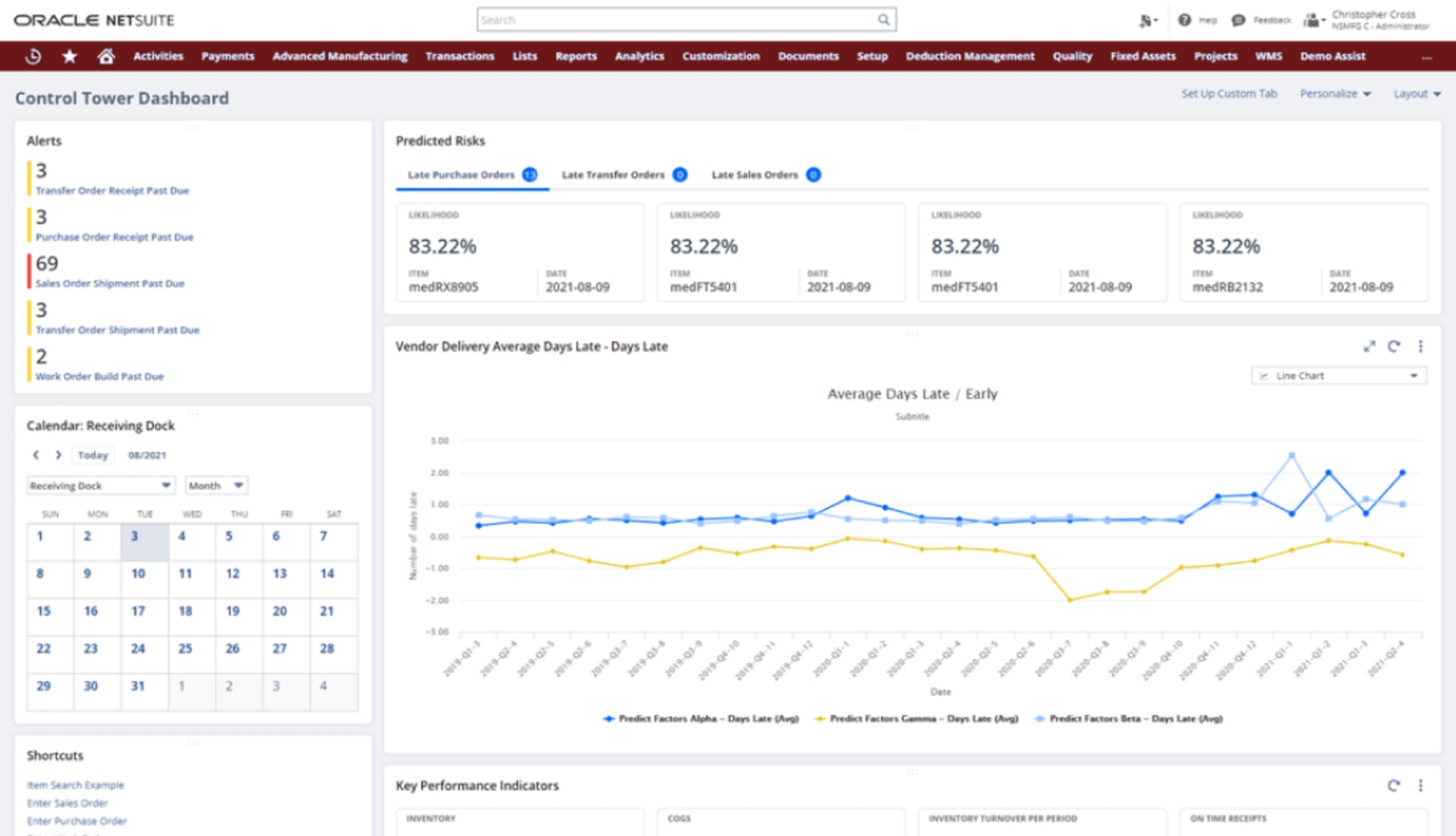
Meanwhile, NetSuite Supply Chain Management incorporates capabilities such as supply planning, inventory management and predictive analytics, with real-time updates for inventory, orders and financial information. For organisations assessing an ERP for healthcare supply-chain management, the relevant question is less whether a system can automate individual tasks and more whether it can connect the data and workflows those tasks depend on.
NetSuite Supply Chain Management Dashboard
Healthcare supply chain management is a place where cost control and patient safety meet, and in the UK, it operates under a complex mix of pressures, from fragmented procurement routes and medicine supply disruption to changing regulation. Organisations that cope best can see their supply chain clearly: what they hold, what they spend, which suppliers deliver and where the risks are. That visibility gives teams a stronger basis for forecasting, standardisation, resilience and compliance, while connected systems provide the data and workflows needed to act on it.
Healthcare Supply Chain Management FAQs
How does an NHS supply chain work?
NHS Supply Chain is a major national procurement route for NHS organisations in England. It procures, warehouses and delivers medical equipment, consumables and other product categories using aggregated demand to negotiate with suppliers. Trusts can also buy through regional procurement arrangements or directly from suppliers, so the NHS Supply Chain does not cover every NHS purchase. Scotland, Wales and Northern Ireland have their own health systems and procurement arrangements.
What are the 7 C's of supply chain management?
There’s no single, universally agreed definition of the “7 C’s”. The framework is used as a memory aid in logistics and supply chain management, with different sources using different terms. One commonly cited version is “connect, create, customise, coordinate, consolidate, collaborate and contribute”, while other versions include terms such as “control”. The underlying idea is that effective supply chains depend on coordination, collaboration, responsiveness and continuous improvement.
What is a supply chain in healthcare?
A healthcare supply chain is the network of manufacturers, distributors, providers and clinical teams, along with the systems and processes used to move medicines, devices and consumables to the point of care. It typically involves several parallel flows, such as pharmaceuticals, general consumables and high-cost items like implants, each with its own handling, storage and regulatory requirements.
What is the focus of the healthcare supply chain?
The focus is to keep the products needed for patient care available where and when they are needed, while controlling costs and protecting quality and safety. In practice, supply chain teams must balance purchasing costs, product availability, clinical requirements and patient outcomes rather than optimising any one measure in isolation.
What are the benefits of supply chain management in healthcare?
Effective supply chain management helps keep essential products available, reduce waste and emergency purchasing and improve resilience to supply disruption. It also supports regulatory compliance and reporting, while reducing the administrative burden of inventory tasks on clinical staff.