
A financial firm’s customer records may sit in a dozen different systems, some older than the people maintaining them. Keeping that data accurate and current is hard enough. But regulators and customers also expect it to be traceable, and AI initiatives need it to be high quality and well structured. Firms can’t afford to fall short, because poor data can lead to flawed products and significant regulatory action. This article takes a closer look at what data governance in financial services involves and how UK firms are getting it right.
What Is Data Governance in Financial Services?
Data governance in financial services refers to the rules and accountability structures that determine how a firm manages its data. It establishes operational standards around data and specifies who owns each data set.
Technology increasingly enforces those standards and keeps owners accountable, because no team can manually check the volume of data feeding financial systems. This matters even more for AI in financial services, which depends on governed, traceable data to make sound decisions.
Key Takeaways
- Financial services firms were early adopters of data governance, having realised that poor data can create flaws in digital products and undermine risk assessments.
- Data governance sets data management policies and standards and establishes accountability over data sets.
- Many financial services companies task a chief data officer (CDO) to lead data governance initiatives.
- UK financial services firms should assign clear ownership and accountability for critical data, with responsibilities aligned to relevant governance and regulatory frameworks.
- Firms generally make more progress on data governance by sequencing it around specific business and compliance priorities.
Data Governance in Financial Services Explained
Financial services were among the first to formalise data governance, and the discipline’s value helped it spread to other industries. Banks created the first chief data officer (CDO) roles in the early 2000s, recognising that in financial services, data is often the product itself. A manufacturer with bad inventory data still has physical products on the shelf, but in financial services, the record and the asset are the same thing. An incorrect interest rate or account balance changes the product.
The 2008 financial crisis reinforced this lesson. Risk data trapped in disconnected systems left some institutions unable to calculate their own exposure when they needed it most, which prompted significant regulatory action. In the UK, the Prudential Regulation Authority (PRA) incorporated the Basel Committee’s international standards for risk data into its supervisory expectations for major banks. Institutions also realised that the root causes of their risk-data failures (weak and inconsistent data ownership and definitions) affected all their data. These factors pushed enterprise-wide data governance into the financial services mainstream.
Data governance sits at the centre of data management, which covers how a firm collects, stores, moves, secures and uses its data. Governance sets quality standards and ownership rules for data sets, and it usually works like other risk management functions.
A governance team led by a CDO, often based in or reporting to risk and compliance departments, sets standards and checks that they are met. The business units that create and use a data set own it day to day and must follow those standards. Internal audits periodically test whether the data governance framework holds up in practice and reports results directly to the board. For firms subject to the Senior Managers Regime, significant data governance responsibilities may be aligned with existing senior-management accountability structures, helping make ownership and escalation paths clear.
Why Data Governance Matters for UK Financial Services Firms
Data governance enables UK financial services firms to navigate regulatory requirements while meeting shareholder and customer expectations. Five pressures are driving institutions to invest in well-governed data management:
- Regulatory confidence: Regulators increasingly judge financial services firms by the outcomes they can prove. That standard applies everywhere a supervisor asks a question, from a standard information request to scrutinising a new AI model. A firm with well-governed data can produce that evidence quickly and confidently.
- Trusted customer and financial data: The Consumer Duty requires firms to evidence good outcomes in four areas: products and services, price and value, consumer understanding and consumer support. Meeting that bar depends on accurate, consistently defined data.
- AI and analytics readiness: Well-governed data makes AI in financial services more reliable, both in what feeds a model and in what an agent does with its output. It also reduces the time required to clean and reconcile data before a new AI product can get out of the starting blocks.
- Risk reporting and resilience: Data governance keeps a current, accurate record of what data a firm holds, who owns it, and how it connects to the systems and services built on it. That same record can help a supervisor verify a reported risk figure and, for firms subject to operational-resilience requirements, help the firm identify which important business services and customers a disruption could affect.
- Customer trust: Customers trust financial institutions that reliably get transactions right and protect them from fraud. AI-driven safeguards can catch mistakes or fraudulent payments before transactions clear, provided the tools use current, consistently checked data, which is what data governance does.
Governable Data Types in Financial Services
Most governance programmes start with customer records, but their scope is much wider, including the following seven types of data:
- Customer and PII data: This covers customer profile information and identity records, Know Your Customer (KYC) documentation, vulnerability flags and consent preferences. While firms usually capture personally identifiable information (PII) at the start of a relationship, they often struggle to keep it current as a customer’s circumstances change.
- Transaction and account data: This includes payments, balances, transaction histories and the fraud and anti-money laundering (AML) signals built from them. Governing it is critical now that open banking moves much of this data outside the firm in real time.
- Market and reference data: This data feeds many calculations within financial services firms and their partner organisations, so errors can ripple quickly. Data includes prices, rates, legal entity identifiers and counterparty hierarchies used for valuations and capital calculations.
- Risk, compliance and audit data: Regulators expect firms to uphold risk aggregations, regulatory returns and the evidence trails behind testing controls and handling complaints. Major UK banks must adhere to the Basel Committee on Banking Supervision (BCBS) 239 standard for accuracy, completeness and timeliness of this data.
- Communications and unstructured documents: Generative AI can now analyse content that used to sit untouched in its archives, which makes this category increasingly important to govern. It includes emails, recorded calls and messaging platforms such as WhatsApp and Teams, some of which the Financial Conduct Authority (FCA) requires firms to record under SYSC 10A.
- Product, pricing and policy data: Under the Consumer Duty’s fair value outcome, a firm must be able to reconstruct exactly how it set a price for a given customer. It covers fee schedules, eligibility rules and pricing algorithm inputs, so all need a full version history of what changed and when.
- Model, AI and metadata assets: Model inventories, training data, prompts and the decision logs an AI system produces require formal governance. UK banks with internal model approval already maintain that kind of inventory under PRA rules, and generative AI and AI agents stretch the expectation onto training data and runtime context.
8 Data Governance Capabilities Financial Firms Need
Knowing what data needs governing is only the first step. Financial firms also need the operational capabilities and technology to apply governance consistently across systems, teams and data flows. Here’s how that looks across eight important governance domains.
Data Ownership and Stewardship
Every critical data domain needs a named business owner with real authority over definitions, quality thresholds and access decisions, backed by stewards who handle the daily work. Under SYSC 10A, the FCA requires firms to record any communication (including those on Teams or WhatsApp) that relates to the reception, transmission or execution of client orders.
Data Quality Management
Quality management means setting measurable thresholds for each data domain and validating data as it enters the system. Automated checks and anomaly detection can discover a threshold breach immediately; the moment it happens. That speed matters because recent UK enforcement cases have focused on weaknesses firms already knew about but had failed to address, rather than problems they had not previously identified. In fact, according to a Chartered Institute of Internal Auditors (CIIA) study, more than 54% of all FCA fines between 2021 and 2025 (exceeding £1 billion in total penalties) stemmed directly from basic failures in internal controls.
Data Catalogue and Metadata Management
A catalogue gives a consolidated, living inventory of its data assets, business glossary terms, classifications and ownership. AI-assisted scanning tools can discover a new source, read its structure, and draft the business definition and classification for a steward to confirm, reducing tasks from days to minutes for analysts. For AI systems, the data catalogue must also stretch to cover models and training data sets.
Data Lineage and Traceability
Lineage lets a firm trace any number back to its source, whether it comes from a regulatory return or an AI model’s output. Automated tools can build that trail in real time by tagging and tracking each step as data moves or gets transformed. This turns a firm’s data handling methods into evidence it can show a regulator.
Role-Based Access and Privacy Controls
Least-privilege access, purpose-based controls and anomaly monitoring limit how much damage a single compromised account or employee mistake can do, since nobody has access to more data than their role requires. That typically relies on identity and access management systems to enforce permissions, data masking or tokenisation to limit exposure of sensitive fields, and AI-driven behavioural monitoring that learns a user’s typical access patterns and identifies deviations for review.
Regulatory Reporting Readiness
Firms should be able to evidence the data sources, definitions and calculations behind figures in regulatory returns. If definition disputes surface close to a deadline, they can delay filings or introduce errors. Readiness means a firm can certify its data sources, align finance and risk definitions, and regenerate a return with evidence. By mapping each critical data element to the reports it feeds, definitions and lineage are settled well before a return is due. AI can also warn when a data element’s definition drifts from what a report expects, so it doesn’t resurface as a reconciliation break at filing time.
Integration, APIs and Data Pipelines
Data frequently moves between systems, and every hop through an integration, pipeline or API increases the risk it arrives corrupted, incomplete or with context stripped. That calls for validating data contracts between systems automatically at each step, plus AI-based monitoring that learns a pipeline’s patterns well enough to catch a broken contract or schema drift before it corrupts data downstream.
AI Governance and Model Oversight
Every financial services data governance programme must keep an inventory of every AI model and use case, tiering them by risk. Agentic AI is already enabling a shift from assistance to delegation, with systems taking on longer, more autonomous tasks, which makes inventory and tiering work more urgent. Meaningful oversight also depends on tools that signal when a model’s predictions drift from its training and a validation process that tests a model before and after deployment. For agentic AI in financial services acting within a workflow, that oversight increasingly means reviewing the data and reasoning behind a decision before the agent acts on it.
Finance Futures: Tomorrow’s Vision

UK Compliance and Risk Considerations for Data Governance
Financial firms sit under a dense and specific set of regulatory expectations, and 90% of financial services firms globally say the demands have grown more complex. Among a broader set of financial services industry trends reshaping the sector, compliance and risk are crucial, and most trace to the same question: Can a firm prove what it did with its data?
UK GDPR and Data Protection Act 2018
UK GDPR and the Data Protection Act 2018 set the legal baseline for how firms collect, use, process and protect personal data. For data governance teams, that means every data set containing personal information needs a documented lawful basis and a named owner accountable for upholding the consumer’s rights. The Data (Use and Access) Act 2025 added new powers for government-backed data sharing schemes, expanding what governance teams need to track.
FCA Consumer Duty
The Consumer Duty requires firms to monitor whether customers get good outcomes and to act when the evidence says they aren’t. Firms struggle most with this for customers in vulnerable circumstances, since they must first identify those customers before they can monitor anything. Signs of vulnerability are often buried in free-text notes that can be difficult to query in a large data set.
FCA/PRA Operational Resilience
UK operational resilience rules require firms in scope to identify their important business services where disruption would cause significant harm to customers or markets, and to prove they can keep each one running within an agreed tolerance. FCA and PRA rules require firms in scope to map the people, technology and information behind each essential service in detail. That mapping works only if a firm knows which data supports which service and often which cloud provider that data sits with.
AML/KYC and Financial Crime Controls
AML rules require firms to run KYC checks at customer onboarding and keep that data current as circumstances change, which are equally data governance and compliance problems. A system must identify when a customer’s risk profile shifts, whether through an unusual transaction pattern or a change in business activity, and initiate a recheck before a scheduled review.
Risk Data Aggregation and Reporting
BCBS 239 requires major UK banks to aggregate risk data accurately, completely and quickly enough to produce a reliable number when a regulator or the board asks. Hitting that bar depends on data governance capabilities that know the source of every risk figure and can pull it together fast. That means moving toward AI-driven continuous aggregation that can keep pace with markets and fraud patterns that shift in real time.
Third-Party and Cloud Risk
UK outsourcing rules require firms to manage the risk of external suppliers that handle critical functions, including cloud providers that hold or process a company’s sensitive data. For data governance, that means maintaining a clear inventory of which data sets sit with which supplier, under what classification and the exit plan if that relationship ends. Many firms focus on the supplier contract; the inventory is the harder, more important part to get right.
AI Accountability and Explainability
The FCA’s July 2026 Mills Review examined ways AI could reshape retail financial services by 2030, naming amplified fraud and cyber-risk as one of four key shifts to watch. The UK’s approach leans on existing law and supervisory pressure instead of creating new AI-specific rules. Firms should be prepared to explain how material AI-supported decisions are reached, particularly where those decisions affect customers, risk management or regulatory outcomes.
Common Data Governance Challenges in Financial Services
A global study of banks found 45% still lack effective data governance, and 41% don’t have a centralised or optimised data infrastructure, a reminder that even the industry that catalysed the discipline is still figuring out how to perfect it. Set against a backdrop of broader challenges to the financial services industry, firms face an assortment of common problems as they endeavour to improve their governance practices.
Data Silos
Many UK high street banks run multiple financial platforms accumulated through decades of mergers and product launches. Governance becomes a challenge when nobody can confidently say which system holds the current, authoritative record for a given customer. Master data management can reconcile and join those records, so an address update or a closed account in one platform reaches all others.
Poor Data Quality
Poor data quality is a symptom of weak governance and the likely cause of future governance problems. Without appropriate structured data validation or ongoing review mechanisms, data quality can drift. And once a model or a report is built on that drifted data, the error spreads into every decision that follows. Correcting low-quality records early costs far less than catching them after they’ve fed a regulatory return or a risk model.
Legacy Systems and Technical Debt
Older core banking platforms often lack field-level lineage and fine-grained access control, and many can’t expose data in real time. Carrying that technical debt makes a cloud migration or open-finance obligation a painful and costly retrofitting process. Building lineage and other data governance controls into a new pipeline may seem daunting, but they cost far less than the accumulated retrofits.
Unclear Ownership
When financial services data sets don’t have a single person or team accountable for keeping them accurate and controlling who can access them, problems are hard to catch and fix. AI makes unclear ownership even more complicated and the consequences harder to manage. Almost half of financial services leaders globally say siloed or unclear data ownership is the single biggest obstacle to AI expansion.
Shadow Data and Unstructured Communications
Financial services teams routinely create and access large volumes of unstructured, ungoverned data that falls outside catalogued systems and leaves few audit trails. Unstructured communications pose a particular challenge for data governance teams, as employees increasingly use collaboration channels that UK regulators require firms to record and retain.
Regulatory Complexity
Regulatory regimes often don’t share a common definition of the data they govern, so data governance teams often need to maintain parallel mappings of the same data set. A customer’s risk profile, for example, might be subject to one retention requirement under AML rules and, for firms within the operational-resilience regime, different controls where that data supports an important business service.
Skills and Data Literacy Gaps
Data management teams must combine financial product knowledge with technical fluency in data and AI, a mix that’s hard to hire for. The Financial Services Skills Commission’s 2026 Annual Skills Report found that the UK’s three largest skills gaps are in machine learning and AI, data analysis, and digital literacy, with demand exceeding supply by 16% to 28%. The shortage lands hard on governance, which needs people who understand the regulatory context and the underlying technical systems.
Discover why Financial Services businesses choose NetSuite
How to Build a Data Governance Framework for Financial Services in 7 Steps
Building a framework from scratch can feel daunting, but the following seven steps can provide some level ground to start incrementally:
- Prioritise business and compliance use cases. Don’t try to govern every data set at once. Start with the outcomes that matter most, whether that’s meeting a Consumer Duty deadline or building an AI use case on trustworthy data, and make them pilots for broader rollouts.
- Inventory and classify critical data assets. Firms can’t govern what they haven’t found. Map where customer, risk and product data live, and label data sets that carry the most regulatory weight.
- Assign data owners and stewards. Every inventoried data domain needs a named owner with real authority and stewards who carry out the daily work. Stewards apply the governance standards, while the owner answers for outcomes when something goes wrong.
- Define data quality, lineage and metadata standards. Set quality thresholds for every data domain and require each new data product to document its sources, so teams can trace its lineage. Metadata standards add a shared glossary so that everyone works from the same definitions.
- Embed access controls, privacy and security requirements. Data governance aims to make data easy to find and use, but its priority is keeping that data protected and traceable. Ideally, access decisions and privacy rules are built into systems and pipelines from the start, not bolted on as a separate compliance layer.
- Automate monitoring, reporting and exception management. Manual data quality and access checks can’t keep pace with a financial firm’s daily transaction volume. Automate checks that catch quality issues and access anomalies as they occur, then route each exception to the right team to resolve.
- Connect governance to AI, analytics and decision-making. AI models, analytics tools and the systems that turn data into decisions must meet the same ownership, quality and access standards as the rest of the catalogue. Firms can enforce that through system integration and oversight, such as certifying data sources, or through process requirements, such as verifying a new model before deployment.
Turning Data Governance into Business Value
Well-executed data governance can create significant value for UK firms and gives boards a stronger business case for investment. These benefits will resonate with C-suite leaders:
- Better regulatory reporting: Certified sources and full lineage make it quicker to answer regulators’ questions and reduce the likelihood of resubmitting a return.
- More trusted analytics: When definitions are clear and quality gets measured continuously, analysts spend less time reconciling numbers and more time acting on them.
- Improved customer experience: Unifying customer data supports consistent treatment between channels and makes it possible to spot a vulnerability earlier, both of which the Consumer Duty requires.
- Faster AI adoption: Governed data is the difference-maker for confidently moving more AI projects out of pilot mode and into higher-risk, customer-facing use cases.
- Lower operational risk: Knowing which data sits with which provider (and why) can help a firm respond quickly to a supplier outage instead of finding out later which data was potentially exposed.
- Stronger decision-making: Executives spend less time debating whether a number is correct when there’s only one version of each figure.
See NetSuite for Financial Services in action here. (opens in new tab)
Build a Trusted Data Foundation with NetSuite
Governing data in separate systems, spreadsheets and legacy platforms takes more manual effort than most finance teams can sustain. NetSuite ERP Software for Financial Services brings financial, operational and customer data into one connected platform, giving firms a single place to enforce data ownership, quality standards and access controls. Built-in AI, through capabilities such as anomaly detection and narrative reporting, helps teams spot data quality issues and unusual patterns before they become regulatory problems. For firms trying to build the kind of evidence trail regulators now expect, starting from one connected data foundation makes that far more achievable than stitching it together after the fact.
NetSuite ERP’s Compliance Dashboard
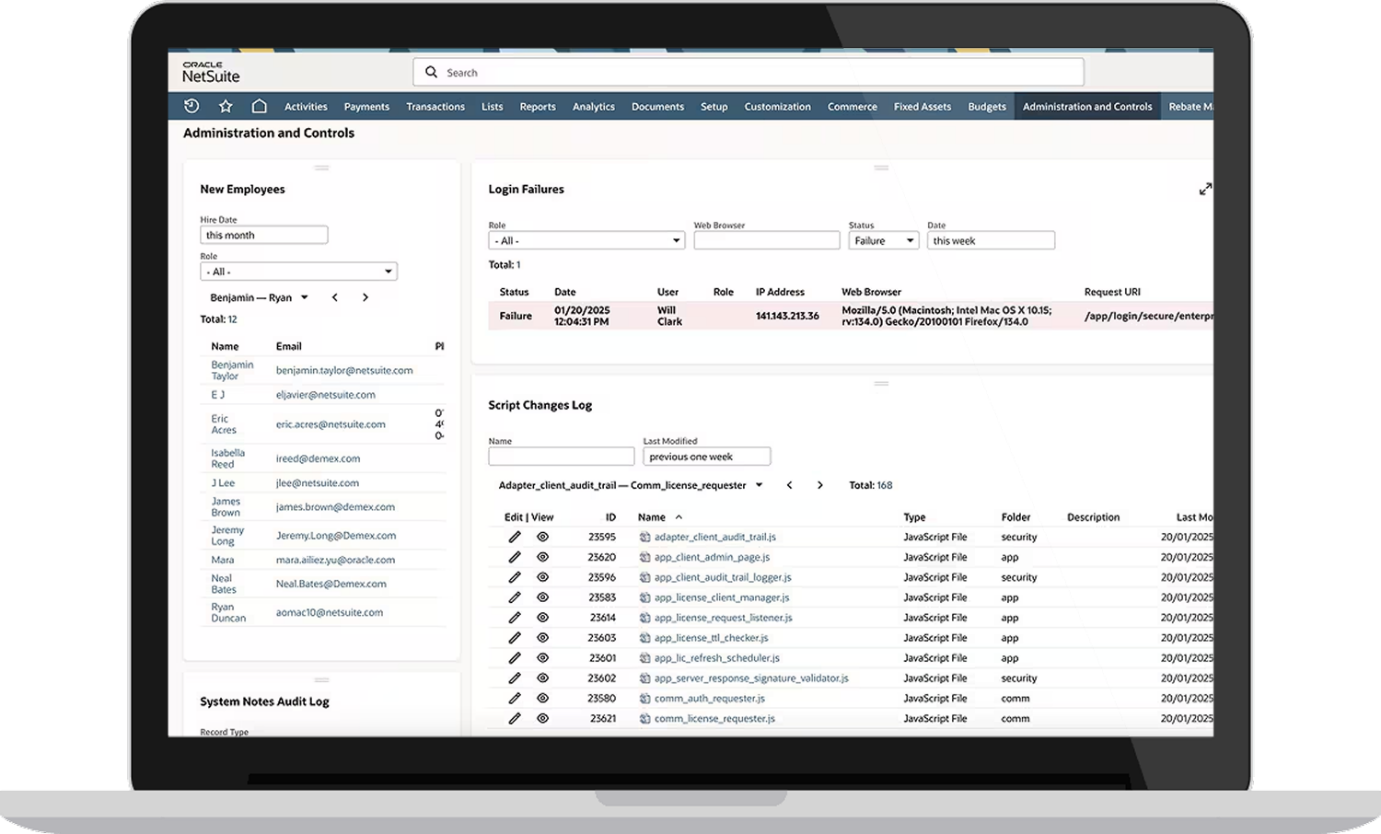
Even the industry that helped to pioneer data governance is still only halfway to making it an industry standard. That’s a sign of how hard data governance work really is. Firms that address legacy systems and scattered ownership can see concrete returns, from faster AI adoption to audits that no longer consume months of staff time.
Data Governance Financial Services FAQs
What is data governance in financial services?
Data governance is the set of practices and technology financial institutions use to assign data ownership and enforce quality and access standards. Without it, a firm can’t prove what happened with its data or trust the data feeding its AI systems.
What are the 4 pillars of data governance?
The four pillars are data quality, stewardship, protection and compliance, and data management. Quality and stewardship cover whether data can be trusted and who’s accountable for it. Protection and compliance cover the rules it follows. And data management covers the practical work of storing and moving it.
Why is data governance important for AI in financial services?
An AI model is only as trustworthy as the data behind it. Poor governance means a firm can’t explain how a model reached a decision, a serious problem when a model makes recommendations or takes actions that affect real customers.
Who is responsible for data governance in a financial services firm?
Typically, a chief data officer leads the framework and standards, while business owners are accountable for the data they create and use, and risk or security teams oversee relevant controls. Firms should also make sure significant data responsibilities have clear senior-level accountability and escalation paths.
How does data governance support compliance?
Regulators demand compliance reporting be built on trustworthy data. Data governance helps make sure that the data used is complete, accurate and formatted according to the requirements.