
If you’re just beginning to consider adopting an ERP system, one of your first questions is likely how this software can help your business. An ERP system serves as a central database for your entire company, offering valuable reporting potential and numerous ways to increase productivity and lower costs across your organisation.
Those are a few of the key reasons to invest in ERP, but we’re here to help you understand what this technology can do for a business like yours. What capabilities will this system give your business that it doesn’t currently have? How will the technology lower costs and facilitate growth? We’re here to help by breaking down 15 advantages ERP can provide for your business in detail.
15 Benefits and Advantages of ERP
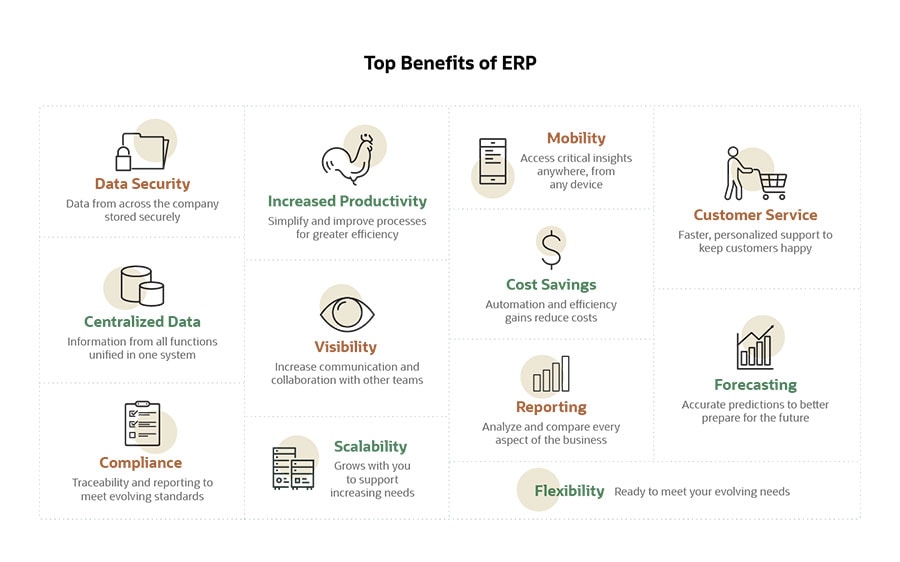
While the concept behind an ERP system is straightforward — unifying all departments and their information on a single system — the benefits are vast. Here are 15 of the most notable advantages an ERP system offers:
-
Data Security
Data has become a prized possession for businesses because it’s so critical to making the best possible decisions, and ERP software can help protect that asset. The fact that all this data is in one place, rather than spread across multiple systems with varying levels of security, increases the level of protection. It replaces spreadsheets and other documents sitting on employees’ desktops and being passed around via email. With a cloud ERP system, your information is typically distributed across multiple remote servers to establish redundancies and protect against a single point of failure, adding another layer of security. This is especially important if your company handles a lot of sensitive customer data.
In another sense, an ERP system can increase data security by limiting who can view and edit data. Most systems have permissions that are easy to control, ensuring employees only see the information they need to and reducing opportunities for fraud or other nefarious activities.
-
Standardised/Centralised Data
Much of the value of ERP can be traced back to the fact that all information from different departments is stored in one place. Without such a system, data is often spread far and wide across an organisation in various applications and spreadsheets, making it harder for staff to track down whatever it is they need. Additionally, this approach often results in duplicate data in inconsistent formats, posing more challenges.
An ERP system can help with that, too, by standardising all your critical data. Since it’s all in one system, everything will be in the same format so you don’t run into issues when running reports or analytics. Standardised information allows you to get all the insights you need to make more informed decisions that help the business save as much time and money as possible.
-
Compliance
Having accurate, up-to-date records that are easy to find and searchable can really reduce the work required to comply with any regulations your company must adhere to. Customisable reporting tools within the software also make it far easier to track compliance and adjust as necessary. This makes you much more auditable, as well, because all the information an auditor might need to review is easily accessible.
Certain ERP systems can even support specific financial standards like GAAP or regulations like the Sarbanes-Oxley Act (SOX). The best solutions will also update to reflect any changes to these regulations so you remain compliant. Staying compliant can quickly become difficult, especially if you’re in a highly regulated industry, but ERP makes it much more feasible.
-
Increased Productivity
There are countless ways an ERP system can give a major boost to productivity. One way is that it automates many basic, repetitive tasks, freeing up employees to work on other projects that bring more value to the organisation. It can also allow them to complete a variety of tasks faster by making processes more straightforward and reducing the time spent searching for the information they need. Since employees have visibility into the entire company, they don’t have to ask around for a specific set of data or details on how certain processes work.
Greater productivity also means you don’t have to add to headcount as much as would be necessary without an ERP platform. By removing a significant amount of work from the plates of employees, they can then take on new tasks and focus on projects that use their true skills and expertise.
-
Visibility
Visibility is another one of the broad, fundamental benefits of ERP — everyone having visibility into various aspects of the business is a powerful thing. It enables faster and better decisions because managers have all relevant context that can assist them. For example, if the purchasing team can see the status of in-transit purchase orders that have not yet reached the warehouse, they can factor that into the orders they’re about to submit to avoid excess or insufficient stock.
Visibility into the status of processes and data managed by other teams ultimately helps all teams and individual contributors do their jobs better. It also eliminates the time and effort spent trying to simply find this information.
-
Scalability
The beauty of leading ERP systems is that you can use the functionality you need now while leaving the door open to add more capabilities down the road. In that sense, the system can scale with your business as it grows and evolves. You can also add new users as your teams grow. There’s no need to get a new ERP solution just because your business has changed — even in big ways — since you implemented the existing system.
If your business has rapid growth plans, a cloud ERP system will provide the most scalability. Since cloud systems run on remote servers, it’s a cinch to add the extra resources needed to keep the solution running smoothly — far easier than handling that yourself. That reduces the work put on IT and can eliminate the need to hire a team of technical experts.
-
Mobility
Employees have become very comfortable using smartphones and tablets instead of computers to complete many tasks, and in light of that trend, today’s ERP systems are mobile-friendly. Since users access cloud systems through the web, they can pull up all the dashboards, reports and other information they need to see in a mobile browser. Many vendors now have mobile apps, as well, that can provide a better user experience on smaller screens.
For some companies, mobility is not just a nice-to-have but a need-to-have. They may have workers in the field or employees who travel frequently and must be able to see an up-to-date view of their business from devices other than a computer. These employees can also take care of critical tasks like approvals and monitoring cash flow (AR and AP) when they have a mobile-friendly ERP solution.
-
Cost Savings
For business owners and leaders, the most convincing reason to buy an ERP system is that it lowers overall costs, often in a big way. The automation we’ve already discussed can reduce or even wipe out many administrative and operational costs. Manual data entry or processes that require long paper trails, for instance, are often eliminated with this software.
All the insights this software can provide mean ample opportunity for other cost savings. The ability to monitor the pulse of your organisation in one place means you can quickly identify the source of higher expenses, which makes it much easier to reduce costs. Additionally, the improvements to planning that an ERP system enables should prevent rush orders, over-production or over-ordering, all of which can drive up costs. There are countless ways an ERP system can reduce your costs, which is why these solutions often have a fast ROI.
-
Organised Workflows
As you go through an ERP implementation, it’s a good idea to work with an expert on your system to evaluate processes and determine if there’s a better way to complete that task in the new system. Often, work is done a certain way because that’s how it’s been done for years, not because it’s the best option. So an ERP can help in that way, cutting out steps and making other improvements to make it faster and easier to get things done.
Much like an ERP standardises data, it also standardise workflows. The way one department handles a certain process may differ from that of another department. Even two employees within the AP department may not follow the same steps to make payments, for example. An ERP system should eradicate those discrepancies, ensuring everyone is following the same best practices.
-
Real-time Reporting
Reporting is without question one of the biggest and most immediate benefits of using an ERP system. The possibilities are endless with the ability to customise reporting across all functions — finance, inventory, orders, procurement, sales and marketing, HR and anything else you can dream up. Whatever you want to measure, or whatever KPIs matter most to your company, an ERP solution can calculate it. You can not only track the performance of different components of the business, but also compare departments to understand what’s driving the business forward and what’s holding it back.
It’s essential that your report reflects the latest data, and that’s why real time is so important. If it takes two weeks to receive revenue numbers from the last quarter, that’s not very useful because the information is already outdated and may not be relevant. But if revenue totals update in real time, as each sale happens, you can immediately use it to inform decision-making. This has become critical in today’s fast-paced, hyper-competitive environment.
-
Operational Efficiency
An ERP solution increases efficiency across your organisation since it touches every piece of the business. Everyone from recruiters to warehouse managers to C-level executives should see improvements that help them thanks to greater automation and availability of information. Processes become less time-intensive, which often benefits not just the company, but customers as well. That can reduce operating costs in a big way and generate higher profits.
Consider a manufacturer that makes 10 products and has an average profit margin of 20%. With an ERP system, it can easily spot its least profitable products, then work through the data to find that labour costs are much higher for the two items with the lowest margins. After talking to staff, the company discovers that most of the work that goes into making those items is manual and time-consuming. So the manufacturer decides to purchase a piece of machinery that can automate the production of those goods and sees its average profit margin climb to 25%. Just like that, the ERP software has saved the business hundreds of thousands of dollars annually.
-
Better Customer Service
Just about every business is competing with other businesses for the same customers. That’s why the customer experience is so crucial, and much of that is shaped by the level of customer service a company can provide. An ERP helps companies step up their service because it puts all customer information, from contact details to order history to support cases, in one place. That facilitates faster solutions and a more personalised experience when customers do need assistance.
And an ERP system can improve your level of service in another way: more accurate inventory and order information mean customers will almost always receive the right items and orders arrive on time. Limiting those issues will keep your customers happy and increase the chances they turn into repeat buyers.
-
Collaboration
So many of the benefits we’ve already covered here facilitate collaboration. Visibility into the way other teams work and what information they’re looking at makes it far easier to work hand-in-hand and for staff to reach out proactively when they see an opportunity to help colleagues. No longer are teams operating on an island and using applications that only they have access to and that aren’t integrated with other back-end systems.
When employees communicate more frequently and work together, the entire business benefits. Together, they may uncover duplicate work that can be eliminated or brainstorm better ways to take care of daily processes. Lapses in communication or unawareness of what others are working on only leads to problems, but an ERP solution helps prevent those.
-
Flexibility
ERP platforms are designed to work for companies of all shapes and sizes, which is why the top providers have built deep flexibility into their systems. That flexibility allows users to tailor the system to meet their specific requirements, like unique processes or uncommon metrics. This ability to satisfy your exact requirements is the same reason ERP systems can be complex, but one is not really possible without the other.
This flexibility is especially important as your business evolves over time. The most efficient workflows and KPIs may change over time, and this flexibility means the system can still work for your business — there’s no need to replace it.
-
Accurate Forecasting
Your business can only be prepared for what’s coming if it knows what to expect. That’s where forecasting comes in: it uses a wide range of historical data and sometimes other inputs to predict future demand, revenue, expenses and other numbers. Forecasts are much more accurate once you’re running an ERP system because they’re based on more accurate and comprehensive information, since all that data is now in one place.
More accurate forecasts mean you can make the appropriate preparations for what is likely to happen. If sales are expected to climb 30%, you can strategically purchase more inventory or, if you’re a services business, hire more employees with the skills where you expect increased demand. If costs are expected to climb at a higher rate than sales, you can start looking for ways to cut back expenses. Ultimately, better forecasts can help organisations both make more money (by having all the necessary resources available) and lower costs (by not overspending in the wrong places).
#1 Cloud ERP
Software
Choosing an ERP System
The right ERP system for your business should at least offer the potential to realise all of the benefits we’ve listed here. As you evaluate solutions from different providers, put in the research and ask questions to find out what type of advantages it would offer your company specifically.
The best ERP platform for your business will of course vary depending on the specifics of your company, including its size, industry, business model and future goals. What ERP modules would be the biggest difference-makers now, and which might make sense to add down the road? Ensure the system can not only address your needs today, but has the scalability and flexibility to support your organisation’s growth and shifting priorities.
With that in mind, cloud ERP systems are the best option for a lot of companies. More than half of companies chose cloud ERP software over an on-premises system, and adoption is only going up. Cloud systems greatly reduce the workload put on a company because it doesn’t have to purchase or maintain the hardware the system runs on. SaaS ERP presents even more advantages, as the vendor takes care of all system maintenance and upgrades in addition to hosting the solution.
NetSuite is one of the leading vendors of SaaS ERP, with more than customers around the globe. With NetSuite ERP, companies can manage their entire business on a single platform. NetSuite has solutions for accounting, inventory management, order management, production, supply chain, commerce and HR to help your entire organisation leverage best practices. NetSuite ERP unifies data and processes from all core business functions to offer all of the benefits outlined here, including company-wide visibility, major efficiency gains, scalability, mobility, data security and compliance. And since it’s a system born on the cloud, users can access critical information from any connected device, regardless of where they are in the world. Furthermore, NetSuite is designed to grow with your business, easily scaling up and allowing you to add new functionality as needed.
Moving to an ERP system for the first time or upgrading your existing system is a large project, but the advantages this system presents make it well worth the effort. This technology can help your business take the next step by keeping everyone on the same page and providing powerful insights while reducing costs and obstacles.
Not using an ERP solution could also leave you at a competitive disadvantage as more companies of all sizes and across verticals recognise the value of having a real-time, complete picture of their business. It’s time to start looking at ERP systems and planning for an implementation, because the sooner you can see these tremendous benefits, the better.