
The best restaurants will always be measured by the quality of their food and their diners’ experiences, both of which hinge on well-trained workers in the kitchen and on the front line. Ironically, though, artificial intelligence can give such restaurants a new edge. AI provides new ways to personalise marketing, optimise menus, match staffing to demand and simply do the work that doesn’t require a human touch, like fielding phone bookings and flagging cost anomalies, while freeing staff to focus on guests.
This article studies how UK restaurants are putting AI to work and the benefits they’re gaining.
What Is AI in Restaurants?
AI in restaurants refers to software and systems that learn from data to make predictions, recommendations and autonomous decisions for both guest-facing and back-of-house activities. AI software uses data from historical transactions, sensors and customer interactions to help optimise menus, staffing, inventory, pricing and marketing. Key AI technologies include machine learning for demand forecasting, natural language processing and chatbots for voice ordering, and computer vision for inventory monitoring.
Key Takeaways
- With AI, restaurants can protect margins by automating many manual tasks, forecasting demand more accurately, flagging cost anomalies and identifying underperforming menu items.
- Nascent AI restaurant applications include voice-assisted ordering, smarter scheduling, inventory management and personalised marketing.
- Successful AI adoption requires investment, change management and reliable data infrastructure; challenges that integrated enterprise resource planning (ERP) software can help address.
AI in Restaurants Explained
Restaurants are embracing AI as part of a broader digital transformation that includes cloud-based point-of-sale (POS) systems, self-service kiosks, online ordering platforms and integrated workforce management. Traditional restaurant technologies (on-premises POS, static scheduling spreadsheets, paper-based stock counts) record transactions but do not learn. AI continuously ingests data from POS, reservations, delivery platforms, labour records and suppliers; the more data it has to draw on, the better its predictions and recommendations become. In time, it becomes good enough to support a shift from reactive recordkeeping to proactive decision-making, marking a fundamental improvement in restaurant operations.
Efficiencies gained from that AI-induced shift can help restaurateurs combat their greatest structural business challenges: rising labour and food costs, persistent staff shortages, multichannel complexity and expanding guest expectations.
How Is AI Addressing the Restaurant Sector's Biggest Challenges?
Cost control remains the top financial priority for most restaurants. AI helps by optimising two of the largest variable expenses (labour and food) through capabilities like smarter scheduling and tighter inventory management. Labour shortages compound the cost challenge. According to the Chartered Institute of Personnel and Development, the accommodation and food services sector turns over 52% of its employees every year, the highest rate of any UK industry. That means restaurants are constantly recruiting and training new staff. AI helps by automating predictable, repeatable tasks like inventory counts, reservation handling, demand forecasting, order capture or simple inquiries; AI also supports scheduling that reduces burnout and improves retention.
Multichannel operations add an extra layer of complexity to restaurateurs’ challenges. Dine-in, takeaway, delivery, click-and-collect and events each have different demand patterns and margin profiles. AI forecasting analyses data from all these channels and creates unified staffing, production and procurement plans. It also supports dynamic menu management and personalised marketing that can steer demand toward higher-margin items or dayparts.
Guest expectations present a different kind of challenge. Diners want the convenience of digital booking, order tracking and personalised offers, but they also want a personal touch. AI can handle transactional interactions, such as answering phone inquiries, processing orders and confirming reservations. This frees staff to focus on moments where human connection matters most, like greeting regulars, resolving complaints and creating memorable experiences that encourage repeat visits.
12 Applications of AI in the Restaurant Sector and Their Advantages
AI applications in restaurants span front-of-house guest interactions, back-of-house operations and strategic decision processes. Here are some of the most common ways UK restaurants use AI, along with the benefits they deliver.
-
Voice-Assisted Systems
Speech recognition and natural language processing technologies capture spoken orders, map them to menu items and route them directly into POS and kitchen display systems. This lets restaurants automate drive-throughs, phone orders, voice-enabled kiosks and in-app ordering. For restaurants that struggle to answer incoming calls (a common pain point that can lead to lost bookings and orders) voice AI fields inquiries around the clock without adding headcount. In addition, orders process faster and manual entry errors drop.
-
Smarter Scheduling
AI scheduling tools forecast sales and traffic by hour and location based on historical data, weather, events, promotions and local holidays. They can then use those forecasts to optimise staffing by role and skill. These more accurate labour plans can reduce overstaffing and overtime while improving service levels during peak periods. Fairer, more predictable rotas also boost staff satisfaction and retention; this is a meaningful advantage when labour is scarce.
-
Inventory Management
AI-powered inventory systems analyse POS data, historical usage and supplier constraints to maintain the right stock at the right time. AI models predict demand for ingredients, while computer vision and scanning technologies can automate counting and shelf monitoring. The result is less food waste, real-time stock visibility that cuts down on emergency supplier calls, and less time spent on manual counts and reconciliation.
-
Automated Reordering
AI can monitor inventory levels and generates purchase orders when items approach defined thresholds, factoring in lead times, delivery schedules and minimum order quantities to time orders correctly. Managers can review these suggested orders and submit them electronically to suppliers through integrated procurement systems. As a result, stockouts and emergency purchases at unfavourable prices diminish, procurement workloads shrink and menu planning aligns more closely with ingredient availability.
-
Customer Sentiment Analysis
Restaurants receive feedback through online reviews, social media, surveys and direct messages. AI text analytics and sentiment analysis tools can process these unstructured inputs to uncover service issues and track how guests respond to changes. Operators can monitor satisfaction by location, detect emerging problems (such as slow service or food-quality complaints) and measure how menu changes or promotions affect guest sentiment.
-
Advanced Analytics and Forecasting
AI and predictive analytics provide the demand forecasts that power scheduling, inventory and procurement tools. They also support strategic decision-making by modelling the margin impact of price changes or promotions. Meanwhile, scenario analyses help operators understand how changing variables such as wages or energy costs might affect profitability. Similarly, AI analytics help support revenue growth through dynamic pricing and personalised marketing that increase average order values.
-
Recommendation Engines
Recommendation engines use a guest’s past purchasing behaviour and other contextual data to suggest products or offers particular to that individual. For example, coffee chains can personalise app recommendations based on drink preferences and time of day, and quick-service restaurants suggest sides or upsizes during drive-thru and kiosk journeys. These personalised touches can increase average order value while making guests feel recognised.
-
Menu Analysis
AI menu tools analyse item-level sales, margins, preparation complexity and guest sentiment to identify high and low performers and can highlight opportunities for improvement. They can also simulate the margin effects of removing or repricing items and optimise digital menu layouts and kiosk ordering flows to increase conversion.
-
Robotic Kitchens
AI-powered automated fryers, beverage dispensers and fully robotic cooking stations may still be the domain of large, multisite groups. But useful technology has a way of “trickling down” fast and going mainstream. Some of these systems already replicate chef movements from programmed recipes, while others focus on repetitive tasks such as salad assembly and beverage service. Robotic kitchen technology has the potential to increase food-quality consistency and reduce reliance on skilled labour.
-
Marketing and Personalisation
AI helps marketing teams segment guests, predict churn and determine which offers are most likely to convert. These findings inform personalised emails, targeted text-message offers and app notifications, which generate higher revenue-per-message than mass mailings. Generative AI extends the capability by drafting review responses and social content at scale, though human oversight may still be necessary to maintain brand voice.
-
Financial Management
AI analyses transaction and cost data to flag anomalies that might otherwise go unnoticed, such as unusual food costs, excessive voids and unexpected labour spikes. Catching these issues early helps operators protect margins and address problems before they deepen. Scenario modelling tools can support investment decisions for new sites, menu changes or refurbishments. ERP systems with AI capabilities integrate financial and operational data, giving restaurant leaders a unified view of performance across locations.
-
Multilingual Support
Multilingual voice assistants and chatbots interpret and respond to guest queries and orders in various languages and accents. This is particularly useful in diverse markets and tourist-heavy locations, because it creates a better guest experience for non-native speakers. AI can also translate menus and key information, such as allergen notices, across websites, apps and kiosks.
Challenges of Using AI in the Restaurant Sector
Investment requirements, organisational change, data regulations and technical limitations all affect how quickly and effectively restaurants can deploy AI technologies. Understanding these challenges helps operators plan realistic implementation strategies.
- Investment costs: AI systems require spending on software, hardware and integration work, plus ongoing subscription or maintenance costs. For independent restaurants and smaller groups, the return on investment may take time to materialise. Cloud-based and SaaS models often significantly reduce large capital outlays, but operators must still weigh AI spending against other priorities.
- Change management and user adoption: Deploying AI is as much an organisational challenge as a technical one. Staff and managers must learn to use and trust new systems, including interpreting forecasts, acting on recommendations and knowing when to override AI with human judgment. Training managers to interpret AI outputs takes time. So does designing intuitive interfaces for non-technical staff and addressing their concerns about job security. Successful implementations typically involve clear communication, visible support from leaders and bringing frontline teams into the process early.
- Navigating data regulations: AI systems that process personal data fall under the Data Protection Act 2018, the UK General Data Protection Regulation, and the Data Use and Access Act 2025 (DUAA), as overseen by the Information Commissioner’s Office (ICO). Restaurants handling guest data for reservations, loyalty programmes, marketing and payments must comply with regulations around lawfulness, transparency, data minimisation and security. That means obtaining valid consent for personalisation and profiling, providing transparency around how AI makes decisions, supporting data access and deletion requests, and monitoring AI outputs for unfair bias. According to the ICO, the DUAA (which phases in between June 2025 and June 2026) amends the earlier laws to make it easier for businesses to automate decision-making while complying with the necessary regulations. A good way to meet these requirements is by choosing SaaS systems vetted for UK use.
Real-World Examples of AI in the Restaurant Sector
Restaurants are seeing measurable results from AI adoption. One of the largest operators of restaurants, pubs and bars in the UK, for example, struggled to handle phone bookings during busy service periods before deploying an AI-powered phone booking system. Answering those calls pulled staff away from diners, but letting the phones ring meant missing reservations. Today, the AI booking system captures reservation details through automated conversations that ask for date, party size and time, and then checks availability before confirming bookings via text message. The system averages over 100 bookings per site per month, and front-of-house staff no longer need to step away from guests to answer phones.
Other operators are finding value in different AI applications. A prominent British multinational restaurant chain specialising in Italian-style pizza, which has more than 450 locations across the UK and Ireland, uses AI analytics to deliver tailored rewards and promotions to more than three million members of its loyalty programme. The UK branch of one global chicken fast-food chain piloted a fully automated AI marketing campaign that delivered a 118% sales uplift in a single day with no manual intervention. And one of the UK’s leading pub retailer and brewer is testing AI food waste capture technology and intelligent dispensing systems across two “innovation pubs” in Leicestershire. Early results show reduced energy use, improved workflows and better beer quality.
Stay on the Leading Edge with NetSuite ERP Software
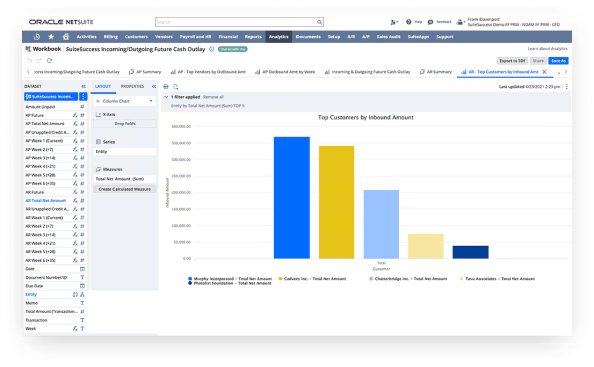
Restaurants need reliable systems to manage the operational and financial data on which AI success depends. NetSuite ERP for Restaurants gives restaurant operators clear visibility into their data and superior control over their businesses through its integrated modules for accounting, order processing, inventory management and supply chain operations. NetSuite ERP provides an all-in-one cloud business management software suite that automates core processes and delivers real-time visibility into operational and financial performance.
With integrated modules for accounting, order processing, inventory management and supply chain operations, NetSuite’s embedded AI capabilities are built on that unified data architecture, so they draw on complete operational context, not just siloed financial data. AI-powered anomaly detection surfaces unexpected variances before they compound, while autonomous close capabilities use AI agents to monitor financial processes throughout the month, discovering exceptions and proposing resolutions for faster period-end closes. NetSuite’s conversational AI feature lets finance teams query data and trigger actions using natural language. And because AI-generated insights cite their sources and explain their reasoning, restaurant operators get the transparency they need to act with confidence.
Gain Control Over Restaurant Operations
AI is reshaping how restaurants manage operations, engage guests and make strategic decisions. From voice ordering and smart scheduling to inventory automation and personalised marketing, these applications address the sector’s most persistent challenges. Restaurants that invest in AI and the data infrastructure to support it position themselves to adapt more quickly as the technology matures.
AI in Restaurants FAQs
How can AI be used in a restaurant?
AI can be used in restaurants to
automate scheduling and inventory management, handle reservations and phone orders through
voice assistants, personalise marketing and loyalty programmes, analyse menu performance,
forecast demand, and support financial management through anomaly detection and dynamic
pricing.
What is the future of AI in the restaurant sector?
The future of AI in
the restaurant sector points toward deeper integration into core operating platforms, with
AI-driven forecasting, scheduling and personalisation becoming standard features rather than
standalone tools.
How can AI improve the customer experience for guests?
AI can improve the
customer experience for guests by enabling frictionless booking and ordering through
conversational interfaces, personalising recommendations based on past behaviour and
preferences, reducing wait times through better demand forecasting, and supporting
multilingual service in diverse or tourist-heavy locations.