
Retail shrinkage — the loss of inventory through theft, errors, fraud and damage — cost UK retailers approximately £9 billion in 2025. For retailers confronting thin margins, a cost-of-living squeeze on their customers and surging violence against their workers, shrinkage threatens not only the bottom line but their ability to retain the people who keep shops running.
But shrinkage is a controllable expense. By understanding its causes and implementing targeted strategies that combine security measures, process improvements and integrated technology, retailers can reduce shrinkage losses while creating safer working environments.
What is Retail Shrinkage?
Retail shrinkage is the loss of stock that prevents retailers from realising the full value of their sales. It’s often thought of as the gap between recorded inventory levels and actual inventory counts, as caused by theft, damage, fraud and operational failures (such as pricing errors and supplier shortfalls). These preventable losses erode retailers’ profit margins.
For British retailers, both organised retail crime (ORC) and employee theft are particularly pressing problems. According to the British Retail Consortium (BRC), retail crime is “spiralling out of control,” with losses from customer theft reaching a record £2.2 billion in 2023/24. Violence and abuse against retail workers have surged to over 2,000 incidents daily (more than four times the level in 2020), including 70 weapon-related incidents each day. Separately, research from Retail Economics found that 40% of the total value of UK retail theft is attributable to employees — higher than the global average — with distribution centres becoming hotspots for organised criminal activity.
Key Takeaways
- UK retail shrinkage was projected to reach approximately £9 billion in 2025, making it one of the sector’s highest controllable costs.
- Employee theft — which is often underestimated — accounts for 40% of UK shrink.
- Administrative errors represent nearly a fifth of all shrinkage and are largely preventable through better processes and technology.
- Effective shrinkage reduction requires a combined approach: tighter security measures, standardised processes, employee training and technology.
- Integrated ERP systems help reduce shrinkage by automating inventory tracking, reducing manual errors and providing real-time visibility across locations.
How Does Shrinkage Impact a Retailer's Bottom Line?
Shrinkage delivers a multilayered blow to retail profitability, extending beyond the immediate cost of missing stock. UK retail sales totalled £531.6 billion in the 12 months ending November 2025, according to the Office for National Statistics (ONS). With the industry’s shrink rate of 1.4% to 1.7%, this translates to losses in the range of £7.5 billion to £9 billion. For a midmarket retailer turning over £100 million, even the lower end of that range translates to £1.4 million in direct losses. And the costs don’t stop there: UK retailers now spend an additional £1.8 billion each year on CCTV systems, security personnel, anti-theft devices and other prevention measures, according to the BRC.
Beyond the balance sheet, shrinkage degrades the customer experience and threatens workforce stability. Locked display cases frustrate legitimate shoppers, stockouts from inaccurate inventory lead to lost sales and some retailers have removed high-theft items from shelves entirely. Meanwhile, violence and abuse against retail workers have reached alarming levels, with nearly half of staff reporting they fear for their safety and many considering leaving the industry. For retailers already struggling to recruit, shrink-related safety concerns make an already difficult labour market even harder to navigate.
What are the Primary Causes of Retail Shrinkage?
Retail shrinkage stems from several distinct sources, each requiring different prevention strategies. External theft dominates headlines, but significant losses occur behind the scenes through errors, fraud and operational failures. Here are the big six:
- Shoplifting: External theft is the largest cause, accounting for roughly 60% of total UK retail shrink. The cost-of-living crisis has intensified pressures, though opportunistic theft represents only part of the picture. Self-checkout adds to the challenge — common covert theft tactics include barcode switching, deliberate mis-scanning and simply walking out with unscanned items.
- Organised retail crime (ORC): Unlike opportunistic shoplifting, ORC involves professional criminal gangs who coordinate theft across multiple locations, specifically for resale. These groups often use bags to clear entire shelves, rotate between shops to avoid detection and work in teams. ORC often involves violence, which causes serious injuries and psychological trauma among staff. By early 2025, dedicated police units had identified more than 30 organised crime groups and made more than 100 arrests linked to millions of pounds in losses.
- Staff theft: Common methods include taking cash from tills, removing merchandise from stockrooms, providing unauthorised discounts to friends and family and processing fraudulent refunds. Recruitment challenges have increased retailers’ reliance on temporary workers, intensifying the risk.
- Administrative mistakes: Administrative errors are less dramatic than theft but are almost entirely preventable. Common mistakes include miscounting products during delivery, entering data incorrectly, inputting the wrong prices in point-of-sale systems and failing to record damaged goods removed from stock. These quiet, undramatic losses accumulate relentlessly.
- Spoilage or damage: Goods damaged during shipping, handling or display — and not reported in the moment — may still appear as sellable inventory. Perishables approaching sell-by dates pose problems when stock-rotation practices fail. Temperature control failures in cold-chain management can render entire shipments unsellable.
- Supplier fraud: Vendors may charge for undelivered goods, submit duplicate invoices, deliver substandard products or collude with dishonest employees. While supplier fraud accounts for a small share of total shrink, the losses can be substantial when they occur.
8 Strategies for Reducing Retail Shrinkage
Effective shrinkage reduction requires action across multiple fronts. Some strategies address external threats; others tackle internal causes. The most successful approaches combine both.
-
Strengthen employee training
Comprehensive training addresses multiple shrink sources simultaneously. Train staff to recognise suspicious behaviour, use inventory systems correctly, follow accurate receiving and counting procedures and respond safely to incidents. Given rising violence, de-escalation training can also be useful.
-
Standardise processes and procedures
When procedures vary by location or shift, errors compound. One employee records damaged goods properly; another simply discards them. One store reconciles deliveries against packing slips; another trusts the count is correct. These inconsistencies create inventory discrepancies that accumulate silently — until the next stocktake reveals unexplained losses.
Standardisation addresses this by defining — and, crucially, enforcing — formal procedures in key areas. These include establishing receiving protocols (mandatory count verification, immediate reconciliation of deliveries against orders, systematic damage inspection), recording and removing damaged goods from inventory systems, coordinating between marketing and IT to validate that promotions are correctly coded before launch, and implementing first-in-first-out inventory rotation with regular expiry checks for perishables.
-
Conduct regular shop audits
By the time an annual stocktake uncovers significant shrink, the losses have accumulated for months and the patterns behind them are difficult to trace. Regular cycle counting — focusing on high-risk and high-value product categories instead of the entire inventory — is a practical way to catch discrepancies earlier. Variances should trigger immediate investigation.
Surprise audits add a deterrent: Staff who know a spot-check could happen at any time are less likely to risk theft. Supplier deliveries should be audited regularly and reconciled against invoices. Anomalies in delivery patterns should be flagged for immediate follow-up.
-
Consider anti-theft measures
Physical security works best when deployed as a broad, visible strategy. A single anti-theft measure can be circumvented or ignored; a combination of deterrents makes theft more difficult and detection more likely.
CCTV tops the list of anti-theft tools because it deters opportunistic thieves and provides evidence for prosecution. Other options include electronic article surveillance tags on high-value items, trained security personnel and body cameras, which both gather evidence and can deter violence against staff. At self-checkouts, AI-powered monitoring systems can detect mis-scans and alert staff in real time, while overhead cameras can show shoppers footage of items that may not have scanned correctly.
-
Provide clear guidance on incident management
When an incident occurs without clear protocols, two problems arise: Staff may respond in a way that puts themselves at risk, and evidence needed for prosecution may be lost. Standard procedures for incident management help prevent both.
When an incident occurs without clear protocols, two problems arise: Staff may respond in a way that puts themselves at risk, and evidence needed for prosecution may be lost. Standard procedures for incident management help prevent both.
Every employee should know the escalation procedure, their role during an incident and when to call security or police. With violence against retail workers at alarming levels, de-escalation training has become as important as theft-prevention training. Incidents should be reviewed to identify potential preventive measures, and psychological support should be provided to employees who experience violence. Proper documentation preserves evidence for prosecution and supports intelligence-sharing with law enforcement.
-
Restrict employee access
Most employees are honest. But when internal theft accounts for 40% of retail theft value, access controls protect both the business and honest staff from suspicion. Stockrooms should use digital locks with individual employee codes, creating an automatic log of who entered and when. ERP and point-of-sale systems should enforce role-based permissions, requiring manager approval for discounts, refunds and voids.
High-value items in distribution centres may need secure caging and checkout procedures for employees leaving the premises. Complete audit trails — tracking who accessed which systems and what transactions they processed — allow unusual patterns to surface before losses mount. For roles with significant inventory access, rigorous background checks help address the risk posed by workers with limited loyalty to the organisation.
-
Enhance inventory management
Manual or poorly integrated inventory management systems are known to deliver inaccurate information. When inventory data is unreliable, every decision built on that data is compromised: ordering, merchandising, staffing — even knowing whether you have a shrinkage problem at all.
Proficient inventory management systems form the foundation of shrink reduction. They provide real-time visibility across locations and update stock levels immediately as items are received, sold or transferred. Automated alerts flag when stock deviates from expected patterns, enabling investigation while the trail is fresh. Exception reporting highlights unusual variances, such as a sudden shrink spike at one location or a specific product category showing consistent losses. Integrating inventory management with back-office systems helps inventory and accounting stay aligned, reducing reconciliation errors and providing a clearer picture of true shrinkage costs.
-
Utilise barcode and RFID tracking
Manual inventory tracking is fundamentally error-prone, creating a flawed foundation for stock decisions. Barcode systems eliminate most data-entry errors and provide item-level tracking throughout the supply chain — from receiving through storage to sale.
RFID technology goes further, enabling real-time tracking without scanning. It counts items automatically as they move through a warehouse or onto a shop floor and can alert staff to discrepancies immediately. RFID also supports delivery verification by automatically counting goods as they arrive, preventing situations where warehouses ship one quantity, but stores receive another.
Monitoring Retail Shrinkage
Shrinkage reduction efforts require monitoring key performance indicators (KPIs) to measure how well those efforts are working and to surface problems while they’re still manageable. Effective monitoring reveals patterns that point to root causes and provides the evidence needed to justify or adjust shrink-prevention investments.
The core KPI to monitor is shrink rate:
Shrink rate = (Recorded inventory – Actual inventory) / Recorded inventory
Though useful, a single formula tells only part of the story. Retailers gain more actionable insight by breaking losses down by cause (theft, administrative error, damage), location and product category.
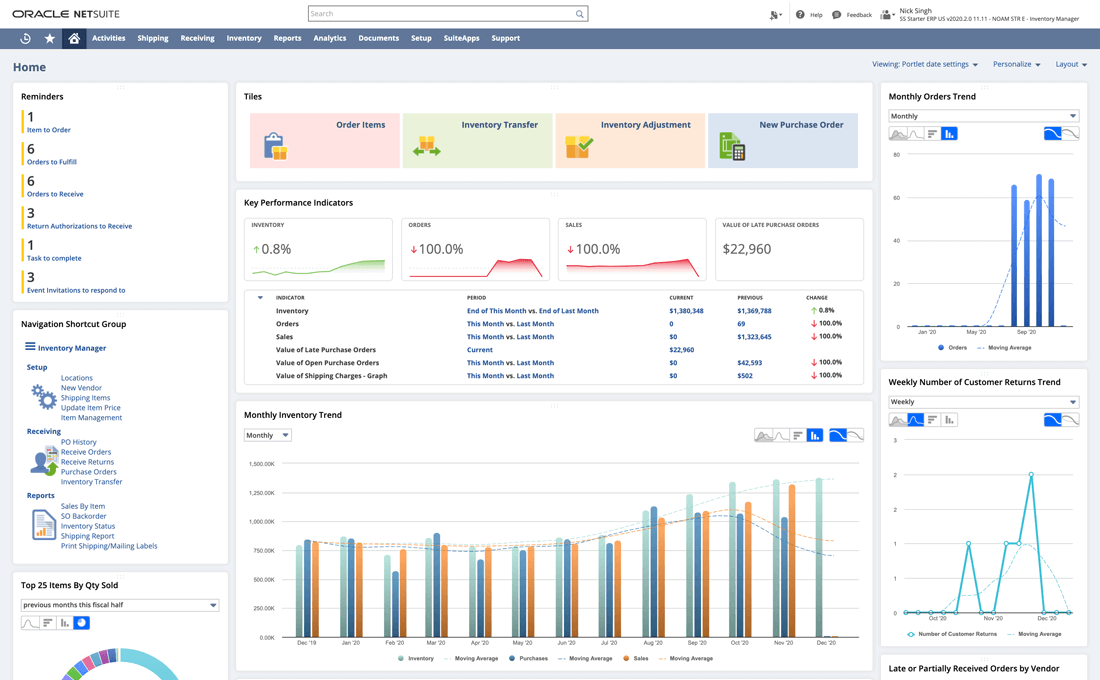
Inventory dashboards are vital monitoring tools that provide real-time visibility, pulling data from point-of-sale, warehouse and ERP systems, presenting it all in a single view. Alerts can trigger when inventory deviates from expected patterns and exception reporting can flag transactions outside normal parameters. Trend analysis adds historical context, distinguishing one-off anomalies from deteriorating patterns and measuring whether prevention initiatives are delivering results. Regular cycle counts support this monitoring by validating system accuracy.
NetSuite Inventory Dashboards
Curb Retail Shrinkage with NetSuite
Fighting shrinkage requires accurate data across receiving, stocking, monitoring and sales. Without this foundation, retailers cannot measure losses, identify causes or target interventions effectively. NetSuite ERP for Retail integrates inventory management and financials within a single platform, reducing duplicate work and manual data entry and lowering the risk of administrative errors that drive preventable shrinkage. NetSuite’s inventory management improves accuracy by automating tasks such as cycle counting and accounting for transactions during real-time counts. For multilocation retailers, it can track inventory across all sites simultaneously, providing the visibility needed to spot discrepancies and loss patterns. And its real-time dashboards help retailers quickly find and interpret the data needed to make informed decisions about where to focus security investment and process improvement.eal-time dashboards help retailers quickly find and interpret the data needed to make informed decisions about where to focus security investment and process improvement.
Addressing shrink strengthens retailers’ businesses. No retailer can eliminate shrinkage entirely, but it is a controllable expense that can be significantly reduced. Targeting its causes with proven strategies helps retailers protect profits, operate more efficiently and create safer environments for staff and customers.
Retail Shrinkage FAQs
How do retailers avoid shrinkage?
Retailers reduce shrinkage through a multilayered approach that includes:
- Employee training on security awareness and accurate processes
- Standardised procedures for inventory receiving, pricing and damage management
- Regular inventory audits
- Anti-theft measures, including CCTV and electronic tags
- Controlled access to stockrooms and high-value areas
- Integrated technology providing real-time inventory visibility.
The most effective results come from combining security measures with process improvements and ERP systems that automate tracking and flag discrepancies.
What is the average shrinkage rate in retail?
The average shrinkage rate for UK retailers ranges from 1.4% to 1.7% of total sales. However, rates vary by sector — grocery typically experiences lower rates while rates in fashion, electronics and health and beauty are often higher.