
Running a restaurant means navigating tight margins, volatile costs and ever-changing customer tastes. Intuition may help establish a good atmosphere and design delicious meals, but when it comes to business performance, operators need to know exactly what’s working and what isn’t. Key performance indicators (KPIs) provide that clarity, turning raw data into a clear picture of financial and operational health. But with dozens of possible metrics to track, choosing the right ones matters as much as tracking them at all. This guide focuses on 15 KPIs that restaurateurs should prioritise, with guidance on how to calculate each one, and what to do when the numbers change.
What Are Restaurant KPIs?
Restaurant KPIs are the metrics owners and managers use to assess their business’s performance. They provide a quantifiable view of what’s working and what needs attention across financials, operations and customer experience.
UK restaurant operators use KPIs to answer the questions that matter most: Is this menu item profitable? Are labour costs outpacing revenue? Are customers coming back? The right KPIs make those answers visible and make it harder to ignore potential problems.
Key Takeaways
- KPIs use hard data to measure a restaurant’s performance in financial, operational and customer-facing areas.
- Financial KPIs, like food cost percentage and prime cost, help operators control their two biggest expense categories: ingredients and labour.
- Operational KPIs, such as table turnover and inventory movement, track efficiency and throughput.
- Customer-focused KPIs quantify loyalty trends and track the impact of service improvements.
- Different KPIs require different review cadences, some daily, others monthly, depending on how quickly underlying inputs change.
Why Do Restaurant Owners Track KPIs?
KPIs give restaurant owners visibility into where money is being made or lost, often before problems show up in the bank balance or financial statements. A spike in food cost percentage could point to supplier price creep, while a drop in table turnover could signal service bottlenecks, for instance.
KPIs also support forward-looking strategies. For example, tracking menu profitability or average order value helps restaurateurs engineer menus that prioritise profitable dishes and cut underperformers. And when conditions shift, operators who monitor their KPIs can catch the impact early and adjust before small problems compound.
15 Critical KPIs for Restaurant Owners
These 15 KPIs cover the metrics that matter most for UK restaurant operators; from restaurant financial metrics like break-even point and gross profit margin, to operational and customer-facing indicators like table occupancy and review scores. Not every restaurant needs to track all 15, as the right mix depends on the business concept and its current priorities.
-
Food Cost Percentage
Food cost percentage measures ingredient costs as a proportion of food sales. It shows whether menu prices cover the cost of what’s on the plate. The key input is cost of goods sold (COGS), which represents the direct cost of ingredients used to generate sales.
Food cost percentage = (COGS / Total food sales) × 100
Food cost targets vary by concept. Quick-service restaurants typically aim lower than fine dining establishments, and pubs often accept higher food costs because drink margins offset them. A rising percentage is an early warning sign of issues such as supplier price increases, portion drift or waste. Tracking weekly or daily helps restaurants catch problems before they hurt margins.
-
Labour Cost Percentage
Labour cost percentage measures all staff costs; wages, National Insurance contributions, pensions, benefits and training, as a proportion of revenue.
Labour cost percentage = (Total labour costs / Total sales) × 100
With National Living Wage and employer National Insurance contributions both rising, labour costs are under increasing pressure for UK restaurants. Training costs are also high in the hospitality sector, with accommodation and food service seeing annual staff turnover of 52%; well above the UK average of 34%. And unlike food costs, labour doesn’t scale down easily when sales dip; a restaurant needs minimal staffing regardless of how busy it is. Monitoring this metric over time helps managers match rotas to actual customer volume and seasonal demand shifts rather than overstaffing quiet shifts or understaffing busy ones.
-
Customer Retention Rate
Customer retention rate measures the percentage of customers who return over a given period.
Customer retention rate = [(Customers at end of period − New customers acquired) / Customers at start of period] × 100
Acquiring new customers usually costs more than keeping existing ones, so focusing on retention is often a more cost-effective path to growth. A falling rate can suggest problems with food, service or value. Loyalty programmes, consistent service quality and personalised offers all influence this metric. POS systems, digital booking platforms, online ordering apps and loyalty accounts help track retention by capturing the customer-level data needed to distinguish new guests from returning ones.
-
Average Order Value
Average order value (AOV), sometimes called average bill value, tracks the average revenue generated per transaction.
AOV = Total sales / Total number of orders
AOV is one of the simplest levers for growing revenue because increasing it doesn’t require proportional labour, marketing spend or even foot traffic. Upselling, bundles, add-ons and premium menu options all boost AOV. Segmenting by channel, like dine-in versus delivery versus takeaway, reveals where margins differ, particularly since third-party delivery platforms often come with commissions and fees that reduce the restaurant’s take.
-
Table Turnover Rate
Table turnover rate measures how many times each table is occupied and vacated during a service period.
Table turnover rate = Number of parties served / Number of available tables
Faster turnover means more covers, but pushing too hard can rush diners, damage satisfaction and lower review scores. Low turnover paired with high occupancy suggests service bottlenecks; low turnover with low occupancy points to a demand problem. Occupancy and reservation data can help pinpoint causes of low turnover, whether it’s gaps between seatings or uneven booking patterns. Target turnover varies by concept, with fast-casual establishments typically turning tables faster than upscale venues, where guests expect a more leisurely experience and spend more per head.
-
Prime Cost
Prime cost combines food costs and labour costs; a restaurant’s two largest controllable expenses into a single figure.
Prime cost = COGS + Labour costs
When prime cost creeps too high, it cuts into headroom for rent, utilities, marketing and growth. Tracking each component of prime cost matters too: if food costs are driving prime cost up, the fix might be renegotiating with suppliers or tightening portions. If labour is the culprit, it's time to revisit scheduling or staffing levels.
Prime cost can also be expressed as a percentage of sales, showing how much of each pound goes to direct service costs:
Prime cost percentage = [(COGS + Total labour costs) / Total sales] × 100
The percentage makes it easier to track prime cost over time, compare across locations and benchmark against industry standards.
-
Inventory Turnover
Inventory turnover measures how quickly a restaurant cycles through its stock.
Inventory turnover = COGS / [(Beginning inventory value + Ending inventory value) / 2]
A high ratio points to efficient inventory management — important in an industry where unsold stock spoils quickly. However, a consistently high ratio may signal stockouts that can lead to rushed procurement or disappointed customers. Conversely, a low ratio could indicate overstocking, excessive spoilage or poorly selling menu items. Inventory turnover is especially useful for multi-site operators comparing locations, or for spotting trends that a quick glance at pantry and walk-in shelves won’t reveal.
-
Average Customer Review
By aggregating ratings from public sites and third-party platforms, average customer review gives operators a snapshot of how their restaurant appears to potential guests.
Average customer review = Sum of all ratings / Total reviews
Online reviews are one of the most important ways to bring in new customers, and delivering a consistent experience often matters more than perfection as guests want to know what to expect. Review volume and recency both matter: a stable rating with a steady volume of recent reviews may be more appealing than a slightly higher score based on only a handful. Responding to negative reviews can help offset ratings drops by signalling that the restaurant takes feedback seriously.
-
Average Table Occupancy
Average table occupancy measures the percentage of available tables (or seats) occupied during operating hours.
Average table occupancy = (Occupied tables / Total available tables) × 100
This KPI is best used alongside other table-centric metrics, like turnover. High occupancy with low turnover suggests service is slow or dining times run too long. Low occupancy with low turnover points to a demand or reservation flow problem. Calculating occupancy for specific periods — lunch versus dinner, weekday versus weekend — can show patterns that averages obscure.
-
Gross Profit/Net Profit Margin
Gross profit and net profit show profitability at different levels. Gross profit shows whether pricing covers ingredient costs, which is an indicator of the direct profitability of serving customers. Net profit reflects what’s left after the business covers every expense — even the ones not directly tied to producing food, including rent, utilities, labour, taxes and interest.
Gross profit margin = [(Total sales − COGS) / Total sales] × 100
Net profit margin = (Net profit / Total sales) × 100
A declining gross profit margin suggests rising ingredient costs or pricing that hasn’t kept pace, meaning it’s time to revisit supplier contracts or menu prices. A shrinking net profit margin, even if gross profit is holding steady or improving, points to overhead or labour costs creeping up. Restaurant margins tend to be slim, so small movements in either metric can signal problems worth addressing.
-
Menu Item Profitability
Menu item profitability measures the total profit contribution of individual dishes, factoring in both margin and sales volume.
Menu item profitability = (Number sold × Selling price) – (Number sold × Item portion cost)
This metric helps restaurants identify which dishes to promote, reprice or remove. A high-margin dish that rarely sells may need better menu placement or server recommendations; a low-margin dish with strong sales volume might warrant portion adjustments or a price increase. Reviewing profitability across the menu regularly helps restaurants keep pace with fluctuating ingredient costs and make informed decisions about what stays and what goes.
-
Break-even Point
Break-even point is the sales level needed to cover all fixed and variable costs, resulting in neither profit nor loss.
Break-even point = Total fixed costs / Contribution margin ratio
The contribution margin ratio represents the portion of each sales pound available to cover fixed costs or generate profit:
Contribution margin ratio = (Total sales − Total variable costs) / Total sales
Owners use the break-even point to set realistic sales targets and evaluate whether a new location, menu change or capital investment is financially viable. Tracking it over time reveals how rent increases, ingredient inflation or wage changes affect this threshold.
Note that some restaurant costs, particularly labour, can contain both fixed elements (salaried managers, minimum staffing) and variable elements (hourly staff scaled to demand). Choose a consistent method to split these costs, such as treating salaries as fixed and hourly wages as variable, and apply it every period.
-
Average Spend Per Head
Average spend per head, also called per-guest average, measures the average revenue generated per guest, regardless of party size.
Average spend per head = Total sales / Total number of guests served
Unlike average order value, which measures revenue per transaction, this metric isolates individual spending. This is useful for assessing how well upselling, server training and incentive programmes translate into actual per-head revenue. For restaurants with limited seating capacity, increasing spend per head is often the most practical path to revenue growth.
-
Server Error Rate
Server error rate tracks the frequency of mistakes made when staff enter orders into the POS system.
Server error rate = Total number of server errors / Total number of items rung in
Errors bring multiple issues, including lost revenue from undercharged items, dissatisfied customers who were overcharged or received the wrong dish, food waste from remade orders, and friction in the kitchen. With high staff turnover common in UK hospitality, error rates are often elevated as new team members learn the ropes. Segmenting by individual server helps managers identify training needs; tracking at the restaurant level can highlight systemic issues like confusing POS interfaces or unclear menu descriptions.
-
Net Promoter Score (NPS)
NPS measures how likely customers are to recommend the restaurant to others, typically gathered via a one-question survey: “How likely are you to recommend us?” Customers who rate 9–10 are “promoters”, 7–8 are “passives” (excluded from the calculation), and 0–6 are “detractors”.
NPS = % Promoters − % Detractors
NPS captures something review scores alone may miss: intent to recommend rather than past satisfaction. Promoters are a major source of organic discovery through word-of-mouth and social media. Cultural context can also impact NPS. European respondents tend to rate more conservatively and are “less likely to give you 9s or 10s”, a pattern that may apply to UK consumers as well. Comparative benchmarks should therefore be interpreted accordingly.
Tips for Measuring KPIs
A food cost percentage or table turnover rate sitting in a spreadsheet or dashboard doesn’t fix anything. To act on KPIs, operators need the right review cadence, relevant restaurant benchmarks and tools that reveal problems before they hurt the bottom line.
- Frequency of KPI review: Not all KPIs need the same level of attention. Food cost percentage, labour cost percentage, and prime cost benefit from daily or weekly monitoring because they move fast and hit margins immediately. Big-picture metrics such as gross profit, net profit and customer retention are better suited to monthly or quarterly reviews, where meaningful patterns emerge. The goal is to build a rhythm that catches problems early.
- Benchmarking: Internal benchmarks — comparing this month to last month or one location to another — show whether performance is improving or declining. External benchmarks from industry reports or trade bodies add competitive context. Both are useful, but external comparisons should be drawn from businesses with similar concepts, locations and scale.
- Tools and software: Restaurants using separate systems for POS, inventory, scheduling and accounting can struggle to see the full picture without manual workarounds or delays. Integrated platforms can consolidate data from multiple modules into a single source, making KPI tracking faster and reducing errors associated with manual entry. Users can access these metrics through real-time dashboards, and automated alerts can flag problems as they develop, not at month-end.
Manage Restaurant KPIs with NetSuite ERP Software
Identifying a problem is only half the job; acting on it quickly is what helps restaurants overcome challenges and protect their bottom line. NetSuite ERP for Restaurants connects financial management, inventory and workforce data into one system so operators can trace a spike in food cost back to specific suppliers, locations and menu items without toggling between systems. NetSuite’s demand forecasting tools help restaurateurs balance their resources and labour with real-world needs, while its financial management capabilities consolidate reports, speeding up the financial close. With live access to operational data, restaurants can see which locations and items are outperforming and why, turning scattered data into a recipe for growth.
NetSuite’s KPI Dashboard
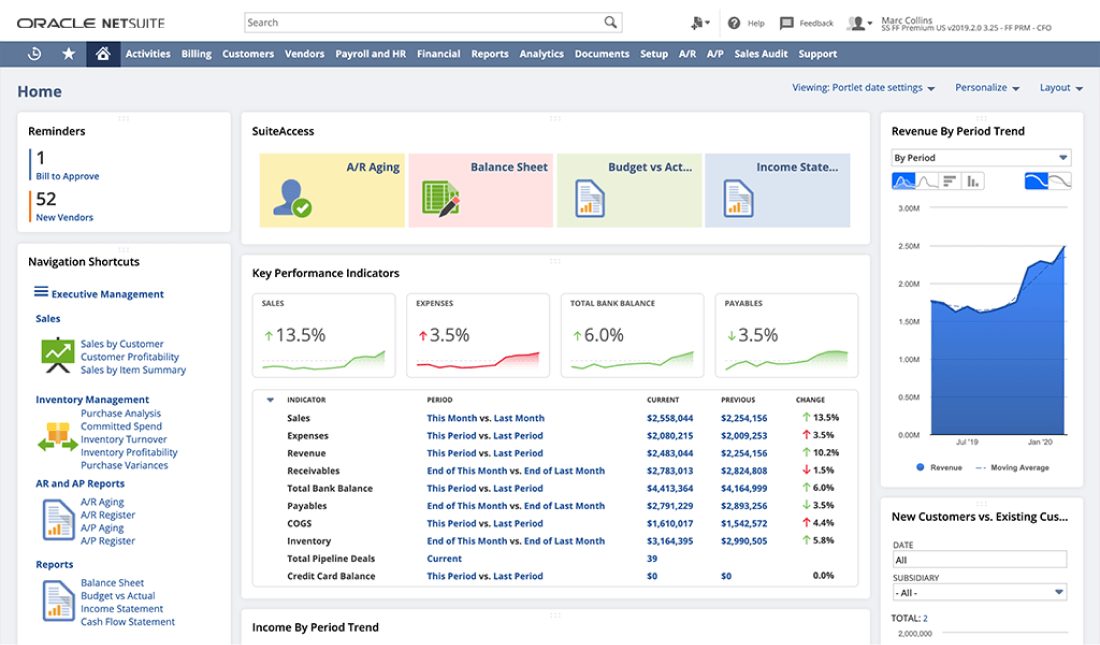
KPIs replace intuition and guesswork with a clear view of financial health, operational efficiency and customer satisfaction. These 15 metrics aren’t exhaustive, but they cover the aspects of a restaurant that matter most; with each one answering a specific question about how the business is performing. In an industry where small margins leave little room for error, the right KPIs help operators catch problems early, make decisions faster and stay ahead of changing conditions.
Restaurant KPIs FAQs
What are the four Ps of a KPI?
The four Ps of a KPI are:
- Purpose: What the KPI measures and why it matters.
- People: Who is responsible for both tracking and acting on the metric.
- Process: How the data is collected and used.
- Performance: The target or benchmark used to compare results.
What are the five key metrics that measure restaurant performance?
Key metrics vary with each restaurant, but five common KPIs are food cost percentage, labour cost percentage, prime cost, customer retention rate and profit margin. Together, these cover ingredient costs, staffing efficiency, overall cost control, customer loyalty and profitability.
What software helps track restaurant KPIs?
Individual software systems may have their own KPI capabilities; a POS can track cost percentages, an inventory management system can monitor stock turnover. Integrated solutions like enterprise resource planning (ERP) platforms bring POS, inventory, scheduling and accounting data together to give operators a more complete view of performance.