

Most organisations forecast, set budgets, write reports and make plans to improve. But when these activities happen in silos, with different teams working from different numbers, it’s harder to respond quickly or trust the data in front of you. Enterprise performance management (EPM) brings these processes into a single system, giving companies a consistent view of operational and financial performance. This connected approach helps any business make better decisions, but it particularly shines in volatile markets where speed and accuracy can be the difference between staying ahead and scrambling to catch up.
What Is Enterprise Performance Management (EPM)?
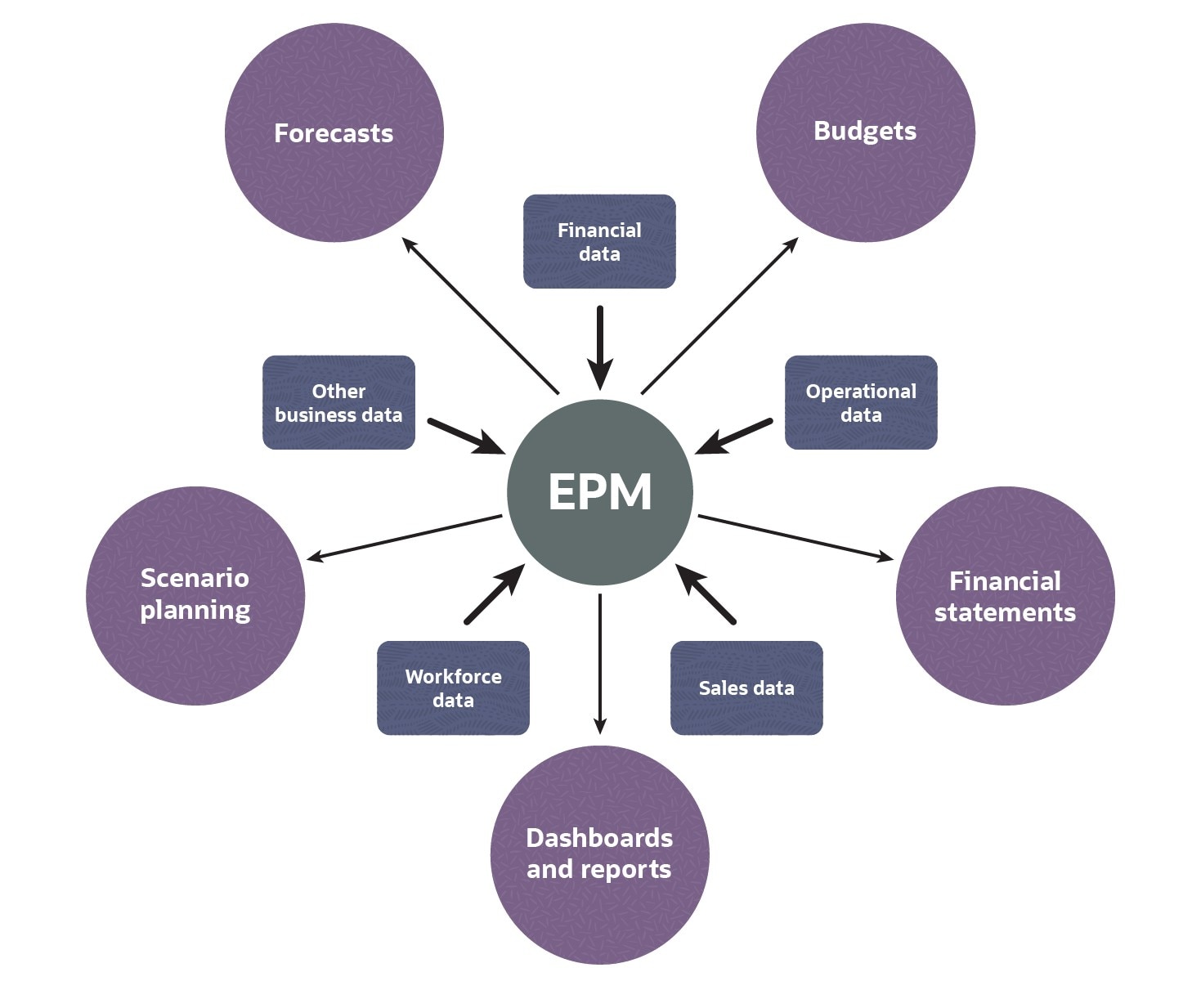
EPM consists of the processes and tools companies use to plan, monitor and improve their operational and financial performance. By consolidating budgeting, forecasting, reporting and analysis capabilities in a cohesive system, organisations can more readily keep daily activities on track to achieve strategic goals.
EPM relies on software that integrates data from throughout the company, including from ERP, CRM and other business platforms. Finance and other department leaders are therefore able to work from the same set of numbers, all fed to one place, rather than parsing through disparate spreadsheets. With better data consistency, it’s easier for teams to model scenarios, track performance against targets and respond to changes in real time.
Enterprise Performance Management
EPM vs. Traditional Spreadsheets
Spreadsheets are familiar, flexible and typically come at little to no extra cost. The challenge is they don’t scale well. As organisations grow, planning becomes more complex, version control issues emerge and formulas break as files are edited and reused. Collaboration often means emailing spreadsheets back and forth with no easy way to track who changed what. This lack of a built-in audit trail makes it difficult to trace how figures were derived — or to satisfy regulatory reviews.
With EPM, a single database replaces scattered files while automated connections pull data directly from sources. Built-in workflows route budgets and forecasts through review and approval — no emailing files, no conflicting versions — with audit trails noting every change. And many platforms even integrate with spreadsheet software, allowing finance teams to work in a familiar interface while benefitting from controlled data sources and real-time updates.
Key Takeaways
- EPM connects planning, budgeting, forecasting and reporting so changes in one area flow through to others automatically.
- Unlike spreadsheets, EPM platforms offer built-in audit trails, automated workflows and a unified source of data for all departments.
- It’s especially useful when organisations outgrow spreadsheets, face regulatory pressure or need to respond quickly to changing conditions.
- Core components of EPM include strategic planning, budgeting and forecasting, financial consolidation, performance reporting, and profitability analysis.
- Successful EPM implementation depends on executive sponsorship, clear objectives, data quality and change management — not just technology selection.
Enterprise Performance Management Explained
To improve performance, companies usually collect financial and operational data, analyse it against KPIs, set targets for specific departments and the organisation as a whole, measure progress and update plans based on what’s changed. Without EPM, these activities often happen discretely — each department collecting its own data, tracking different metrics and setting targets independently. Then, finance scrambles to reconcile it all at month-end. EPM connects these efforts so that, for example, when one assumption changes, the adjustment flows through connected plans, forecasts and reports automatically.
A revised sales target, for instance, would instantly update turnover projections, expense budgets and hiring plans instead of triggering a chain of manual revisions — giving leaders the agility to respond to change as it happens.
How Does Enterprise Performance Management Work?
EPM users build plans, track performance against targets and adjust forecasts as conditions change without switching between systems. Behind the scenes, the platform validates inputs, runs calculations, highlights variances and routes tasks based on predefined workflows. Users are alerted to problems, often before they affect operations, rather than discovering them manually by reviewing every line.
Benefits of EPM for Organisations
With cost pressures rising and forecasting windows shrinking, organisations are being asked to do more with less — and to do it faster. EPM addresses that tension by compressing manual processes and helping leaders across departments respond to change as it happens. More specifically, EPM offers benefits such as:
- Improved financial planning and forecasting: EPM replaces static annual plans with dynamic, continually updated forecasts. Because forecasts are tied to real business drivers, projections adjust according to business changes. The result is more realistic targets and fewer surprises at month- and quarter-end.
- Real-time performance visibility and reporting: Dashboards monitor KPIs throughout the organisation as data flows in, rather than days or weeks after the fact. Leaders can monitor progress against targets, spot variances early and drill down into details without waiting for reports to come in.
- More accurate budgeting with reduced manual effort: Automated data collection limits the errors that creep in when figures are manually transferred between spreadsheets. Teams can therefore spend less time gathering numbers and more time analysing them.
- Stronger strategic alignment across departments: EPM connects departmental plans to enterprise-wide objectives. Sales forecasts feed into marketing plans, which inform hiring decisions, which roll up into cash flow projections, for instance. Everyone works towards the same goals with a clear understanding of how their piece of the puzzle supports the whole organisation.
- Better decision-making through unified data: When all departments draw from a single data source, reconciliation disputes are less likely to occur. Leaders and staff can trust the numbers in front of them, without second-guessing whether other departments are looking at different versions of reality. This improves decision-making speed and confidence.
- Enhanced regulatory and compliance reporting: EPM builds compliance requirements directly into its workflows, from accounting standards and tax rules to disclosure formats. Audit trails track every change, and reports can be generated in formats regulators expect. Better compliance and reporting mitigate noncompliance as well as the scramble that can accompany internal and external reviews.
- Increased operational efficiency and cost control: With data centralised and workflows automated, finance teams spend less time on repetitive tasks and more on strategy. To help with costs, preset thresholds and alerts flag cost overruns before they get out of hand. Similarly, predictive tools can identify savings opportunities before they slip away.
- Faster month-end and year-end close processes: Automated reconciliation, intercompany eliminations and workflow orchestration remove manual steps that tend to slow the close. Tasks that once ran sequentially can run in parallel, and an EPM system’s unified source of real-time data means fewer surprises to reconcile at period-end.
- Scenario modelling to assess risks and opportunities: EPM platforms let teams test the impact of a price increase, a supply chain disruption, a shift in demand or other key change — and instantly see how it affects budgets, forecasts and resource plans. Because models are connected, scenarios that might take days to build in spreadsheets can be run in minutes.
- Greater agility to adapt to market or business changes: When assumptions shift, EPM propagates the changes across connected plans automatically. This responsiveness allows organisations to pivot quickly — whether by reallocating resources, revising forecasts or adjusting strategy — before opportunities close or risks materialise.
Key Components of an EPM System
EPM platforms typically include five core components. Each component addresses a different stage of the performance management process, but they all work together. Data flows among them, so changes in one area cascade through the others and analyses feed into strategic plans, creating a cycle of continuous improvement.
- Strategic planning: Teams can test assumptions to see how each plays out before committing to a direction. This improves long- and short-term goal evaluation. For instance, a team can model different sales projections, market shifts or investment options to assess their financial impacts.
- Budgeting and forecasting: This includes setting financial and operational targets, sales and expense forecasts, and resource allocations. Rolling forecasts are often used in EPM to maintain a consistent forward view, while models based on operational assumptions automatically update financial projections when assumptions change.
- Financial consolidation and close: Consolidation capabilities bring data together from throughout the business at month- or quarter-end, automatically reconciling figures and producing financial statements to show how actual plans and budgets stack up against projections. Period-end processes such as multi-entity consolidation, intercompany eliminations, currency translation and journal entries are automated. Workflow tools manage approvals and track their status.
- Performance reporting and analytics: Auto-generated reports communicate results to stakeholders such as managers, investors and regulators. Dashboards provide visual overviews of financial and operational performance; KPI tracking and variance analyses highlight where results deviate from plans. Self-service, role-based access lets users explore data and drill-down without waiting to build or receive custom reports.
- Profitability and cost management: Analytical tools reveal performance by product, customer, channel or activity to understand true cost drivers. Businesses can see which parts of the operation actually make money, which consume resources without adequate return and where to focus improvement efforts — informing decisions on pricing, product mix and resource allocation.
Who Needs EPM?
EPM becomes valuable when spreadsheets hit the wall, planning grows too complex, close cycles drag on or departments operate from disconnected data. Organisations with multiple entities, currencies or reporting requirements often reach these points quickly as they grow. So do those facing regulatory scrutiny or pressure to forecast more frequently.
The roles that feel this pain most acutely tend to be in finance, such as CFOs, controllers and FP&A teams. But the need extends further as planning becomes more cross-functional. HR, sales and operations, for instance, are increasingly requiring connected plans that tie back to financial outcomes — a response to economic volatility that demands faster, more coordinated decision-making across the business.
A mid-sized manufacturer with three entities and tight margins may need EPM more than a large, single-entity retailer with straightforward offerings and simpler reporting. Adoption tends to be most mature in sectors where regulatory pressure, margin sensitivity or operational complexity make integrated planning essential, such as financial services, healthcare and manufacturing — though any business stands to benefit.
Common Use Cases for Enterprise Performance Management
EPM shines in situations that demand faster, more connected planning. Here are some common use cases:
- Leadership needs to understand the margin impact of supplier price hikes. The new cost assumption goes into the company’s financial planning model. Within minutes, the EPM system recalculates gross margin by product, flags items that fall below threshold and shows which customer segments are most affected. Instead of spending a week analysing spreadsheets, leadership immediately gains the data needed to make a decision: absorb the cost, raise prices selectively or renegotiate with the supplier.
- The board wants multiple scenarios for next year’s plan. The company’s FP&A team builds three versions of the annual forecast: a base case reflecting current trajectory, a downside assuming weaker demand or higher costs and an upside if growth accelerates. The EPM system generates P&L, balance sheet and cash flow projections for each version within hours rather than weeks. In the board presentation, the scenarios appear side by side with the assumptions behind each clearly visible, making it easier for leadership to pressure-test the plan and align on a direction.
- The financial close is taking too long. Instead of waiting for subsidiaries to submit their numbers manually, the EPM system pulls actuals directly from each entity’s general ledger. Transactions between subsidiaries are automatically matched and removed from the consolidated view so sales and expenses aren’t counted twice. A status dashboard tracks each entity’s progress through the close checklist, making it easy to see what’s complete and where delays are occurring. The result is a compressed cycle that gives finance teams time back to focus on strategic analysis.
- A department wants to expand headcount. A manager submits a request for three new hires. The EPM system calculates the total cost of each hire, including salary, benefits and taxes, and shows how the additions affect the department’s budget, the company’s overall labour spend and cash flow over the next 12 months. Leadership can see the tradeoffs before approving, reducing the risk of budget overruns showing up after new hires are onboarded and receive their first paycheques.
- A revised sales forecast raises questions about cash flow. The sales team updates their projections in the EPM planning module. Sales assumptions flow into the financial model, which recalculates expected collections, adjusts expense timing and refreshes the cash forecast. No need to re-key data or reconcile spreadsheets; numbers are updated in real time, ready to act on.
EPM and AI: What’s Changing?
While AI adoption is still maturing, the technology’s capabilities are advancing quickly. Here are some notable changes AI is bringing to EPM:
- Predictive forecasting: AI analyses historical patterns and external signals to generate forecasts and move teams beyond basic trend extrapolation.
- Anomaly detection: Machine learning flags unusual variances, outliers or data quality issues that might otherwise go unnoticed.
- Natural language queries: Built-in assistants let users ask questions in plain language and generate charts or tables in response, without building custom reports manually.
- Automated commentary: When results differ from plan, AI can analyse the underlying data and draft written explanations, cutting time spent on writing variance narratives from scratch.
- Process automation: Routine tasks — from data collection and workflow approvals to plan consolidation or report distribution — can run with minimal human intervention.
How to Choose the Right EPM Solution
EPM selection can go wrong when organisations skip the groundwork or focus too heavily on features. The following five steps can help narrow the field and set your business up for success.
- Start with a needs assessment. Whether the business is dealing with slow financial closes, disconnected planning or difficulty creating “what if” scenarios, first identify the pain points inspiring the need for an EPM. Clarify which departments and processes need to be supported. Involve IT and legal early to resolve technical requirements and contract terms before they cause delays.
- Distinguish must-haves from nice-to-haves. Map capabilities back to the pain points identified in step one. If a feature directly addresses a core problem, it’s probably a must-have. Planning, forecasting, reporting and audit trails are essential for most companies. Other requirements vary: for example, multi-entity businesses need consolidation, and international operations need multi-currency support.
- Evaluate integration requirements. List the systems from which the EPM will pull data, such as ERP platforms, accounting software, CRM systems, payroll, warehouse management system (WMS) or others. Check whether the EPM solutions being evaluated offer pre-built connectors for those systems. If not, evaluate what custom work will be required for integration and factor that into the timeline and budget.
- Vet vendor expertise and support. Does the vendor have experience with businesses of similar size and complexity? What support resources do they provide? Dedicated consultants, training programmes and ongoing help are all worth asking about. Ask for UK reference customers in similar industries and reach out to get their opinion.
- Be realistic about total cost and scope. Software licensing is only part of the picture. Factor in the cost of implementation, integration, training and ongoing support. Avoid over-scoping the initial rollout by focusing on core use cases. Many providers will allow you to expand once you have a solid foundation.
How to Implement EPM Successfully in 6 Steps
EPM implementation changes how people work. Getting the technology right matters, but so do organisational factors such as sponsorship, data quality and change management. The following steps can help keep the project on track:
- Secure executive sponsorship: Without leadership support, implementation will struggle to get off the ground. Top-level commitment is necessary for quick decisions and for projects to get the resources they need. The executive sponsor should stay engaged throughout, not just sign off at the start — otherwise competing priorities may take over.
- Define clear objectives: A goal such as “improve financial processes” lacks the specificity required for action. Define the reason for implementing an EPM system, whether the objective is to reduce close times, improve forecast accuracy, enable scenario planning or something else. Clear objectives guide decisions and help measure success.
- Address data quality early: EPM systems depend on accurate, structured data. Organisations frequently underestimate the effort required to cleanse historical data, establish master data governance and maintain quality over time. Poor data quality undermines even well-designed systems, so take careful measures to audit, cleanse and validate data before migration.
- Invest in change management: EPM changes processes and accountability. Users accustomed to spreadsheet control may resist centralised systems. Involve affected teams early, communicate why the change matters and address resistance directly.
- Start small and scale deliberately: Phased rollouts tend to outperform “big bang” approaches. Begin with a pilot group, identify lessons learned, build internal expertise and expand from there. Starting small reduces risks and early wins can help build momentum.
- Set realistic timelines: Timelines vary widely. Simple cloud deployments may take a few months; complex, enterprise-wide rollouts with extensive integration can stretch beyond a year. Build in a buffer for unforeseen issues, such as data quality problems discovered mid-project or integration complications.
Make Better-Informed Financial Decisions with NetSuite
NetSuite Enterprise Performance Management brings planning, budgeting, forecasting, account reconciliation, financial close and reporting together in one connected solution. By consolidating financial and operational data in real time, it gives leaders a clear, current view of business-wide performance. What-if modelling lets teams test scenarios before committing to a direction, and automated processes free up time for analysis. When teams spend less time chasing numbers and reconciling data, they can respond faster when markets shift — and shape the business’s future with confidence.
Spreadsheets helped many companies reach where they are today, but they struggle to keep up when planning gets complex and markets move fast. EPM offers a way forward by connecting business-wide planning, budgeting, forecasting and reporting. Teams are therefore always able to work from the same trusted numbers and can adjust plans in lockstep when conditions shift — shortening the path from question to answer, even when the stakes are high.
Enterprise Performance Management FAQs
What’s the difference between EPM and ERP?
ERP systems manage day-to-day operations — finance, HR, inventory, order management — and store the transactional data that keeps the business running. EPM sits on top of that data to support strategic planning, budgeting, forecasting and performance analysis. In short, ERP runs the business; EPM helps manage and improve it. The two are complementary: EPM draws on ERP data to generate insights, and many organisations use both together.
What is the purpose of EPM?
EPM helps organisations plan, monitor and improve performance by connecting financial and operational data in a single system. Instead of managing budgets, forecasts and reports in disconnected spreadsheets, teams can work from shared data, model scenarios and track progress against targets in real time. The goal is better decisions, faster — supported by accurate, current information.