
Inventory Control: An Introduction
Inventory control is the practice of monitoring stock levels and aligning them with customer demand. By ensuring the right products are available at the right time and in the right quantities, businesses reduce the risk of overstocking, avoid shortages and minimise losses from damage or theft. Effective control also strengthens supply chain performance, supports customer service and improves overall profitability.
What is Inventory Control?
Inventory control, sometimes called stock control, focuses on maintaining appropriate stock levels within an organisation. When supported by strong internal processes, it helps ensure the business can meet customer demand while preserving financial flexibility.
Effective inventory control draws on data from purchasing, reorder cycles, receiving, warehousing, storage, shipping, loss prevention, customer feedback and turnover rates. The objective is to generate the highest possible return from the lowest necessary investment in stock, without compromising service levels. Good control practices allow businesses to understand their current position, accurately report financials and avoid issues such as stockouts. Poor control can be costly; for example, one large US retailer previously reported billions in lost sales due to inadequate inventory procedures.
Inventory control is closely linked to supply chain management, which manages the flow of materials and finished goods, and to warehouse management, which handles storage, product coding, reorder points, audit trails and movement of stock. Together, they ensure inventory levels are synchronised with purchasing and sales activity.
By contrast, inventory management is a broader discipline covering procurement, storage, fulfilment and the financial strategy around stock. Inventory control focuses specifically on what is already in the warehouse; inventory management covers how goods get there — and where they go next.
Inventory control extends beyond raw materials and finished goods. Many other categories of stock, from spare parts and packaging to consumables and maintenance items, also require careful handling.
The Reach of Inventory Control: Beyond Finished and Raw Goods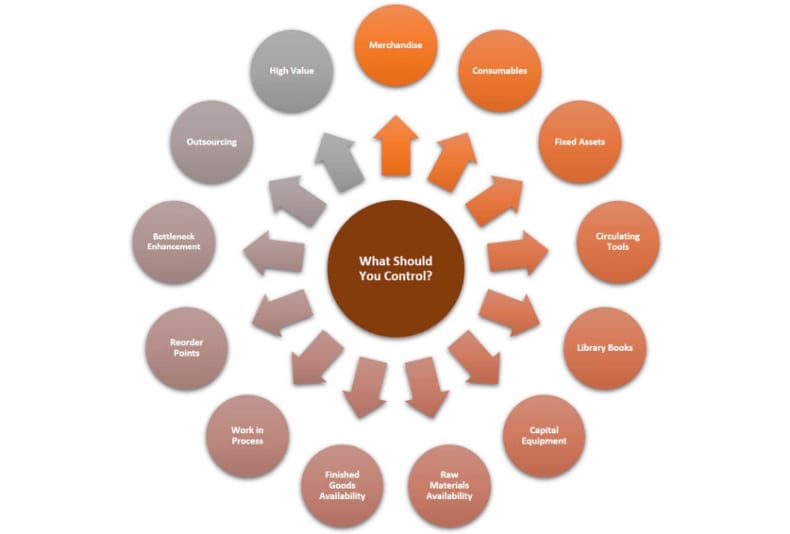
Key Takeaways:
- Inventory control improves cash flow and profitability, aligns stock with demand to cut overstocking/stockouts and strengthens customer service.
- Choose the right system and techniques for your scale: Periodic vs. Perpetual visibility; apply FIFO/LIFO, min-max, JIT, par levels with safety stock and ABC analysis, ROP and EOQ for forecasting.
- Enable accuracy and speed with barcodes/QR codes or RFID, clear SOPs, cycle counts and audits; track KPIs like sell-through, average inventory and fill rate.
- Scalable software is key — look for real-time visibility, automated replenishment, forecasting and multi-location support. NetSuite streamlines these capabilities end-to-end.
Why Inventory Control is Important
Inventory is one of the most significant capital investments for any product-based business. It typically represents a substantial portion of current assets on the balance sheet and can strain cash flow if not managed correctly.
Inventory control helps avoid the costs associated with overbuying, such as excess storage, tied-up capital and spoilage. At the same time, it prevents the disruption caused by running out of essential items. Even businesses using lean or just-in-time models require some level of stock, plus robust controls to manage it effectively.
Reducing inventory frees up capital for growth or investment, while maintaining the right levels can increase sales and improve customer satisfaction. Strong control practices optimise stockrooms, warehouses and retail locations, cutting waste and supporting better financial performance.
How Inventory Control Can Improve Your Business
Implementing well-designed inventory control procedures helps ensure a business operates efficiently, consistently meeting customer expectations. Poor availability is a common cause of customer dissatisfaction — with research showing that a significant share of consumers will abandon a brand with unreliable service, and many will leave a store altogether if a preferred product is unavailable.
Out-of-stock issues also erode revenue. Studies indicate that some retailers lose a measurable percentage of their customer base due to persistent stockouts, and more than half of shoppers will not choose an alternative item when their usual product is unavailable. Inventory control can address many common cost and operational challenges, including:
- Spoilage
- Dead stock
- Excess storage and handling costs
- Reduced sales performance
- Customer churn
- Surplus inventor
- Inaccurate stock records
- Misplaced or lost goods
By establishing sound practices, businesses can balance customer demand with stock availability in the most efficient way, often unlocking cash and improving profitability in the process.
4 Practical Ways to Control Inventory
At its simplest, stock control is about knowing what you have and where it is, so you can manage it effectively. Not every inventory control approach suits every business or every stage of growth — some methods are too complex or resource-heavy for smaller organisations. Whatever you choose, your system should at least let you track stock levels, raise orders and despatch goods.
Common basic approaches include:
- Manual records: The most straightforward option is to record stock movements by hand in a notebook, ledger or stock book. This can work for very small businesses with a limited product range. However, manual records are difficult to analyse, share or use for forecasting, and they become unwieldy as volume grows.
- Stock cards (bin cards): A step up from a simple ledger, stock cards — often called bin cards — track the running quantity, cost price and selling price for each item. Each product has its own card, typically stored at its bin location in a storeroom or warehouse. Movements such as purchases, sales, returns and promotional withdrawals are all logged here, along with any relevant notes. For this method to stay accurate, cards must be updated consistently. Unrecorded pulls or adjustments will quickly lead to unreliable data.
- Basic spreadsheets: Many small companies graduate to spreadsheets (for example, in Excel) to manage inventory. This allows them to capture product details electronically and apply basic formulas to keep a running balance and generate simple reports. Spreadsheets are easy to customise, but that flexibility also means every file is built differently — new users often need to understand the creator’s logic before using it. Unless you add advanced macros or integration, updates are still largely manual, so this approach is often classed as only a small step beyond paper.
- Entry-level inventory software: Lightweight inventory applications, usually aimed at small and midsized businesses, automate much of the process. They’re often cloud-based and link directly to point-of-sale systems, so stock levels update in real time as transactions occur. These tools typically offer reporting and analytics, help generate purchase orders, highlight best- and worst-performing products and provide quick access to item or customer history. Many of these simpler systems can scale to more sophisticated functionality as the business grows.
- Advanced inventory software: Purpose-built inventory management systems integrate with existing business applications, support automation and offer richer analytics and templates. Thanks to cloud delivery and more accessible pricing, this kind of advanced software is now realistic even for many small and mid-market companies.
Types of Inventory Control Systems
Businesses can choose from several different systems to manage their inventory, depending on their size, operational structure and how frequently stock moves. Some organisations still rely on highly manual systems, while others use increasingly automated or fully integrated solutions. Each approach has its benefits — and limitations.
The Periodic System vs. the Perpetual System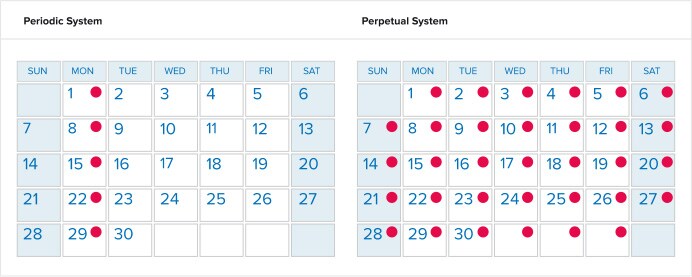
Periodic inventory systems
A periodic system tracks stock by counting physical inventory at set intervals, often monthly, quarterly or annually. Because updates happen only when a count is completed, businesses don’t maintain a live, running record of inventory levels. Instead, they compare counts across periods to understand usage, shrinkage or trends.
This method is straightforward and inexpensive, making it suitable for very small businesses or companies with slow-moving items. However, it does expose the organisation to gaps in visibility, increasing the risk of stockouts or excess stock between count cycles. Reconciling discrepancies can also be time-consuming.
Your Complete Guide to Financial Management Software

Perpetual inventory systems
A perpetual inventory system maintains constantly updated stock levels by recording every sale, purchase, return and adjustment as it happens. When supported by barcode scanners, RFID, point-of-sale systems or integrated ERP software, a perpetual system provides real-time visibility into stock movement and valuation.
This approach supports tighter control and faster decision-making. Teams can spot anomalies quickly, automate replenishment and reduce the need for full physical counts. Although implementing a perpetual system requires more investment and operational discipline, its accuracy and speed make it the preferred option for most growing businesses.
Barcodes
Barcodes can be used in both perpetual and periodic inventory systems. Although often associated with full inventory management platforms, barcodes are simply tools that work within your existing stock-control processes. The printed label containing text or numbers represent detailed product information, and when scanned, this data is transferred into your system, which then records item movements and locations. Scans typically take place when goods are received and again when they are issued or shipped. Barcodes offer a strong return on investment, even for smaller organisations, by reducing operating costs and improving accuracy.
Additional benefits of barcoding include:
- Removal of manual data-entry errors
- Faster data capture
- Automated inventory updates
- Streamlined documentation and reporting
- Easier movement of stock across warehouses or departments
- Quick identification of reorder points and minimum levels
Because they are accurate, scalable and inexpensive, barcodes are an effective choice for businesses of all sizes.
Radio frequency identification (RFID)
RFID tags are another form of tracking technology that sits within existing inventory systems.
RFID provides “smart” identification, with tags storing far more data than standard barcodes and can be read automatically.
Tags come in two forms: active (battery-powered) and passive (powered by the reader’s radio waves). Both types support automatic updates that identify items and capture relevant information without manual scanning.
RFID is particularly useful for safeguarding high-value goods or products subject to strict compliance requirements, such as pharmaceuticals. Active tags are especially effective in environments where stock security has been a challenge.
Key advantages of RFID include:
- Remote reading: Passive tags can be read from around 40 feet; active tags up to roughly 300 feet.
- Simultaneous scanning: Multiple tags can be read at the same time — ideal for pallets or bulk handling.
- Unique identification: Tags can be programmed with unique codes to track individual items rather than generic product types.
- Continuous updates: Systems can update item information — such as location — without changing the physical tag.
Challenges to consider include:
- Passive tags require dedicated scanners or a handheld reader
- Costs may be higher than barcoding
- Supply chain partners may also need compatible equipment
RFID adoption has become more affordable in recent years. One effective strategy is to place readers at high-risk points, such as building exits or restricted zones. For products with limited shelf life, RFID can also support quality control by tracking receipt dates and expiry information.
A growing trend, especially among smaller businesses, is the use of QR codes. These function similarly to barcodes but can be scanned using a smartphone app instead of specialist hardware. QR codes hold more data than traditional barcodes, offering an inexpensive alternative to RFID for simpler tracking needs.
8 Inventory Control Techniques
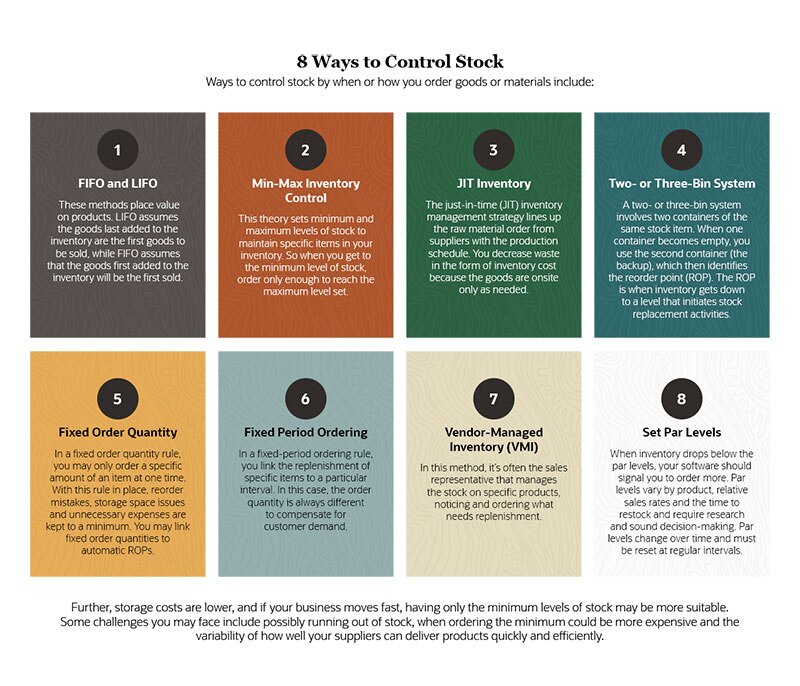
Ways to control stock based on when and how you place orders include:
-
FIFO and LIFO
These are two common methods for valuing and flowing stock. Under LIFO (last in, first out), the most recently received items are treated as the first ones sold or used. FIFO (first in, first out) does the opposite, assuming the oldest units in inventory are issued first.
-
Min-max inventory control
This method sets a defined minimum and maximum level for each stocked item. When quantity falls to the minimum, you reorder enough to bring levels back up to the maximum. It’s simple and easy to automate, but it can be blunt: if demand is volatile or lead times shift, you can still end up with too much or too little stock on hand.
-
JIT inventory
Just-in-time (JIT) inventory aims to synchronise incoming materials with the production schedule or customer orders so that stock arrives shortly before it’s needed. The payoff is lower carrying costs and less waste, because goods aren’t sitting idle on the shelf. The trade-off is risk: Unreliable suppliers or unexpected disruptions can leave you without critical items. Strong supplier relationship management and good forecasting are essential to make JIT work.
-
Two- or three-bin system
In a two- or three-bin setup, the same item is split across two or three containers. You use stock from the first bin until it’s empty, then switch to the second (or third), which acts as your signal to reorder. The reorder point (ROP) is effectively when you start drawing from the backup bin. This works well for low-value, fast-moving parts but offers limited real-time visibility — you may not always know precisely how much inventory is available for large or sudden orders.
-
Fixed order quantity
With a fixed order quantity rule, you always reorder the same number of units when stock hits a certain trigger point. This simplifies purchasing, helps avoid over-ordering and can make it easier to plan storage space and negotiate with suppliers. Fixed quantities are often tied to automated reorder points within an inventory or ERP system.
-
Fixed period ordering
Instead of ordering a fixed quantity, this method schedules replenishment at set time intervals (weekly, monthly, etc.). The volume ordered each time varies according to current stock levels and recent demand.
-
Vendor-managed inventory (VMI)
In VMI, the supplier or sales representative monitors stock levels at the customer site and takes responsibility for replenishment. For example, a drinks company rep might check shelf and storage quantities during each visit and top up as needed.
-
Set par levels
Par levels define the minimum quantity you want to hold for each product. When stock drops below that threshold, your system or process should flag a reorder. Determining pars requires analysis of sales velocity, lead times and service-level goals, and they should be reviewed regularly as conditions change. The benefits include leaner stock, lower storage costs and more flexibility to introduce new products, but there’s also a risk of stockouts if pars are set too low or suppliers can’t respond quickly. In practice, many businesses pair par levels with safety stock — a small buffer held in reserve for unexpected demand or supplier delays.
Stocking Methods Compared
| Stocking Methods | How | Who/When |
|---|---|---|
| FIFO, LIFO | Allocate outgoing stock using either a first‑in, first‑out flow or a last‑in, first‑out flow. | FIFO is ideal for industries dealing with perishable goods; LIFO is often adopted when input costs are rising and for certain accounting needs. |
| Fixed order quantity | Restock by purchasing a consistent, predetermined quantity each time. | Best applied when supply and cost conditions are stable. |
| Fixed period | Schedule replenishment at regular intervals rather than relying on stock‑level triggers. | Environments with fluctuating demand patterns. |
| Vendor‑managed inventory (VMI) | Entrust suppliers with monitoring your stock. | Useful when demand varies significantly or when goods have limited shelf life. |
| Min–max | Set lower and upper stock thresholds and reorder whenever inventory dips below the minimum. | A straightforward method commonly used by smaller or newer businesses. |
| Just‑in‑time (JIT) | Hold inventory only when it is immediately required, reducing excess stock. | Most effective for organisations with mature, reliable supply chains. |
| 2–3 bin system | Use one bin actively while keeping additional full bins as backup to prompt timely reorders. | Ideal for small, frequently used items that can be replenished quickly. |
| Set par levels | Trigger orders once inventory hits a predefined minimum level. | A universal technique applicable to businesses of all types. |
7 Top Best Practices for Inventory Control
The most effective way to manage stock will differ from business to business. Regardless of the approach you adopt, staff must understand it, and it must be supported by documented policies and standard procedures. If you’re using software to underpin your methodology, look for systems that offer the functionality your organisation genuinely needs, rather than settling for a generic package. Good operational control also begins with accurate item identification — whether that’s via SKUs or a more sophisticated labelling system — and quality control depends on having defined standards and guidance for employees to follow.
- Choose a management improvement methodology: Improvement frameworks do more than guide inventory control — they support better performance across the entire organisation. Adopting a recognised methodology and embedding it into day-to-day operations can create lasting cultural and process change. Popular examples include Kaizen, Lean and Six Sigma.
- Optimise purchasing procedures: Sound inventory control relies on smart purchasing. Using accurate data and demand forecasts helps ensure you order the right products, at the right time, and in the correct quantities. This also involves reviewing customer buying patterns, removing obsolete items from your catalogue and recalibrating safety stock and reorder points as conditions change.
- Manage supplier relationships: Strong supplier partnerships are central to effective stock control. Close collaboration can help you identify and resolve issues early. For instance, suppliers may be willing to adjust minimum order quantities, accept returns of slow-moving products or expedite replenishment when a particular line suddenly spikes in popularity.
- Create automated reports: Inventory systems generate large volumes of data — but the value comes from how well that data is analysed and shared. Automated reporting tools can deliver insights into stock status, transaction history, reconciliations, ageing inventory and financial metrics. Determine which reports should be shared with suppliers or other stakeholders along your supply chain so they can plan effectively and maintain service levels.
- Conduct a risk assessment: Operational challenges are inevitable: Unexpected surges in demand, storage limitations, cash shortfalls, inaccurate stock counts or products that no longer sell. A structured risk assessment helps you identify the most significant threats and map out how to respond when they arise. Creating a risk matrix allows you to prioritise issues and prepare contingency plans ahead of time.
-
Regularly audit: Routine stock audits ensure system records match physical quantities. Businesses generally use one of three methods:
- Full physical inventory: A complete count of all items, usually conducted annually and often aligned with financial reporting requirements.
- Spot checks: Ad hoc counts of selected products, typically those with high turnover or known issues, to validate system accuracy.
- Cycle counting: A rolling approach where different product groups are counted at set intervals throughout the year, with high-value items checked more frequently.
Regular auditing is essential for maintaining trustworthy data and identifying discrepancies early.
- Selective inventory control (forecasting): Selective control techniques help businesses prioritise their attention based on the importance or characteristics of each item. Inventory can be classified by usage, procurement difficulty, seasonality, unit cost or rate of consumption. Once categories are assigned, forecasting formulas or rules can be applied to manage stock in line with each group’s strategic value to the business.
Expert Tips for Inventory Control
Developing a full understanding of inventory control theory and procedures can feel overwhelming at first. The guidance below highlights what businesses should consider before rolling out a new inventory control framework:
- Build a solid foundation for your inventory control plan: Simply investing in warehouse software isn’t enough. A strong inventory control strategy must address the entire product journey, from procurement or production through to sales and eventual removal from the ledger. A robust plan should encompass space utilisation, data-driven replenishment techniques and proactive supplier management to minimise waste and improve efficiency.
- Map out your approach before taking action: Inventory control is an ongoing discipline, not a one-off exercise confined to the warehouse. Managers should continually refine their plan, then execute against it. This includes weekly reviews of key metrics, updating forecasts for the months ahead and adjusting stock strategies as demand shifts. External factors such as supply chain disruptions or global events may also require strategic changes to your inventory model.
- Identify and safeguard critical items: Determine which components, materials or products are essential to operations or revenue. These must never fall to zero. Establish a dedicated control process to ensure critical stock remains available at all times, supported by accurate forecasting and appropriate safety buffers.
- Inspect all incoming deliveries carefully: A large proportion of inventory loss starts at the receiving stage. Always check incoming shipments against packing lists and inspect goods for damage or discrepancies.
- Assign the right people to manage inventory processes: Employee engagement is important, but those tasked with inventory responsibilities should have the right skill set. Strong numerical capability, attention to detail and sufficient time to perform the role are essential. Ideally, your inventory control team should represent each part of the workflow — including warehouse leads, procurement staff and fulfilment operatives. Smaller organisations may include all managers and select front-line staff to ensure broad perspective.
- Store similar products together: Where possible, keep related items in the same storage zone, and assign a single, clearly defined location for unique products.
- Strike the right balance between stock costs and service levels: An effective inventory control system depends on balancing the cost of producing and holding stock with the risk of running out. Stock ties up cash, so businesses must understand total inventory cost including warehousing, spoilage and handling, and weigh this against demand patterns and the cost of stockouts. With experience and good data, organisations can select the forecasting models and control techniques that maintain service levels without unnecessary burden.
- Consider broader operational plans: Weak inventory control may indicate that other business frameworks also need attention. Review whether you have adequate quality management processes, up-to-date facility management plans and other high-level controls.
- Choose technology that can scale with your business: It’s often tempting for smaller companies to adopt simple, low-cost or generic software tools. However, cloud-based systems that can expand as your business grows typically offer better long-term value.
- Remember that software alone won’t fix poor processes: Technology can automate tasks, but it cannot correct flawed procedures.
- Prepare contingency plans: Even with strong systems and modern tools, businesses must be ready for the unexpected — from power outages to theft or system failures. Cloud-hosted platforms offer greater resilience than on-premises servers, but every organisation should maintain a robust backup plan to protect operations.
Control Stock through your Sales Approach
Inventory doesn’t need to sit in your warehouse to be managed effectively. In many cases, how you sell products can influence stock levels and help control costs. Below are several sales-driven strategies that support better inventory control.
- Bundling: Offer several products or services together for a single price. From an inventory perspective, it’s a useful way to move older or slow-moving stock by pairing it with a popular item or adding it as a free gift. Bundling can also enhance the customer experience and help improve sales margins.
- Rolling inventory: Goods remain loaded on trailers rather than stored inside the warehouse. The trailer is kept on-site, and a driver moves it to the store when stock is required. This reduces handling time and eliminates unnecessary warehouse movements.
- Drop shipping: Also known as cross-docking, drop shipping allows retailers to sell items they never physically handle. When a customer places an order, the manufacturer or supplier ships directly to them. A common model in ecommerce, it can significantly reduce holding costs, though retailers must rely heavily on suppliers for fulfilment quality and lead times.
- Consignment inventory: In a consignment arrangement, one business provides goods to another to sell on its behalf. The receiving company pays only when the item sells, based on an agreed percentage. This approach lowers the financial risk for smaller retailers because they don’t carry the upfront cost of ownership, while suppliers gain broader market exposure.
- Backordering: Backorders occur when businesses take orders, and often payment, for items that are temporarily out of stock. Customers may accept a wait time for high-value or low-turnover products, making backordering a flexible option for managing cash flow and minimising excess inventory. However, the more backorders accumulate, the harder they become to manage. Delays can lead to customer dissatisfaction, extended fulfilment times and operational strain. For small companies that typically keep stock on hand, extensive backordering is rarely advisable.
Stock Control Methods Compared
| Stock Control Method | How | Who/When |
|---|---|---|
| Consignment inventory | You receive payment only after another retailer sells your goods | Ideal for sellers of high-value items or businesses operating with limited cash flow |
| Bundling | Pairing items together and offering them at a combined, reduced price | Useful for impressing customers, clearing old stock or for discounts |
| Drop shipping | Manufacturers send products straight to the customer on your behalf | Suited to online retailers or businesses without warehouse capacity |
| Rolling inventory | Stock stays in transport trailers rather than being unloaded into a warehouse | Best for fast-turnover or evergreen products |
| Backordering | Accepting orders before stock has been produced or received | Works for goods with strong demand or higher-value items customers are willing to wait for |
Forecasting for Inventory Control
Rather than relying on manual judgement to decide when to reorder, businesses can use mathematical forecasting techniques to determine what is in stock and when replenishment is required.
ABC analysis
ABC analysis divides all stocked items into three categories based on their value and sales behaviour:
- A items are high-value products with lower, less predictable sales volumes. They require careful oversight due to their financial impact.
- B items have moderate value and sell at a steadier pace, sitting between A and C in terms of control requirements.
- C items are low-value goods with high turnover. They typically need less supervision and are easier to manage.
By grouping items, businesses can prioritise resources and attention where it matters most. ABC classification also supports forecasting by showing how much stock is available in each group and helps inform warehouse layout and picking processes.
Reorder point (ROP) formula
The reorder point formula identifies the exact moment when you should purchase or produce more inventory. It combines two core elements: lead time demand (how much stock you expect to sell during the supplier lead time) and safety stock (your buffer for variability).
You may also need to know the reorder lead time, which is the period between placing an order and receiving it. Factoring this into the calculation ensures you avoid stockouts.
Reorder Point = Lead Time Demand × Safety Stock
Economic order quantity (EOQ)
EOQ identifies the most cost-efficient quantity of stock to purchase or produce at one time. Its goal is to minimise the combined costs of ordering and holding inventory. The formula works best when demand, ordering costs and carrying costs remain relatively stable.
Businesses can adapt the EOQ model to reflect different production volumes, order cycles or operational constraints, making it a flexible tool for planning optimal replenishment levels.
| EOQ | = √2DS/H, where, |
| D | = Demand in units per year |
| S | = Per purchase order cost |
| H | = Holding cost per unit, per year |
Supply Chain Inventory Control
Businesses can apply several techniques across their supply chain — whether in production, warehousing or distribution — to maintain tighter control over inventory levels and improve operational efficiency.
Supply Chain Inventory Control Techniques
- Batch control: Used in manufacturing environments to produce goods in defined quantities that match available components and forecasted demand. Producing in batches helps ensure raw materials are used efficiently and that production runs are aligned with customer requirements. This method supports Lean, just-in-time and similar improvement frameworks, helping organisations reduce waste, manage resources effectively and control production costs.
- Third-party logistics (3PL): Many companies outsource parts of their supply chain operations, such as warehousing, fulfilment or distribution, to specialised 3PL providers. This is especially common during seasonal peaks. However, because 3PLs often rely on temporary or rotating staff, inexperience can contribute to misplaced, damaged or missing stock. Clear procedures, close oversight and strong communication are essential when relying on external partners for inventory handling.
- Bulk ordering and shipping: One cost-management strategy is to order or ship high-demand, consistently selling items in bulk. Although this approach requires a larger upfront investment, the financial risk is lower when products move quickly and predictably. Bulk orders can reduce unit costs through supplier discounts and simplify stock management due to product uniformity. However, this method also increases storage costs, ties up capital and is unsuitable for perishable goods or items prone to obsolescence. For products with uncertain demand, bulk purchasing can introduce significant risk.
Stock Quantities: Deciding How Much to Hold
The amount of inventory a business should keep depends heavily on the type of stock — whether it’s raw materials, work-in-progress (WIP), finished goods or consumables. Each category requires a different approach when determining appropriate stock levels.
Raw materials
When deciding how much raw material to hold, consider:
- Supplier reliability and backup options
- Batch production schedules
- Demand predictability
- Bulk discounts
- Unfinished (WIP) stock: WIP stock takes up space and ties up capital, but it can provide valuable protection within the production process. Holding some unfinished goods can help you bypass bottlenecks or machinery prone to failure. For example, if a key machine is at risk of downtime, pre-produced WIP can ensure production continues without interruption.
- Finished stock: Maintaining additional finished stock may be beneficial when demand patterns are well understood or when batch manufacturing can reliably meet customer requirements. You will also naturally hold more finished product when preparing to fulfil large orders or during peak trading periods.
- Consumables: The right quantity of consumables such as packaging, cleaning products or maintenance materials depends on supplier dependability and usage patterns. If consumption is predictable or suppliers offer favourable pricing for bulk purchases, carrying extra stock may be practical. Stocking ahead of anticipated price increases can also provide cost savings.
Inventory Control Policies and Processes
Inventory control begins as soon as goods arrive at your organisation. Establishing clear standard operating procedures (SOPs) ensures everyone involved understands their responsibilities and how stock should be managed. SOPs outline routine tasks in a step-by-step format, promoting consistency and accountability.
What to Include in a SOP
A SOP should cover at least the following areas:
- Receiving goods and materials
- Storing and tracking items
- Inspection schedules and stock rotation
- Security procedures
- Shipping and dispatch
When creating or updating SOPs, define each process clearly and ask team members, especially newer staff, to review them for clarity and ease of use.
Additional guidance for strong inventory control policies includes:
- Keep administrative inventory control separate from finance: For security and internal control purposes, staff responsible for day-to-day inventory administration should not be the same people handling financial stock records. This reduces the risk of errors or fraud.
- Prioritise accurate stock counts: Order fulfilment becomes risky when stock levels are uncertain. Maintaining accurate inventory data should take precedence over processing orders, as accuracy underpins reliable planning, purchasing and customer service.
- Choose appropriate tools: Before finalising your processes, consider the inherent risks and limitations of your chosen tools, whether that’s dedicated software, RFID technology, scanners, spreadsheets or bin systems. Define the capabilities and constraints of your systems upfront.
- Embed continuous improvement: SOPs should include expectations for review cycles. Even a brief section outlining how often processes must be evaluated encourages staff to refine and update procedures regularly.
- Define your stock count frequency: Stock counts can be carried out periodically, perpetually or through a hybrid approach. Decide which method suits your operations and document the intervals and responsibilities within your SOPs.
- Consider all required equipment: When writing policies, take the tools and resources staff will need to meet expectations into account. If you want physical counts completed over a weekend, ensure employees have access to scanners or other equipment that speeds up the work.
- Establish at least annual stocking policies: As a minimum, organisations should define annual stocking rules covering maximum and minimum stock levels, safety stock requirements and optimal reorder points. Calculating average inventory levels also helps with setting these policies.
- Create an annual inventory budget: Do this before purchasing stock and at least once a year. The budget should reflect the total cost of ownership for the year, including materials, storage, operations, logistics, redistribution and any other associated costs.
Basic Invoice Control Policies
Clear invoicing policies ensure staff understand how and when customers are billed, which documents to use and the steps required to complete the process. Strong invoice controls help safeguard revenue by ensuring every fulfilled order is invoiced correctly and on time. Because invoices are typically issued after goods or services have been delivered, templates and straightforward procedures make it easier for teams to follow the process consistently.
The Key Invoice Types to Manage
- Purchase orders: Before any order is fulfilled, customers or sales teams should submit a purchase order. It must be completed and authorised by the customer, confirming item details, quantities and agreed terms.
- Order receipts: Order receipt policies define the checks that take place when goods arrive at the customer’s premises. These act as the trigger for invoice creation. Accurate receipt information helps ensure invoicing aligns with what was delivered.
- Invoicing processes: Templates streamline invoicing, particularly when your software can generate them automatically. Policies should outline the essential elements of each invoice, including the purchase order reference, invoice date and full payment details.
- Software: As the customer base expands, dedicated invoicing software becomes increasingly valuable. Your policies should support template creation, ensure that the system stores and archives transactions and enable efficient reporting, especially regarding unpaid invoices.
- Past-due payments: Customers should be informed of your late payment and non-payment policies. While it’s sensible to allow some degree of flexibility, formal documentation should clearly state the consequences of overdue invoices, outline grace periods and clarify who is responsible for chasing outstanding payments.
Key Performance Indicators (KPIs) in Inventory Control
Within inventory control, KPIs highlight operational weaknesses, explain where losses occur and reveal areas affecting customer satisfaction — such as recurring stockouts. By reviewing both short- and long-term KPIs, businesses can adjust processes and strengthen performance.
Below are several KPIs commonly used in inventory control:
-
Stock-to-sales ratio
This compares the amount of stock held at the start of a month with the sales made during that month. It helps determine whether inventory levels are aligned with demand and supports forecasting decisions.
Stock-to-sales ratio = Beginning of month stock (BOM) / Monthly sales
-
Sell-through rate (STR)
STR shows how quickly you sell the stock you receive from suppliers. It helps identify ageing inventory, informs pricing decisions and signals when to reorder. STR is often reviewed alongside inventory turnover, which typically uses a full year of data.
STR = (Sales / BOM stock) × 100
-
Average inventory
Average inventory indicates how much stock you carry over a defined period.
Average inventory = (Current inventory + Previous inventory) / 2
-
Fill rate
Fill rate measures how effectively you fulfil customer orders, either per delivery or across a defined period. Also known as the line item fill rate (LIFR), it reflects the percentage of requested items or order lines that are successfully delivered. A 100% fill rate means the order was completely fulfilled.
LIFR = (Number of items shipped / Number of items ordered) × 100
LIFR = (Number of order lines fulfilled / Total order lines) × 100
Inventory Control Software
Managing inventory manually can be demanding and inefficient. Paper-based or spreadsheet-driven systems often require significant effort to update, can be difficult to share across teams and are vulnerable to human error. They also generate unnecessary administrative workload and require constant checking to keep information accurate.
Modern inventory software provides a more reliable and scalable alternative. Some organisations integrate specialist tools directly with their ERP systems, while others build customised solutions that reflect their unique processes. Smaller businesses may start with simpler tools or structured spreadsheets, whereas larger companies often rely on advanced platforms capable of handling complex operations. There are also affordable, entry-level systems that offer strong functionality without the cost of enterprise software.
4 Questions to Ask About Advanced Inventory Tracking Software
When evaluating more sophisticated inventory control software, it’s important to take a thoughtful, structured approach. Consider the following four questions:
-
What products and inventory do we need to manage?
Your software requirements will vary depending on your product range and volumes. A food manufacturer, for example, needs expiry-date tracking and batch traceability, while a retailer selling high-value electronics may prioritise security features and analytics to avoid obsolescence. Understanding your inventory profile helps narrow down the right tools.
-
What are the essential features we need?
Some systems integrate seamlessly with existing applications; others do not. Determine whether integration is necessary or whether you’re prepared to upgrade other systems to accommodate new software. If your business expects significant growth over the next few years, prioritise platforms that can scale.
-
What is our software budget?
Inventory control systems range widely in price. When evaluating options, include not only the software cost but also the impact on related applications, implementation expenses and staff training. Assess the expected return on investment (ROI) and how long each option will take to pay back.
-
What are the staffing implications?
New software often changes how work is performed. Assess whether your existing team can adapt to new processes or whether you’ll need to recruit or upskill staff. For example, a move to a perpetual inventory system may reduce the need for manual counting, while complex platforms might require dedicated technical support. Where possible, retrain valued employees, but ensure your staffing model supports your chosen technology.
Getting Started with Inventory Control Software
Effective inventory control depends on item-level visibility, which software can deliver when it is used consistently across the business. Consistency means every team member records production, sales and receipts in the same way, every time. With reliable system data, you gain immediate insight into what has sold, how quickly items are moving, which products are discontinued and which promotions are active. Every transaction is captured electronically, including part numbers, quantities and time and location details. Dedicated inventory control software offers several benefits, including:
- Higher profitability
- Elimination of stockouts
- Barcode and label-based tracking
- Reduced write-offs
- Faster, more accurate audits
- Time savings and process efficiency
- Greater system flexibility
- Rapid access to information
- Built-in analytics to support decision-making
Start by looking for software that fits your current operational needs and can grow with your business.
Key Features to Consider When Selecting Inventory Control Software
When evaluating new systems, prioritise tools that provide:
- Inventory optimisation parameters
- Forecasting and anomaly-detection tools
- Automated replenishment functions and stock-level calculations
- Lead time tracking and management
- Safety stock calculation tools
- Cost-control functionality
- Alerts for expired or slow-moving stock
- Multi-location inventory support
- Integration with back-office systems
- Automated inventory monitoring
- Batch-control automation
- Supplier performance metrics
- Barcode compatibility
- RFID integration
- Customer-specific pricing
- Multi-currency pricing
- Item-level or group-level update options
- Communication across multiple warehouses
- Quality-control reporting
- Batch and lot tracking
- Multi-user access and permissions
When choosing a system, consider not only what you need today but what you will need as your organisation evolves. Emerging technologies and trends, such as advanced forecasting tools and greater supply chain transparency, will increasingly influence how businesses manage stock. Selecting software that can adapt to new capabilities will help ensure long-term value and resilience.
Best Practices for Using Inventory Control Software
Even with a dedicated software platform, good results still depend on strong processes. Whether you're using a full inventory system or a structured spreadsheet, following best practices will help you maintain optimal stock levels and get the most value from your tools.
Once your inventory control software is in place, apply the following guidelines:
- Use systems that integrate well or adopt a single platform that covers all core functions.
- Manage each SKU individually — every product behaves differently and warrants its own controls.
- Validate supplier performance and product quality using the data available in your system.
- Incorporate mobile devices wherever possible to speed up data entry and reduce errors.
- Slot inventory effectively to make picking, storage and replenishment more efficient.
- Carry out cycle counts and immediately update your system with any adjustments.
- Ensure every stock movement — receipts, picks, transfers, returns — is recorded in the software.
It’s also important not buy a system that’s overcomplicated. Choose a solution that fits your organisation’s size, operational model and budget. Overly advanced systems can cause unnecessary frustration and fail to deliver a meaningful return. If your platform includes analytics, make full use of it. Measurement is essential to improving stock performance.
If you currently use, or plan to purchase, inventory control software, ensure it can support key calculations such as:
- Identifying fast- and slow-moving products
- Total cost of inventory
- Inventory trends and sales data
- Your overall inventory budget
How to Keep your Stock Secure
Stock security is a critical component of inventory control. Losses from theft directly impact profitability. Protecting valuable goods requires understanding which items are most attractive to thieves and implementing layered security measures to deter both shoplifters and staff misconduct.
High-demand consumer items, such as laundry detergent or razor blades, are frequently targeted because they are easy to resell. These products may need to stay accessible to customers but placing them in high-visibility areas or near staffed zones can help reduce risk.
Protecting high-value items and deliveries
Premium products like electronics and computers should be equipped with RFID tags or other security devices that trigger alarms when removed improperly. Deliveries also require careful handling: goods are particularly vulnerable before they are logged into your system. Remove packaging promptly so it’s not obvious that a new shipment has arrived, and secure receiving areas to prevent unauthorised access.
If possible, install CCTV in loading bays, car parks and other sensitive locations. Visible surveillance is an effective deterrent and can support investigations if shrinkage occurs.
Managing internal security risks
Internal theft can be just as damaging as external theft. Make sure staff are trained on security procedures, understand disciplinary policies and appreciate the impact theft has on the business — from financial losses to reduced job stability. To reduce opportunities for theft:
- Separate stock-handling duties from financial record-keeping.
- Restrict access to storage areas and assign permissions thoughtfully.
- Ensure auditing responsibilities are held by staff who do not control day-to-day stock movements.
- Rotate staff assignments regularly to discourage collusion.
- Review whether existing software features — such as access controls, audit trails and alerts — are being fully utilised.
How NetSuite can help
Effective inventory management is essential to a company’s performance, and real-time visibility into stock levels plays a significant role in that success. Whatever inventory control approach your business adopts, leaders need reliable systems that support accurate, timely decision-making.
NetSuite provides a comprehensive set of built-in tools to track stock across multiple locations, calculate reorder points, manage safety stock and streamline cycle counts. Its demand planning and distribution requirements planning capabilities help organisations maintain the right balance between supply and customer demand across the entire operation.
Discover how NetSuite can automate inventory processes, lower handling costs and improve cash flow throughout your business.
Inventory Control FAQs
What is the inventory control process?
The inventory control process refers to the methods and procedures a business uses to manage its stock effectively. These processes ensure products are held at appropriate levels, do not exceed their shelf life, are not stored unnecessarily long-term and are available in the right place at the right time.
What is an example of inventory control?
A common example is seen in supermarkets and other retailers selling perishable goods. They aim to keep enough fresh stock on hand to meet customer demand without ordering so much that it spoils. In non-perishable environments — such as warehouses — inventory control focuses on maintaining strong availability for high-demand items while holding smaller quantities of slower-moving products.
What is the purpose of inventory control?
Inventory represents a significant investment. Beyond the cost of the goods themselves, businesses must fund storage space, labour and utilities to maintain stock. The purpose of inventory control is to optimise stock levels so a business avoids both overstocking and stock shortages, reducing waste and controlling operational costs.
What are the four types of inventory?
The four primary categories of inventory are:
- Raw materials or components
- Work in progress (WIP)
- Finished goods
- MRO (maintenance, repair and operations) supplies
Not every organisation holds all four types, but most rely on at least one of these categories to operate effectively.