
The instincts that get a restaurant through its early years, reading a busy service, knowing when to push covers, sensing when a supplier relationship has gone stale, only take an operator so far. But the past few years have made instinct alone a riskier bet than it used to be. At some point, growing the business means getting more deliberate about the numbers.
Making that shift means getting serious about the core functions of financial management, the metrics that matter and the strategies that keep a growing operation on solid ground.
What Is Restaurant Financial Management?
Restaurant financial management involves tracking revenue, controlling costs, managing cash flow and reporting on the restaurant’s financial status. Core activities include daily sales reconciliation, supplier payments, margin analysis and cash forecasting.
Key Takeaways
- Restaurant financial management covers budgeting, cash flow, cost control, revenue management, forecasting and tax compliance.
- The profit and loss (P&L) and cash flow statements, along with the balance sheet, work together to reveal whether a restaurant is profitable, liquid and heading in the right direction.
- Well-run restaurants share common habits including weekly performance reviews, careful inventory tracking and menu pricing based on actual costs.
- Connecting POS, inventory and accounting systems on a single platform minimises manual data entry and errors while supporting digital tax compliance.
Hospitality Futures: Tomorrow’s Vision
Discover how technology and AI are reshaping the sector, strategies to build resilience, foster loyalty, drive value for the next decade, and so much more.

Restaurant Financial Management Explained
Many factors make restaurant finance distinct from other industries. Inventory spoils, so stock valuation can’t wait until the end of the month. Revenue comes from multiple channels and settles on different timelines: dine-in settles immediately, for example, while delivery platforms pay on a weekly cycle. Each channel also works on different margins. VAT treatment depends on whether food is served hot or cold, eaten in or taken away. And labour costs fluctuate constantly as rotas adjust to demand.
Pulling all of this into a coherent financial picture means leaning on three complementary reports. The P&L shows whether revenue exceeds costs over a given period. The balance sheet freezes the picture at a single date, highlighting assets, liabilities and the equity left for owners. The cash flow statement follows the actual movement of money in and out.
Each report tells a different story, and reading any one of them alone can mislead. Strong margins on the P&L don’t help much if cash is locked up in stock or sitting in a delivery platform’s settlement queue. Monthly management accounts remain standard, but sharper operators also watch key metrics such as revenue, labour costs and cash position on a weekly basis.
Core Restaurant Financial Management Functions
Day-to-day financial management involves six recurring disciplines. Each operates on its own rhythm, but together they determine whether a restaurant stays solvent. They’re also deeply interconnected: Forecasting informs budgeting, budgeting shapes purchasing, purchasing affects cash flow and cash flow constrains everything else. The restaurants that manage these functions well tend to think of them as a system rather than a set of separate tasks.
-
Budgeting
A budget maps out expected revenue and expenses, usually for a year, and breaks them into monthly or weekly segments. Restaurants use a budget to make staffing decisions and supplier commitments, as well as determine marketing spend. Budgets also create a benchmark. When actual performance deviates from the budget, it could signal a problem or an opportunity. Common budgeting tasks include estimating revenue by week (accounting for seasonality and the inevitable January dip), projecting costs by category and building in contingency for equipment failures or repairs.
-
Cash Flow Management
Cash flow management is about the timing of when money arrives compared to when it leaves. For example, dine-in card payments typically settle within a day or two. Delivery platforms, after taking their commission, usually pay out weekly or on even longer cycles. Meanwhile, supplier invoices come due on fixed terms, wages go out every week and VAT bills land monthly or quarterly. These mismatches in cash inflows and outflows mean a restaurant can be profitable on paper but short on cash when a bill comes due. The core task for cash flow management is maintaining a rolling forecast that commonly looks out 8 to 13 weeks ahead and is updated weekly. These forecasts aim to reveal pinch points in advance so operators have time to adjust before they become problems.
-
Cost Management
Restaurants operate with three main cost categories: food and beverage (cost of goods sold or COGS), labour and overheads. Cost management means tracking each against revenue and responding before margins shrink. Managing food costs begins with accurate recipe costing, monitoring supplier prices and running variance analysis to catch waste or portion changes. Managing labour costs increasingly relies on scheduling software that uses POS data to predict demand and build rotas accordingly. Overheads, such as rent, utilities and insurance, tend to be fixed or slow to renegotiate, but that’s no reason to ignore them. Leases, energy contracts and insurance policies all come up for renewal eventually, and switching or renegotiating can yield savings.
-
Revenue Management
Revenue management is about getting more out of the seats you have. It’s essential to understand which menu items actually contribute to profit. Food cost percentage matters, but so does contribution margin, what’s left after accounting for ingredients, prep time and plating. Items that sell well and carry strong margins deserve top billing on the menu; underperformers may need repricing or removal.
The same logic applies to how customers order: dine-in, takeaway, delivery, catering. Third-party delivery platforms take a commission that tightens margins, so high delivery volume doesn’t always yield high profit. The recurring work is reviewing sales mix reports, tracking margin by item and channel and adjusting menu placement or pricing based on what the data shows.
-
Forecasting
Forecasting uses historical information and forward-looking signals to estimate what’s coming. Restaurants rely on several types of forecasts. Revenue forecasts help determine how many staff to schedule and how much stock to order. Cost forecasts feed into budgeting and pricing decisions. Cash flow forecasts flag liquidity risks and help time major outlays.
Useful forecasts blend internal data (past sales, booking patterns, seasonal trends, etc.) with external inputs like school holidays and local events. AI-powered forecasting tools can process these signals continuously, adjusting predictions as conditions change. The point is to narrow the range of surprises rather than predict the future with certainty.
-
Taxes and Compliance
Compliance depends on financial management. If the books get messy, compliance gets harder and the risk of errors and penalties increases. The recurring tasks include daily reconciliation, timely invoice entry, keeping payroll records current and maintaining documentation for VAT returns. Despite the familiarity, some of these tasks can still catch restaurants off guard. VAT, for instance, is particularly tricky to get right: treatment depends on whether food is hot or cold, eaten in or taken away, which can be challenging for restaurants with wide offerings.
Other requirements are simpler but still demand attention. The Employment (Allocation of Tips) Act, which came into effect in October 2024, requires fair distribution, a written policy and three years of records. And digital tax filing requirements continue to expand: from April 2026, sole traders earning above £50,000 must file income tax digitally. For most operators, staying compliant means working with an accountant who understands hospitality.
Key Restaurant Financial Statements, Ratios and KPIs
Day-to-day financial management generates data. Financial statements organise it; ratios and KPIs make it actionable. Together, they tell operators whether the business is profitable, liquid and heading in the right direction. The following are fundamental for restaurateurs:
- Profit and loss statement (P&L): The P&L shows revenue, costs and profit (or loss) over a specific period. It answers a basic question: Is the restaurant making money from operations? Monthly review catches shifts, such as narrowing gross margins or rising labour costs early enough to avoid a crisis.
- Balance sheet: The balance sheet captures what the business owns (assets), what it owes (liabilities) and what remains for the owners (equity) at a single point in time. Lenders and landlords pay close attention to it. They want to see current assets that cover current liabilities, and debt that a restaurant can comfortably service.
- Cash flow statement: The cash flow statement tracks cash inflows and outflows over a given period. That visibility matters because a profitable P&L doesn’t guarantee cash in the bank, because profit is an accounting measure, not a bank balance. VAT bills come due in lump sums, equipment purchases require immediate outlay even though the expense is spread over years on the books and catering clients may take weeks to pay. The cash flow statement shows where the gaps between earning and receiving actually are.
- Profit margins and gross margins: Gross margin is revenue minus COGS, expressed as a percentage of revenue. Net profit margin is net profit divided by revenue, or the percentage of each pound that remains after all expenses. Gross margin is typically easier to influence because it responds to menu pricing, supplier negotiations and portion control. Net margin includes fixed costs that don’t scale with sales, making it harder to move.
- Current ratio: The current ratio divides current assets by current liabilities to gauge short-term liquidity. A ratio below 1.0 can signal trouble in most industries, but restaurants are unusual: cash arrives daily while suppliers typically allow 30-day terms, so many operate comfortably below 1.0.
- Inventory turnover ratio: This ratio measures how often stock is sold and replaced over a given period. High turnover points to efficient purchasing and fresh ingredients. Low turnover may signal over-ordering or dishes that aren’t moving, potentially leading to spoilage and waste.
- Cost of goods sold (COGS): COGS represents the direct cost of food and beverages sold, calculated as opening stock plus purchases minus closing stock. When expressed as a percentage of revenue, it's referred to as food cost percentage. A rising food cost percentage, without a corresponding price increase, suggests a problem with supplier pricing, portion control or waste.
- Prime cost: Prime cost is the sum of COGS and total labour cost. When expressed as a percentage of revenue, prime cost becomes a powerful ratio that captures a restaurant’s two highest variable expenses: food and people in a single number. Because these costs fluctuate directly with sales volume and operational decisions, prime cost percentage is the ratio restaurateurs tend to watch most closely.
Strategies for Restaurant Financial Management
Financial statements and KPIs tell you what’s happened, not what to do next. The following strategies translate financial awareness into operational decisions like where to focus, what to fix and how to build habits that keep margins healthy.
-
Set and Monitor Financial KPIs
Pick three to five metrics that connect directly to profitability; prime cost, labour percentage and average cover are common choices. Review them weekly, not monthly, and build that review into a fixed slot with the same people to create a consistent, practical habit. When a number moves in the wrong direction, decide immediately whether it’s a one-off or a trend that needs action.
-
Strengthen Inventory Controls
Count stock weekly or daily for high-cost items and compare actual usage against theoretical usage based on sales. When the numbers don’t match, find out why. Things like over-portioning, theft or supplier shortfalls are all common. Tightening the inventory turnover ratio, even by a few percentage points, benefits the bottom line.
-
Frequently Review Your Financials
Monthly management accounts serve as the baseline, but they arrive too late to change anything for the month they describe. Reviewing key figures weekly, including revenue, labour costs as a percentage of sales and cash position gives time to adjust rotas, chase payments or hold off on discretionary spending before a slow week becomes a bad month.
-
Establish a Comprehensive Budget
Seasonality hits restaurants hard, and a January target that matches July is useless. Build the budget month by month, not as a single annual figure. Compare actuals to budget every month and treat variances as questions to answer, not just numbers to note. Revisit the budget quarterly to adjust for what’s changed, such as supplier price increases, new hires or a shift in average covers.
-
Evaluate Your Equipment
List your highest-energy and most repair-prone equipment and calculate what each costs to run annually: energy plus maintenance plus downtime. Compare that to the cost of replacement spread over its expected life. When keeping something costs more than replacing it, the decision makes itself.
-
Price Your Menu Appropriately
Cost every dish quarterly using current supplier prices, not the prices you paid when the menu launched. For items where margins are slipping, quickly decide whether to raise the price, shrink the portion, swap an ingredient or cut the dish. Consider bundling price increases with a seasonal menu refresh to draw less attention than a mid-cycle adjustment would.
-
Use the Latest Technology
Technology can take much of the manual work out of financial management. Cloud accounting software, especially when integrated with POS and payroll systems, keeps data flowing automatically so teams don’t need to waste time re-keying. Automated bank feeds speed up reconciliation. Invoice capture tools pull supplier data straight into the accounts. Some platforms now use AI to flag exceptions and generate cash flow forecasts automatically. The payoff is faster reporting, easier digital tax compliance and accurate numbers available when you need them.
-
Stay Informed of Industry Trends
Join a trade body like UKHospitality or the British Institute of Innkeeping; both of these bodies flag regulatory changes and cost pressures before they hit. Build a quarterly check-in with your accountant to review what’s coming. The earlier you adjust to wage increases, tax changes or shifting customer expectations, the easier they are to manage.
-
Build a Contingency Fund
Set a target and treat contributions like a recurring expense, not something to do with whatever’s left over. Two to three months of fixed costs is a common goal to keep in reserves. The point isn’t to hit the target immediately; it’s to have something set aside when a slow month or equipment failure hits. Even a small weekly transfer will build up over time.
Common Restaurant Financial Management Challenges
Even well-run restaurants face financial management challenges that discipline alone won’t fix. Some are structural which are baked into how the industry operates, while others are driven by external forces beyond any single restaurateur’s control. Common restaurant financial management challenges include the following:
- Payment timing mismatches: The gap between when cash arrives and when it leaves is a constant tension in restaurants. Revenue varies day to day, but wages, rent and supplier invoices don’t. A slow week doesn’t pause obligations, and no amount of profitability on paper changes the fact that cash has to be there when payments are due.
- VAT complexity: VAT rules can’t be simplified. They’re set by HMRC, and the distinctions between standard-rated, zero-rated and exempt items don’t map neatly onto how restaurants actually operate. Mistakes are common and penalties don’t account for how confusing the system is. The only real mitigation is good systems, careful training and regular review with an accountant who knows hospitality.
- Labour cost pressure: The National Living Wage and employer National Insurance have risen sharply. The April 2026 wage increases alone added £1.4 billion in costs across the hospitality sector. Unlike food or overhead, labour can’t be cut without directly affecting service or output.
- Fragmented systems: When POS, inventory, payroll and accounting run on separate platforms, data has to be manually re-keyed, which takes time, introduces errors and delays the reports operators need to act. Integration solves the problem, but it requires upfront investment, staff retraining and workflow changes, all of which can be hard to fit around daily service.
- Seasonal revenue swings: The January slump after December’s peak is predictable, but that doesn't make it easier to manage. Rent, insurance and salaried staff cost the same in a slow month as in a busy one. Building cash reserves during peak periods is the main buffer, but that assumes there’s margin left to set aside in the first place.
How Does Technology Enhance Restaurant Financial Management?
Financial management strategies are easier to execute with the right technology. The shift from spreadsheets to AI cloud-based systems hasn’t changed what needs to be done, but it has changed how quickly and reliably it can happen.
The biggest operational benefits come from integration. When POS, inventory, payroll and accounting systems share data, information flows among systems without manual re-entry. This connected view is what makes weekly financial reviews practical.
Automation handles the repetitive work. For example, bank feeds pull transactions into the accounting system. Payroll software calculates tax and NIC, generates payslips and submits real-time information to HMRC. AI takes this further by monitoring transactions continuously and flagging anomalies such as margin shifts, unusual supplier charges or cash flow pinch points before they require manual discovery. As a result, teams can spend more time on work that actually requires judgement.
A limitation worth noting: Technology only works if the underlying processes are sound. Automated reporting built on bad data just produces bad reports faster. The restaurants that benefit most are those that have already established clear financial disciplines.
Take Control of Your Restaurant's Finances with NetSuite
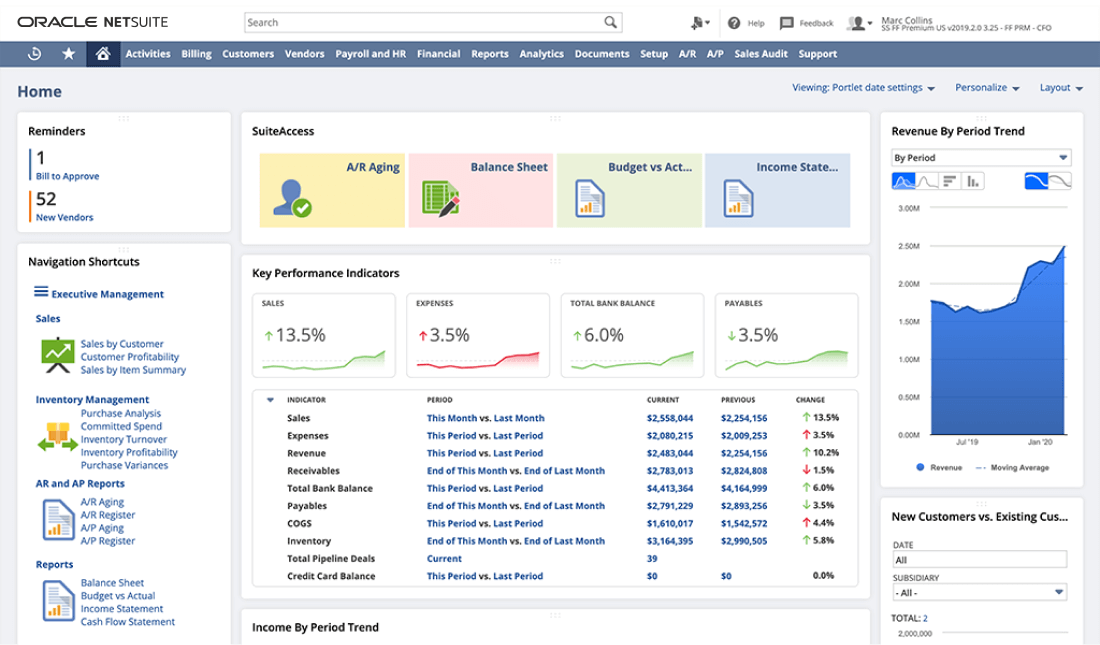
Managing restaurant finances means juggling daily sales, supplier payments, VAT across eat-in and takeaway, and payroll for staff on variable hours. Compliance deadlines add pressure year-round. NetSuite Financial Management brings accounting, inventory and reporting onto a single cloud-based platform, so sales data flows in from POS systems, stock levels update as transactions occur and financial statements are generated on demand.
Built-in AI monitors transactions throughout each financial period, flagging exceptions and anomalies before they become month-end surprises. The system supports digital tax submissions and scales as restaurants grow or add locations. As part of NetSuite ERP, NetSuite Financial Management connects finance with broader operational functions, such as human resources and customer relationship management, giving restaurant operators a complete view of the business from a single dashboard.
A restaurant can have excellent food and a committed following and still fail if its finances aren’t managed well. That’s the nature of the business, profit margins are thin and cost pressures persistent enough that instinct alone won’t cut it. That’s where financial management comes in: not as a back-office task to delegate and forget, but as the informational backbone for every operational decision worth making.
Oracle NetSuite Hospitality Masterclass
See NetSuite Hospitality in action here (opens in a new tab).
Restaurant Financial Management FAQs
What is the 30/30/30 rule for restaurants?
The 30/30/30 rule is a rough guideline for allocating restaurant revenue: 30% to food and beverage costs, 30% to labour and 30% to other operating expenses, leaving around 10% as profit. Actual percentages vary by restaurant type, so targets should reflect the specific operation. Full-service operations, for instance, typically have higher labour costs, while quick-service formats tend to have lower food costs.
What does a finance manager do in a restaurant?
A finance manager oversees budgeting, cash flow, financial reporting and cost control. Day-to-day work includes reviewing sales and labour reports, managing payables, preparing financial statements and handling VAT and payroll compliance. In smaller operations, the owner typically fills this role. Larger restaurants may have a dedicated finance manager or work with an external accountant.
What is a good operating margin for a restaurant?
Operating margin data for restaurants is scarce, most industry benchmarks report net profit margin instead, which is lower because it includes interest, depreciation and taxes. For net margins, full-service UK restaurants typically run 3–5%, while quick-service operations can reach 6–10%. Operating margins will sit a few points higher, but the exact gap depends on a restaurant's debt, lease structure and tax position. What matters more than hitting a specific number is consistency: A restaurant that holds a steady margin is often in better shape than one that swings between strong months and losses.